Legal casino gambling age in Anguilla
Anguilla, a British Overseas Territory in the north-eastern Caribbean, has a restrictive gambling regime. It has no casinos and no law that licenses online casino gaming. Lotteries, a category that under local law includes raffles and similar draws, are permitted only with government approval and carry a 10% duty on every ticket sold. The territory’s anti-money laundering assessors recorded in 2024 that casinos are prohibited under section 346 of the Criminal Code and the Public Lotteries Tax Act. Since 2014 successive governments have considered opening a small, tightly controlled casino sector for tourism. A draft gaming policy published for consultation in 2023 proposed up to two members-only casinos supervised by the Anguilla Financial Services Commission, but no gaming legislation had been enacted by October 2026.
Key points
- Casinos are prohibited in Anguilla. The Caribbean Financial Action Task Force (CFATF) cites section 346 of the Criminal Code and the Public Lotteries Tax Act as the legal basis, and recorded in 2024 that “there are no casinos in Anguilla”.
- Any public lottery, including a raffle or bingo, needs written permission from the Governor in Council and pays lottery duty of 10% of the ticket price under the Public Lotteries Tax Act.
- No Anguillan law creates a licence for online casinos, online sports betting or other remote gambling, and no online gambling regulator exists.
- A 2023 draft gaming policy proposed up to two members-only casinos, a 15% tax on gross gaming revenue and a 15% charge on winnings, with the Financial Services Commission acting as “Gaming Commission”. It remained under consultation in January 2025, and no Gaming Act had been passed by October 2026.
- The UK Gambling Act 2005 does not extend to Anguilla, so UK Gambling Commission licensing has no local effect.
Last reviewed: 13 October 2026.
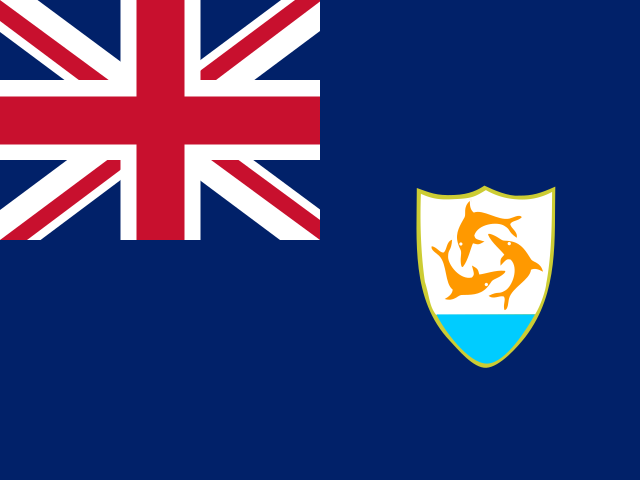
Online casinos for Anguilla
We may earn commission from links. Commission and paid placements do not affect casino ordering. Affiliate disclosure · How these listings work.

Vegas Casino Online
Sign Up400% up to
$500

Liberty Slots Casino
Sign Up100% up to
$259

Sloto'Cash Casino
Sign Up100% up to
$500

Tsars Casino
Sign Up100% up to
€300
+ 100 Spins

22Bet Casino
Sign Up100% up to
$/€300
+ 30 Spins

Lucky Tiger Casino
Sign Up250% up to
$1,000
Vegas Casino Online
Sign Up400% up to
$500
Liberty Slots Casino
Sign Up100% up to
$259
Sloto'Cash Casino
Sign Up100% up to
$500
Tsars Casino
Sign Up100% up to
€300
+ 100 Spins
22Bet Casino
Sign Up100% up to
$/€300
+ 30 Spins
Lucky Tiger Casino
Sign Up250% up to
$1,000
Historical development
Anguilla has never had a licensed casino. Its tourism economy has developed around high-end resorts, and gaming has periodically been discussed as an additional amenity for visitors rather than as an industry in its own right. The earliest official record found for this guide is from a special meeting of the Executive Council on 19 May 2014. Under the heading “Introduction of Gaming in Anguilla”, the Council directed the Tourism Investment Committee to research a suitable model, draft a policy and bring it back for consideration before public consultation (Executive Council, minutes of 19 May 2014).
The project was revived later in the decade. According to the government’s draft gaming policy, the Government of Anguilla contracted a consultancy in August 2019 to carry out a Gaming Market Assessment. The assessment was to cover market capacity, options for expansion, social impacts and fiscal effects. The resulting draft policy, which described gaming as having “an integral role in the tourism economy”, was presented at a public consultation in the House of Assembly on 21 March 2023 and streamed online. According to reporting by Anguilla Focus, members of the public raised concerns during the consultation about the social impact of gambling and about how the industry would be regulated for fairness and transparency.
Lotteries have a longer legal history. The Public Lotteries Tax Act, in the form consolidated in the Revised Statutes, reflects amendments made by Acts 6 and 7 of 2010, which came into force on 1 November 2010 (Public Lotteries Tax Act, Cap. P135).
Legal framework

Status as a British Overseas Territory
Anguilla is a self-governing British Overseas Territory with its own House of Assembly and its own body of statute law, published as the Revised Statutes of Anguilla. United Kingdom gambling legislation does not apply there. The Gambling Act 2005, the main statute regulating gambling in Great Britain, extends only to England and Wales and Scotland, apart from a few provisions that also extend to Northern Ireland (Gambling Act 2005, section 361). As a result, a licence from the UK Gambling Commission has no legal effect in Anguilla, and Anguillan law alone determines what forms of gambling are lawful there.
The Criminal Code
The general prohibition on casino gaming rests on the Criminal Code (Cap. C140). In its 2024 mutual evaluation of Anguilla, the CFATF stated that “casinos are prohibited in Anguilla”, that this reflects a policy decision, and that casinos “are prohibited under section 346 of the Criminal Code and the Public Lotteries Tax Act” (CFATF Mutual Evaluation Report, 2024, paras. 56 and 60(m)). The official text of section 346 could not be retrieved from the government’s legislation portal while this guide was being prepared. This guide therefore does not describe the wording of the offence, its penalties, or whether it reaches people who play as well as those who organise games.
The Public Lotteries Tax Act
The Public Lotteries Tax Act (Cap. P135) is the main statute on lotteries currently in force. It defines a “public lottery” broadly to include “any game, method or device whereby money or money’s worth is distributed” where “the public or any class of the public” has or may have access, and it presumes every lottery to be a public lottery “until the contrary is proved”. A “lottery ticket” covers tickets for any lottery, sweepstake or raffle, tickets for pari-mutuel or pool betting, and bingo cards sold separately from admission. The Act’s key provisions are as follows:
- Permission (section 2). Anyone wishing to run a public lottery must apply in writing to the Governor in Council (the Governor acting with the Executive Council). The Governor in Council is not obliged to grant permission. Organising, promoting, holding, printing or selling tickets for a lottery without written permission is an offence punishable on summary conviction by a fine of $1,250.
- Lottery duty (section 3). Duty is charged at 10% of the price of each ticket, exclusive of the duty itself.
- Payment and returns (sections 4 to 7). Tickets may not be sold until the organisers have made arrangements for payment of the duty “to the satisfaction of the Comptroller” of Inland Revenue. Returns are due within seven days after a one-off lottery ends, or monthly for recurring lotteries.
- Remission (section 8). The Governor in Council may remit all or part of the duty for lotteries with charitable, educational, religious, philanthropic or sporting purposes.
- Enforcement (sections 9 to 12). Police officers and persons authorised by the Comptroller may enter premises where a lottery is held. Evasion of duty is an offence, and offences without a specific penalty carry a fine of $1,250.
The government’s list of revised statutes and regulations also includes a separate Lotteries Act (Cap. L095) and Lotteries Regulations. Their text could not be retrieved for this guide, so their content is not described here.
Anti-money laundering legislation
Lotteries are also brought within the anti-money laundering system. A public notice of 22 September 2022 from the Anguilla Financial Services Commission (FSC) required “a licensed lottery” to register with the Commission as a non-regulated service provider under section 158(1) of the Proceeds of Crime Act and the Externally and Non-Regulated Service Providers Regulations. The categories are defined in Schedule 2 of the Anti-Money Laundering and Terrorist Financing Regulations (FSC, Externally and Non-Regulated Service Providers).
Regulator and licensing model
Anguilla follows what is best described as a prohibition model with a narrow permission system. A prohibition model is one in which most forms of gambling are unlawful unless a statute expressly allows them. Unlike jurisdictions with a dedicated gambling regulator, Anguilla currently has no gaming commission and issues no casino, betting or online gaming licences. Responsibility is divided as follows:
- Governor in Council (Executive Council). Grants permission for public lotteries and decides on waivers of lottery duty. Executive Council minutes show individual raffles being approved, sometimes with the duty waived on condition that the proceeds go to a named charitable cause (Executive Council minutes, 9 February 2024).
- Comptroller of Inland Revenue. Collects lottery duty, approves payment arrangements and receives returns under the Public Lotteries Tax Act.
- Anguilla Financial Services Commission. Acts as the anti-money laundering supervisor of lotteries. The CFATF describes the Commission as “the sole AML/CFT supervisor of FIs, most DNFBPs and VASPs in Anguilla” (financial institutions, designated non-financial businesses and professions, and virtual asset service providers). It also recorded that the Commission had carried out onsite inspections of “two (2) lotteries” (CFATF, paras. 35 and 51).
- Royal Anguilla Police Force. Investigates illegal gambling and has powers of entry under the Public Lotteries Tax Act.
The 2023 draft gaming policy would change this structure if enacted. Its main features, as set out in the consultation document, are:
- Regulator. The FSC “shall be coined as the ‘the Gaming Commission'”, with “jurisdiction and oversight over the licensing and regulation of all forms of licensed gaming”. It would have powers to license, inspect and monitor compliance, keep a master list of authorised games and set fees (draft gaming policy).
- Casinos. The policy “supports the development of no more than two stand-alone brick-and-mortar casino gaming locations”, described as Gaming Clubs offering table games and electronic gaming machines. They would operate “on a registration and membership basis only”, with walk-in customers excluded. The policy states that it “does not support expansive licensing of standalone gaming facilities”, such as slot parlours.
- Licence categories. The policy lists Gaming Club, lottery, betting and “other games” licences, plus personnel licences for key employees, gaming employees and technicians, and registration certificates for equipment suppliers. Applicants must be incorporated or registered in Anguilla and pass fit-and-proper checks on directors, shareholders and beneficial owners.
- Location. Gaming venues would be kept away from the capital, schools and churches, and their design and location would need approval from the Department of Physical Planning.
The fee schedule in the consultation document contains no amounts, and the proposed “Anguilla Gaming Act 2023” named in it had not been enacted at the time of writing.
Online gambling

No Anguillan statute provides a licence for online casinos, online sports betting, online poker or any other form of remote gambling. Remote gambling means gambling conducted by internet, telephone or other communication technology rather than in person. No official register of online gambling operators licensed in Anguilla exists, and none of the government or FSC sources reviewed for this guide refer to an online gambling licensing regime.
The 2023 draft gaming policy does not propose to change this for casino games. It requires that Gaming Club games “must be operated exclusively on the licensed Gaming Club premises”. The only reference to remote products is in the lottery category, where the permitted lottery types are listed as “traditional lottery, electronic lottery, instant lottery, online lottery” (draft gaming policy).
No published measures were found that target offshore online gambling. In particular, no legislation was found requiring internet service providers to block gambling websites, banks to block payments to gambling operators, or restricting the advertising of foreign online casinos. Whether offering online casino games to people in Anguilla from abroad falls within the Criminal Code prohibition depends on the wording of section 346, which could not be verified. The prudent reading is that no lawful, locally licensed online casino service exists, and that foreign operators accepting Anguillan residents do so without any Anguillan authorisation.
Position of players
The sources available do not settle precisely when an individual player commits an offence. The Public Lotteries Tax Act places its main duties on “the organisers, promoters or holders of a public lottery”, and its permission offence is aimed at those who organise, promote, hold, print or sell tickets for an unpermitted lottery (Public Lotteries Tax Act, sections 2 and 6). The casino prohibition in section 346 of the Criminal Code could not be checked, so it is not possible to say whether it penalises taking part in a game as well as running one.
Illegal gambling is nevertheless enforced in practice. The CFATF reported that Anguillan law enforcement had identified illegal gambling as “an emerging threat that received some investigative priority”. It recorded “a total of 13 illegal gambling investigations, 11 illegal gambling prosecutions”, resulting in “10 convictions for the predicate offence and 1 ML conviction” (CFATF, 2024, paras. 2 and 60(m)). The report notes that “multiple individual actors operating as part of a suspected organized group have been conducting illegal lottery sales”, the proceeds of which “generally do not enter the financial system”. The report does not give dates for these cases or say whether any were brought against players rather than sellers. No reported prosecution of an individual for playing at a foreign online casino was found.
In practical terms, people in Anguilla who play with offshore online casinos have no local regulator to complain to and no Anguillan legal framework protecting their deposits or winnings.
Taxation
The only gambling-specific tax in force is the lottery duty under the Public Lotteries Tax Act. It is charged at 10% of the price of each lottery ticket, payable by the organisers to the Comptroller of Inland Revenue, and forms part of the Consolidated Fund. Executive Council minutes illustrate how this works for raffles:
- In February 2024 the Council approved a club raffle of 350 tickets at US$20 each, with the club to pay the 10% duty, calculated at EC$1,881.74 (Executive Council minutes, 9 February 2024).
- At the same meeting it waived duty of up to EC$8,064.60 on a business-promoted raffle of 1,500 tickets, on condition that the proceeds be donated to a pre-school, and instructed the ministry to prepare a remission regulation for the House of Assembly under section 16 of the Financial Administration and Audit Act.
Such remissions are given legal effect through regulations; the government’s document library lists, for example, Remittance (Lottery Duty) Regulations, 2023.
The draft gaming policy proposes a different structure for any future casino sector: an annual licence fee payable by the end of January, “an annual levy of 15% gaming taxes on Gross Gaming Revenue”, and a requirement that “winners of a gaming activity are to pay 15% of the winnings” (draft gaming policy). Gross gaming revenue (GGR) is the amount staked by players minus the prizes paid out. None of these proposals is law. No current provision imposing a tax on players’ gambling winnings was identified, and the government’s 2025 Budget Address does not refer to gaming or lottery revenue.
Consumer protection and responsible gambling
Because there is no licensed casino or online gambling sector, Anguilla has no statutory self-exclusion register, no mandatory deposit limits and no dedicated gambling regulator issuing player-protection rules. Protection currently comes indirectly, from the requirement for government permission for lotteries and from criminal enforcement against illegal gambling.
The 2023 draft gaming policy sets out the safeguards that would apply to licensed Gaming Clubs. These include a minimum age of 21 (“no person under the age of twenty-one (21) years will enter any designated area that is identified for gaming purposes”), staff training on a self-exclusion programme, notices at entrances about problem gambling, a supply of information pamphlets, and access to counselling for people affected by problem gambling. Persons involved in managing an operator would be barred from gambling at that business or any other gaming business, and operators would have to submit internal control standards to the Commission for approval (draft gaming policy).
No gambling-specific helpline was found for Anguilla. A directory of mental health and psychosocial support services published in January 2024 by UNICEF for the Eastern Caribbean Area and partners lists the SAFE (7233) hotline, a 24-hour line offering counselling and referrals, on 1-264-772-7233, and a substance misuse counselling service in the Department of Education (Mental Health and Psychosocial Support Services Directory, Anguilla). General guidance on recognising and limiting gambling harm is available in our responsible gambling guide.
Recent and upcoming developments
- CFATF mutual evaluation (2024). The CFATF’s fourth-round evaluation of Anguilla, based on an onsite visit from 26 June to 7 July 2023, was adopted at the June 2024 plenary and is published by the FATF (FATF, Anguilla mutual evaluation). It rated gambling “a high threat for ML” (money laundering) in the territory, chiefly because of illegal lottery sales.
- Public Lotteries Tax (Amendment) Act 2024. On 6 June 2024 the Executive Council approved this amendment for tabling. According to the minutes, the Attorney General’s Chambers recommended an EC$35,000 threshold below which requests would be overseen by the Minister of Finance, through the Permanent Secretary, Finance, rather than by the Executive Council. An earlier decision to exclude raffles and bingo cards from the Act altogether had been revisited after the Chambers “emphasized the continued importance of regulating raffles and bingo cards” (Executive Council minutes, 6 June 2024). The Bill was listed for second reading, committee stage and third reading in the House of Assembly on 25 June 2024 (Order of Business), and it appears as Act 15 of 2024 in the government’s list of 2024 Acts. The enacted text could not be retrieved, so the final form of the threshold has not been confirmed.
- Casino policy stalls (2025). At a press conference on 20 January 2025, then Premier and Finance Minister Ellis Webster said written consultation responses on the casino policy were still being gathered (Anguilla Focus, 27 January 2025).
- Change of government (February 2025). The Anguilla United Front won eight of eleven seats in the general election of 26 February 2025, and Cora Richardson-Hodge was appointed Premier on 27 February 2025 (Virgin Islands News Online; Official Gazette, 27 February 2025). No public statement by the new government on the casino policy was found, and press coverage of the 2026 Budget in November 2025 did not mention gaming.
- Status in October 2026. No Gaming Act, casino licence or online gambling licensing regime had been enacted or announced.
Casino listings for players in Anguilla
The listings below are generated automatically from our casino database. They do not show that any operator is licensed or authorised in Anguilla, which has no licensing regime for online casinos and no register of permitted online gambling operators. Casinos are prohibited under Anguillan law, so the listings must not be read as an indication that playing is lawful or protected locally.
Vegas Casino Online
No Deposit Bonus
$ 20
Liberty Slots Casino
No Deposit Bonus
$ 18
Sloto'Cash Casino
100% up to
∞
Tsars Casino
100% up to
€300
+ 100 Spins

Casino Extreme
200 Spins
22Bet Casino
100% up to
$/€300
+ 30 Spins
Lucky Tiger Casino
No Deposit Bonus
$ 55

Shazam Casino
Exclusive No Deposit Bonus
$ 50

Casino Brango
500% up to
$/€100
+ 500 Spins

1Red Casino
20% up to
∞

Highway Casino
$ 30

Red Stag Casino
25% up to
∞

Rich Palms Casino
250% up to
∞

Lincoln Casino
No Deposit Bonus
$ 18

Miami Club Casino
50 Spins

Omni Slots
50% up to
€200
+ 20 Spins

BitStarz Casino
100% up to
₿1
+ 180 Spins

LOKI Casino
50% up to
€500
+ 60 Spins

Yabby Casino
202% up to
∞

Casino Classic
1 Spins

Uptown Aces
250% up to
∞

PlayCroco Casino
300% up to
∞
+ 60 Spins

Fair Go Casino
200% up to
∞

Betsafe Casino

Fruits4Real
125% up to
€125
+ 60 Spins

Zodiac Casino

Las Vegas USA Casino
No Deposit Bonus
$ 20

CasinoCasino
100% up to
€100

Omni Casino
75% up to
$/€150

Casilando
10 Spins
.jpg?x15984)
Everygame Classic Casino
200% up to
∞
+ 50 Spins

EnergyCasino
100% up to
$/€200
+ 400 Spins

Sun Palace Casino
No Deposit Bonus
$ 20

Slots Plus
No Deposit Bonus
$ 20

Slots Empire
230% up to
$7,500

Casino Max
400% up to
∞
+ 20 Spins

Red Dog Casino

El Royale Casino
230% up to
∞

EmuCasino
100% up to
∞

Gold Prize Casino
10% up to
$100

Slotsroom Casino
400% up to
∞
+ 20 Spins

888 Casino
100% up to
€200

Villento Casino
100% up to
$/€150

Spinfinity Casino
400% up to
∞
+ 20 Spins

PokerStars Casino

Luxury Casino
100% up to
$/€150

Jackpot Capital
25% up to
∞

House of Jack Casino
100% up to
€200

SlotsPalace Casino
50% up to
$/€200
+ 50 Spins

Las Atlantis Casino
$ 2,500

Wicked Plays
45% up to
∞
.jpg?x15984)
Eddy Vegas Casino
30% up to
∞

Ripper Casino
25% up to
∞

Scatters Casino
100 Spins

North Casino
100% up to
$/€100

BlackJack Ballroom
100% up to
$/€150

Yeti Casino

Slotastic
250% up to
∞

William Hill Casino

Fun Casino

Grande Vegas
150% up to
$300

Roaring 21 Casino
400% up to
∞
+ 20 Spins

LadyLuck Casino
100 Spins

TrueFortune
200% up to
€2,000

Ozwin Casino
$ 10

Cherry Jackpot
400% up to
∞
+ 20 Spins

21 Casino
21 Spins

Playzee Casino
100% up to
$/€300
+ 100 Spins

10bet Casino

Grand Mondial

PlayOJO Casino
50 Spins

La Riviera Casino
5% up to
∞

DBbet Casino
100% up to
€100

Cadoola Casino
120% up to
$/€100
+ 150 Spins

Dafabet Casino
100% up to
$140

Casino Mate

MELBET Casino
100% up to
€350
+ 50 Spins

Justspin Casino
100% up to
$/€100

777 Casino
100% up to
$/€20

Slot Planet
100% up to
€222
+ 22 Spins

Nomini Casino
100% up to
€500
+ 200 Spins

Wazamba
50% up to
∞
+ 200 Spins

Bet365 Casino

Betway Casino
150 Spins

BetOnline Casino
100 Spins

Slottica Casino
200% up to
∞

CasinoClic
200% up to
€100

Jazz Casino
10% up to
$250

Betmaster Casino

Betfair Casino
Related country guides
- Saint Kitts and Nevis gambling guide
- British Virgin Islands gambling guide
- Antigua and Barbuda gambling guide
- US Virgin Islands gambling guide
- Puerto Rico gambling guide
Sources and further reading
- Government of Anguilla, Draft Gaming Policy (consultation review) (2023).
- Government of Anguilla, Inland Revenue Department, Public Lotteries Tax Act, Cap. P135, Revised Statutes of Anguilla (accessed 13 October 2026).
- Government of Anguilla, Revised Statutes and Regulations (accessed 13 October 2026).
- Government of Anguilla, Acts 2024 (accessed 13 October 2026).
- Government of Anguilla, Public Lotteries Tax (Amendment) Act, 2024 (Act 15 of 2024) (accessed 13 October 2026).
- Government of Anguilla, Remittance (Lottery Duty) Regulations, 2023 (accessed 13 October 2026).
- Anguilla Executive Council, Minutes of special meeting, 19 May 2014: Introduction of Gaming in Anguilla (2014).
- Anguilla Executive Council, Minutes of the 172nd meeting, 9 February 2024 (2024).
- Anguilla Executive Council, Minutes of the 187th meeting, 6 June 2024 (2024).
- Anguilla House of Assembly, Order of Business, Nineteenth Meeting of the Fourth Session of the Twelfth House of Assembly, 25 June 2024 (2024).
- Government of Anguilla, 2025 Recurrent and Capital Estimates and Budget Address (2024).
- Government of Anguilla, Official Gazette (Extraordinary), Vol. 52, No. 7 (27 February 2025).
- Caribbean Financial Action Task Force, Anti-money laundering and counter-terrorist financing measures: Anguilla, Fourth Round Mutual Evaluation Report (2024).
- Financial Action Task Force, Anguilla’s measures to combat money laundering and terrorist financing (accessed 13 October 2026).
- Anguilla Financial Services Commission, Public Notice: Requirement to Register as Non-Regulated Service Provider (22 September 2022).
- Anguilla Financial Services Commission, Externally and Non-Regulated Service Providers (accessed 13 October 2026).
- UK Government, legislation.gov.uk, Gambling Act 2005, section 361 (Extent) (accessed 13 October 2026).
- Rebecca Bird, Anguilla Focus, Anguilla’s casino plans remain under consultation two years later (27 January 2025).
- Anguilla Focus, Anguilla’s 2026 Budget: a call to unity, shared purpose and common good (12 November 2025).
- Virgin Islands News Online, Cora Richardson-Hodge elected as first female Premier of Anguilla (27 February 2025).
- UNICEF Eastern Caribbean Area, Healthy Caribbean Coalition and partners, Child and Youth Mental Health and Psychosocial Support Services Directory: Anguilla (2024).