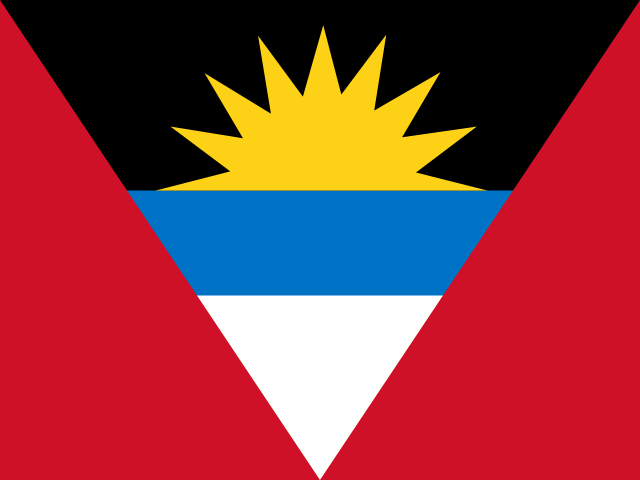
Legal casino gambling age in Antigua and Barbuda
Antigua and Barbuda, a small twin-island Caribbean state, holds an unusual place in the history of online gambling. It was one of the first jurisdictions in the world to license internet gaming and wagering companies, beginning in 1994, and it later brought, and won, a landmark World Trade Organization (WTO) case against the United States over American restrictions on cross-border gambling. Today two regimes coexist. Interactive (online) gaming and wagering is licensed and supervised by the Financial Services Regulatory Commission (FSRC) under the Interactive Gaming and Interactive Wagering Regulations. Land-based gambling, including casinos, gaming machines, betting and lotteries, is the subject of the Gambling Act 2016, a comprehensive statute whose chapters come into force on dates set by ministerial notice.
Key points
- Antigua and Barbuda began licensing interactive gaming and wagering companies in 1994, according to the FSRC. Online operators are regulated by the FSRC’s Directorate of Offshore Gaming (also called the Division of Gaming).
- The Gambling Act 2016 (No. 22 of 2016) states that all gambling is prohibited unless authorised by or under the Act, and provides for a Gambling Authority, resort casinos, betting, gaming machines and commercial lotteries.
- In the WTO dispute United States – Gambling (DS285), an arbitrator in December 2007 set Antigua’s annual loss at US$21 million and found that it could request authorisation to suspend obligations towards the United States, including intellectual property obligations, up to that amount. The dispute remained unresolved in January 2025.
- Taxes on land-based gambling set in 2017 include 8% of player loss on gaming machines and tables, 8% of gross revenue for betting providers, and 8% to 14% of gross sales for lottery games, collected by the Commissioner of Inland Revenue.
- Online gaming companies are treated as financial institutions for anti-money laundering (AML) purposes. We found no published national gambling helpline.
Last reviewed: 8 October 2026.
Online casinos for Antigua and Barbuda
We may earn commission from links. Commission and paid placements do not affect casino ordering. Affiliate disclosure · How these listings work.

Vegas Casino Online
Sign Up400% up to
$500

Sloto'Cash Casino
Sign Up100% up to
$500

Lucky Tiger Casino
Sign Up250% up to
$1,000
Shazam Casino
Sign Up250% up to
$2,500
Casino Brango
Sign Up500% up to
$/€100
+ 500 Spins
Rich Palms Casino
Sign Up250% up to
∞
Vegas Casino Online
Sign Up400% up to
$500
Sloto'Cash Casino
Sign Up100% up to
$500
Lucky Tiger Casino
Sign Up250% up to
$1,000
Shazam Casino
Sign Up250% up to
$2,500
Casino Brango
Sign Up500% up to
$/€100
+ 500 Spins
Rich Palms Casino
Sign Up250% up to
∞
Historical development
In November 1994 the Governor-General assented to the Free Trade and Processing Zone Act 1994 (No. 12 of 1994), which allowed a statutory commission to license businesses operating in designated zones. The Act is often cited in industry literature as the original basis for the first internet gaming licences. Its text, however, does not mention gaming, casinos or the internet: it authorises licensees to “engage in any industrial or commercial activity not specifically prohibited by law” (section 12). The FSRC itself states only that Antigua and Barbuda “was one of the first jurisdictions to license interactive gaming and wagering companies in 1994”.
The sector grew quickly. An Associated Press report published in December 2012 (AP via KATU) stated that in 2000 Antigua had numerous licensed online casinos employing about 3,000 people, with annual income of nearly US$1 billion. Much of that business was directed at customers in the United States. As US federal authorities moved against offshore gambling, the industry contracted. The same report records that by 2012 the sector employed about 400 people and its income was described as “miniscule”. It also notes that in 2006 the United States barred banks and card companies from processing payments to offshore gambling sites.
Regulation was formalised over the same period. The FSRC traces its own origins to a series of amendments to the International Business Corporations Act ending in 2002, and it was continued as a statutory body by the Financial Services Regulatory Commission Act No. 5 of 2013 (FSRC, About us). According to the FSRC, the interactive gaming regulations were amended in May 2001 to require “Know Your Customer” procedures; the regulations it currently lists date from 2007. In 2016 Parliament enacted the Gambling Act, which replaced the older Betting and Gaming Act and created a modern framework for land-based gambling.
The WTO dispute (DS285)
The best-known episode in Antigua’s gambling history is its WTO case against the United States, formally United States – Measures Affecting the Cross-Border Supply of Gambling and Betting Services. The chronology published by the Office of the United States Trade Representative (USTR) records the main steps:
- 21 March 2003: Antigua requested consultations, and a panel was established on 21 July 2003.
- 10 November 2004: the panel report found that US measures breached the market-access commitments the United States had made under the General Agreement on Trade in Services (GATS).
- 7 April 2005: the Appellate Body report partly reversed the panel, including on the “public morals” defence; the reports, as modified, were adopted on 20 April 2005.
- 19 August 2005: an arbitrator set the period for US compliance, which expired on 3 April 2006.
- 30 March 2007: a compliance panel found that the United States had not complied; its report was adopted on 22 May 2007.
- 21 December 2007: an arbitrator under Article 22.6 of the Dispute Settlement Understanding set the level of nullification or impairment at US$21 million a year and found that Antigua could request authorisation to suspend obligations under the TRIPS Agreement (intellectual property) up to that amount.
Suspending intellectual property obligations in response to a dispute about services is known as cross-retaliation. Antigua had claimed impairment of US$3.4 billion a year, which the USTR described in December 2007 as “patently excessive”. The United States also said that in May 2007 it had invoked the GATS Article XXI procedure for modifying schedules so that its schedule would “reflect the original U.S. intent of excluding gambling” from its commitments. On 28 January 2013 the WTO Dispute Settlement Body formally authorised Antigua to suspend TRIPS obligations towards the United States up to US$21 million annually, as reported by the Third World Network. At that meeting Antigua said the United States had “ruined our domestic remote gaming industry”, while the United States called the proposed suspension “misplaced”. Antigua has not, on the sources reviewed, implemented any suspension; it has instead pursued a negotiated settlement.
Legal framework

Gambling law in Antigua and Barbuda rests on several instruments. The official Laws of Antigua and Barbuda portal publishes the Gambling Act and its amendments; the interactive gaming regulations were not available there in a form we could retrieve.
The Gambling Act 2016
The Gambling Act 2016 (No. 22 of 2016) received assent on 14 February 2017 and was published in the Official Gazette on 30 March 2017. Its central rule, in section 41, is that “All gambling is prohibited and illegal unless it is authorised by or under this Act.” Section 42 makes gaming and wagering contracts void except where the Act permits them. Its chapters cover:
- the Gambling Authority of Antigua and Barbuda, a corporate body of at least five members appointed by the Minister after consulting Cabinet, with the function of regulating gambling and “interactive gambling activities in and from Antigua and Barbuda” (sections 4, 6 and 9);
- resort casinos, meaning premises defined as a casino under the Act, with the Minister able to direct the maximum number of resort casinos (sections 43 to 46);
- local commercial gambling providers, gaming machines and gaming tables;
- betting providers, who must be licensed (section 300);
- commercial lotteries, with the Minister determining the number and type of licences (section 319), and trade lotteries;
- onboard gambling, private gambling, and community and charitable gaming; and
- responsible gambling codes, self-exclusion, pre-commitment and exclusion orders (sections 120 to 131 and 356 to 364).
The Act repealed the Betting and Gaming Act and the Small Charges Act (sections 445 and 446), and amended the Interactive Gaming and Interactive Wagering Regulations 2007 (section 447), with transitional provisions for matters pending under those Regulations (sections 451 and 452). Under section 2, each chapter comes into force on a date the Minister appoints by notice in the Gazette. We could not locate published commencement notices, so it could not be verified which chapters are in force or whether the Gambling Authority has been constituted. The FSRC’s website, as accessed in October 2026, continued to present the FSRC as the regulator of interactive gaming.
Two amending acts followed. The Gambling (Amendment) Act 2017 (No. 5 of 2017), assented to on 17 March 2017, replaced the tax schedule and tightened rules on credit to patrons. The Gambling (Amendment) (No. 2) Act 2017 (No. 38 of 2017), assented to on 16 January 2018, transferred the collection of gambling taxes and levies from the Authority to the Commissioner of Inland Revenue.
Interactive gaming regulations and related laws
Online gambling is governed by the Interactive Gaming and Interactive Wagering Regulations, which the FSRC lists as the 2007 Regulations among the laws it administers (FSRC, About us). As financial institutions, internet gaming companies are also subject to the Money Laundering (Prevention) Act 1996 and the Prevention of Terrorism Act 2005, both cited in the CFATF mutual evaluation. The Free Trade and Processing Zone (Amendment) Act 2019 (No. 28 of 2019) revised the free-zone incentive regime but does not refer to gaming.
Regulator and licensing model
Antigua and Barbuda operates a licensing model: private operators may lawfully offer gambling if they hold the relevant licence, rather than the state holding a monopoly. In practice there are separate authorities for different sectors. The 2018 mutual evaluation of Antigua and Barbuda by the Caribbean Financial Action Task Force (CFATF) described casinos as falling under an Inspector of Casinos, and internet gaming and wagering as regulated by the FSRC, which licenses “International Wagering and International Gaming”.
The FSRC’s Directorate of Offshore Gaming page sets out the main conditions for interactive licensees:
- companies must maintain clear internal “Know Your Customer” procedures;
- their accounts must be audited by external auditors, who must certify “solvency, safety and soundness, player protection and compliance with AML/CFT regime”; and
- internet gaming companies are classified as financial institutions and are “subject to all the Anti-Money Laundering (AML) and Caribbean Financial Action Task Force (CFATF) requirements of the jurisdiction”.
The FSRC page refers to licensing applications and a licensees section but does not publish fees, licence categories or a current list of licensees in a form we could retrieve. Figures for licence fees circulating on commercial websites are not attributed to official sources, so they are not repeated here. The most recent official count we found is in the CFATF report, which recorded 3 casinos, 4 internet gambling operators and 4 sports betting operators, based on an on-site visit in June 2017. The same report elsewhere refers to five online gaming and wagering companies, so these numbers should be treated as indicative. The FSRC states that the jurisdiction hosts “a significant portion of the industry and some of the largest i-gaming companies”, but it does not quantify that claim.
The FSRC does withdraw licences publicly. In a regulatory notice effective 16 June 2016, for example, it announced that one company was “no longer licenced to conduct interactive gaming and interactive wagering” because of non-compliance, adding that “Any statement or inference to the contrary is false.”
Online gambling: what is permitted and how it is enforced
Antigua and Barbuda is primarily an exporting jurisdiction for online gambling: its licensing regime was built to host companies serving customers abroad. Licences issued under the Interactive Gaming and Interactive Wagering Regulations cover interactive gaming (casino-style games) and interactive wagering (betting). Whether a given foreign market may lawfully be served depends on the law of that market, not on the Antiguan licence. The DS285 dispute illustrates this: the WTO rulings did not oblige the United States to admit Antiguan operators, and the United States responded by invoking the GATS procedure to modify its schedule so as to exclude gambling.
Within Antigua and Barbuda, the Gambling Act 2016 treats gambling as unlawful unless authorised, and gives the Gambling Authority a mandate over interactive gambling “in and from” the country. We did not find any official source on whether interactive licensees may accept customers resident in Antigua and Barbuda, and that question could not be verified. We found no evidence of website blocking, payment blocking or blocklists aimed at unlicensed foreign sites.
Advertising is addressed in the Gambling Act mainly in connection with excluded persons: section 131 bars advertising to people who are subject to exclusion orders. We found no separate advertising code for online gambling.
Position of players
The sources reviewed describe obligations placed on operators, not on players. The Gambling Act sets 18 as the minimum age: people under 18 may not play gaming equipment or be allowed to game (sections 279 and 280), and betting with anyone under 18 is prohibited (section 315). The Act also contains a section on “unlawful gambling” (section 411) and one prohibiting gambling in a resort casino “by certain persons” (section 133), but the full text of these provisions could not be retrieved, so we cannot say whether, or how, a participant in unauthorised gambling commits an offence. We found no record of a player being prosecuted for gambling online.
Because gaming and wagering contracts are void unless permitted by the Act (section 42), a player would be unlikely to be able to enforce a claim for winnings against an unauthorised provider in the local courts.
Taxation
Land-based gambling and lotteries
The tax rates for land-based gambling are set out in Schedule 1 to the Gambling Act, as replaced by the 2017 amendment. Since the 2018 amendment, they are payable to the Commissioner of Inland Revenue. Most amounts are due within seven days after the end of each calendar month, and late payments attract interest of 1% per month.
| Tax or levy | Rate |
|---|---|
| Commercial lottery tax, existing online lottery games (for example Super Lotto, Pick 3, Caribbean Keno) | 14% of gross sales |
| Commercial lottery tax, new online lottery games | 10% of gross sales |
| Commercial lottery tax, instant ticket games (scratch cards) | 8% of gross sales |
| Gaming machine and gaming table tax | 8% of player loss |
| Betting provider’s tax | 8% of gross revenue from bets settled in the previous month, with no carry-forward of losses |
| Gaming machine levy | $30 per machine per month |
| Gaming table levy | $30 per table per month |
Here “online” lottery games means terminal-based draw games, not internet gambling, and “player loss” is the amount players lose to the operator. The Act also provides for a separate resort casino tax and supervision charge (sections 143 and 144), but the 2017 schedule does not state a casino rate. During the Senate debate in March 2017, an opposition senator argued that the rates were too low and that casinos should pay more, while the government said the rates followed industry standards (Focus Gaming News).
Online operators and players
We did not find an official published rate of gaming tax or licence fee for interactive licensees; figures quoted on commercial websites could not be verified against FSRC or government sources. We found no provision taxing players’ gambling winnings. Players resident elsewhere may be taxed on winnings under the law of their own country.
Consumer protection and responsible gambling
The Gambling Act 2016 contains a full set of protection tools on paper:
- Responsible Gambling Codes of Conduct (section 356);
- self-exclusion facilities, which allow a person to bar themselves from gambling (section 358), and pre-commitment facilities, which allow players to set limits in advance (section 360);
- powers over “undesirable” gambling products (section 362) and banning orders requiring licensees to bar particular persons (section 364);
- exclusion orders issued by the Authority or by the Commissioner of Police; excluded persons may not enter a resort casino and may not be targeted by advertising (sections 120 to 131); and
- restrictions on credit to patrons, strengthened in 2017 (section 277).
How far these tools operate in practice depends on the commencement of the relevant chapters, which could not be confirmed. We found no national self-exclusion register in operation. For online licensees, the FSRC requires auditors to certify player protection as part of the annual audit. The international directory Find A Helpline listed no gambling helpline for Antigua and Barbuda when checked in October 2026, and we found no dedicated national gambling support organisation. Anyone affected should contact a doctor or local mental health services. General guidance is available in our responsible gambling guide.
Money laundering safeguards are more developed. The CFATF mutual evaluation (July 2018) found that licensing controls were “generally robust” for casinos and internet gambling and sports betting operations, though fit-and-proper requirements were not applied consistently. It rated casinos as high risk for money laundering and terrorist financing and internet gaming companies as medium risk, and noted that the Office of National Drug and Money Laundering Control Policy had carried out few AML examinations of casinos between 2012 and 2016.
Recent and upcoming developments
- WTO dispute still unresolved (January 2025). Lionel Hurst, Chief of Staff in the Office of the Prime Minister, said in January 2025 that he did not expect a settlement soon and that “it will take us another generation almost to get that done”, according to the Jamaica Observer. Antigua has received no payment. In June 2018 its ambassador, Ronald Sanders, told the WTO that the country had lost US$315 million and that “we are now losing all hope”, while the US ambassador, Dennis Shea, said Antigua had made “extreme demands” (Reuters via Stabroek News).
- Gambling Act commencement. No commencement notices or announcements about the establishment of the Gambling Authority were found for 2024 to 2026. The status of the Authority and the transfer of interactive gaming oversight from the FSRC should be rechecked.
- Lottery technology (December 2023). Antigua Lottery Co. Ltd. was among the Caribbean lotteries covered by what the release headline describes as a ten-year contract for an independent random number generator (RNG) draw system for lotteries run by IGT’s Antilles business (World Lottery Association). Antigua and Barbuda also participates in the multi-territory Caribbean Lottery, whose Super Lotto game began in 2009 (overview).
Casino listings for players in Antigua and Barbuda
The listings below are generated automatically from our casino database. They do not show that an operator is licensed in Antigua and Barbuda or that it may lawfully serve residents, a point we could not verify from official sources. Readers should check an operator’s licence status directly with the Financial Services Regulatory Commission.
Vegas Casino Online
No Deposit Bonus
$ 20

Liberty Slots Casino
No Deposit Bonus
$ 18

Slots.lv
100% up to
$2,000
+ 20 Spins
Sloto'Cash Casino
100% up to
∞

Casino Extreme
200 Spins

Bovada Casino
100% up to
$1,000
Casino Brango
500% up to
$/€100
+ 500 Spins
Lucky Tiger Casino
No Deposit Bonus
$ 55
Shazam Casino
Exclusive No Deposit Bonus
$ 50

Miami Club Casino
50 Spins

Lincoln Casino
No Deposit Bonus
$ 18

Highway Casino
$ 30
Rich Palms Casino
250% up to
∞
Red Stag Casino
25% up to
∞
Yabby Casino
202% up to
∞
PlayCroco Casino
300% up to
∞
+ 60 Spins
Uptown Aces
250% up to
∞

DuckyLuck Casino
500% up to
$/€2,500
+ 150 Spins
Fair Go Casino
200% up to
∞
Drake Casino
300% up to
$2,000
Las Vegas USA Casino
No Deposit Bonus
$ 20
Slots Plus
No Deposit Bonus
$ 20
Sun Palace Casino
No Deposit Bonus
$ 20
Ignition Casino
200% up to
$100
.jpg?x21442)
Everygame Classic Casino
200% up to
∞
+ 50 Spins
Slots Empire
230% up to
$7,500
Red Dog Casino
Slots And Casino
500% up to
∞
+ 150 Spins

Slotsroom Casino
400% up to
∞
+ 20 Spins
Black Lotus Casino
300% up to
$7,000
+ 45 Spins
El Royale Casino
230% up to
∞

Casino Max
400% up to
∞
+ 20 Spins
JacksPay
200% up to
$2,000

Spinfinity Casino
400% up to
∞
+ 20 Spins

Lucky Creek
50 Spins

Jackpot Capital
25% up to
∞

Slotastic
250% up to
∞
Ripper Casino
25% up to
∞

Las Atlantis Casino
$ 2,500
Ozwin Casino
$ 10

Grand Eagle
200% up to
$5,500
+ 30 Spins

Roaring 21 Casino
400% up to
∞
+ 20 Spins
LadyLuck Casino
100 Spins
Grande Vegas
150% up to
$300
Treasure Mile
200% up to
$/€4,000
+ 50 Spins
Cherry Jackpot
400% up to
∞
+ 20 Spins
Borgata Online Casino

TropicanaCasino

BetOnline Casino
100 Spins

Grand Rush
200% up to
$4,000
+ 40 Spins

Jazz Casino
10% up to
$250

BetMGM Casino NJ
100% up to
$1,000
Sources and further reading
- Laws of Antigua and Barbuda (Ministry of Legal Affairs), The Gambling Act, 2016 (No. 22 of 2016) (2017).
- Laws of Antigua and Barbuda (Ministry of Legal Affairs), The Gambling (Amendment) Act, 2017 (No. 5 of 2017) (2017).
- Laws of Antigua and Barbuda (Ministry of Legal Affairs), Gambling (Amendment) (No. 2) Act, 2017 (No. 38 of 2017) (2018).
- Government of Antigua and Barbuda, via FAOLEX, Free Trade and Processing Zone Act, 1994 (No. 12 of 1994) (1994).
- Government of Antigua and Barbuda, via FAOLEX, Free Trade and Processing Zone (Amendment) Act 2019 (No. 28 of 2019) (2019).
- Financial Services Regulatory Commission, Gaming: Directorate of Offshore Gaming (accessed 8 October 2026).
- Financial Services Regulatory Commission, About Us (accessed 8 October 2026).
- Financial Services Regulatory Commission, Regulatory Notice: Gaming Ventures Ltd (2016).
- Office of the United States Trade Representative, Measures Affecting the Cross-Border Supply of Gambling and Betting Services (DS285) (accessed 8 October 2026).
- Office of the United States Trade Representative, Statement on Internet Gambling (21 December 2007).
- Third World Network, Antigua authorised to suspend TRIPS obligations against US (2013).
- Associated Press, via KATU, Antigua pursues sanctions over U.S. online betting ban (2012).
- Reuters, via Stabroek News, Antigua “losing all hope” of U.S. payout in gambling dispute (2018).
- Caribbean Media Corporation, via Jamaica Observer, Antigua believes another generation will be needed to settle WTO dispute with US (2025).
- Caribbean Financial Action Task Force, Anti-money laundering and counter-terrorist financing measures: Antigua and Barbuda, Mutual Evaluation Report (2018).
- Focus Gaming News, Antigua passes gambling amendment (2017).
- World Lottery Association, Szrek2Solutions secures 10-year contract to supply trusted draw RNG for IGT Antilles (2023).
- Wikipedia, Caribbean Lottery (accessed 8 October 2026).
- Find A Helpline, Gambling helplines in Antigua and Barbuda (accessed 8 October 2026).