


In short: Baccarat ratio tracking compares patterns on the scorecard, such as singletons against runs, or runs of two against runs of three or more. In a typical eight-deck shoe these come out roughly even, about 18 singletons and 18 runs. But each hand is independent, so a shoe that has drifted off balance is no more likely to swing back, and ratio betting cannot overcome the house edge (1.06% Banker, 1.24% Player).
Many baccarat players keep a scorecard and look for patterns in it. One popular approach is to track ratios: how many results stood alone compared with how many formed streaks, or how many streaks stopped at two compared with how many went further. This page explains what those ratios are, what a normal shoe looks like, and why an unusual ratio does not tell you what comes next.
What baccarat ratios measure
On a typical scorecard, each column records one streak of Banker or Player wins, and ties are noted separately. Row One shows every streak, Row Two is filled when a streak reaches two wins, Row Three when it reaches three, and so on.
A singleton is a streak of one: a Banker win followed by a Player win, or the other way round. A run is a streak of two or more. Ratio players usually compare two things:
- Singletons against runs, which shows whether Row Two is being filled.
- Runs of exactly two against runs of three or more, which shows whether Row Three is being filled.
Ignoring ties, Banker wins about 50.7% of decided hands and Player about 49.3%. Because each result is close to a coin flip, every streak has roughly a 50% chance of continuing for another hand. That is why singletons and runs, and runs of two and longer runs, come out roughly even over many shoes.
What a typical shoe looks like
An eight-deck shoe usually produces about 80 hands, and roughly 9.5% of them are ties, which leaves about 72 decided hands. We simulated 200,000 such shoes, treating each hand as independent with standard punto banco probabilities. On average a shoe contained:
- about 36 streaks in total;
- about 18 singletons and 18 runs;
- about 9 runs of exactly two and 9 runs of three or more.
Individual shoes vary a lot around these averages. The number of runs of two typically falls somewhere between about 6 and 12, and a shoe in which runs of two outnumber longer runs by 3:1 or more at the end happens in roughly 1 in 70 shoes. Part-way through a shoe, when only a few runs have been completed, lopsided ratios such as 3:1 or 1:3 are much more common.
Best Online Baccarat Bonuses

Shazam Casino
$ 50

JuJu Vegas
150% up to
∞

Black Lotus Casino
300% up to
$7,000
+ 45 Spins

Lucky Creek
200% up to
$/€7,500

Grand Eagle
200% up to
$5,500
+ 30 Spins

Treasure Mile
250% up to
$/€5,000

Bovada Casino
100% up to
$1,000

Ignition Casino
$ 425

Slots.lv
100% up to
$2,000
+ 20 Spins

Jazz Casino
200% up to
$2,000
+ 100 Spins

Slots And Casino
500% up to
∞
+ 150 Spins
Does an off-balance ratio predict the next result?
No. This is the key point most ratio systems miss. Baccarat outcomes depend on the cards left in the shoe, and with eight decks the cards already played shift the odds of the next hand only by tiny amounts. They do not push the scorecard back towards a 50/50 ratio.
The simulation shows this directly:
- When runs of two had outnumbered longer runs by 3:1 or more (with at least eight runs completed), the next run stopped at two 50.2% of the time, against 50.7% across all runs.
- When runs had outnumbered singletons by 3:1 or more, the next streak was a singleton 50.2% of the time, about the same as usual.
A ratio returns towards 1:1 over a long shoe only because new results are added to a growing total, not because the game “corrects” itself. Betting that it will even out is a form of the gambler’s fallacy. Whatever ratio the scorecard shows, the Banker bet keeps its 1.06% house edge, Player 1.24% and Tie at 8:1 about 14.36%.





Keeping track of ratios on the scorecard
If you want to follow ratios, the simplest method is to write a running number above each column: count the singletons in one colour and the runs in another, or circle the number above every column that reaches Row Two. You can then read the current ratio at a glance instead of recounting the card.
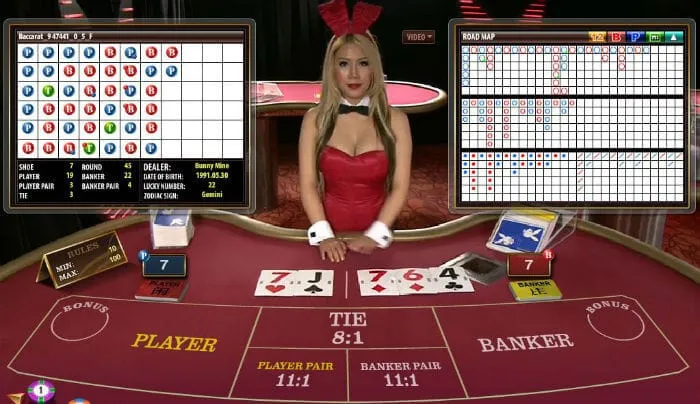
The singleton vs. the run
Betting for or against a singleton means betting on whether the current one-hand streak will reach Row Two. In practice that is a bet on Banker or Player for the next hand: to bet on a run you back the side that just won, and to bet on a singleton you back the other side. Either way you face the normal odds of that bet. A scorecard showing ten runs and three singletons does not make the next streak more likely to be a singleton.
Betting Row Three and Row Four
Some systems bet that a run will stop at two (Row Three stays empty) or that it will continue. About half of all runs reach Row Three, and about half of those reach Row Four, so a typical shoe has only around four or five runs of four or more. Each of those steps is again a bet on the next hand, at roughly even odds, with the usual house edge. Increasing your stake because a ratio looks stretched, for example from one unit to three, raises the amount at risk without improving your chances.
Using ratios sensibly
Tracking ratios can make baccarat more engaging, and the numbers above show what a normal shoe looks like. Treat them as a description of the past, not a forecast. If you play:
- set a budget for the session and a fixed unit size before you sit down;
- remember that Banker has the lowest house edge, and that no betting pattern changes it;
- avoid progressions that raise your stake after losses or when a shoe looks “due” to change;
- see our baccarat money management guide for ways to control your stakes.