


In short: In eight-deck baccarat, the Banker bet has a house edge of 1.06% after the 5% commission, the Player bet 1.24%, and a Tie paying 8:1 has an edge of 14.36%. The Banker hand wins about 45.86% of the time, the Player 44.62% and a tie 9.52%, so Banker and Player bets offer far better value than Tie.
The game of Baccarat, also popular as Punto Banco, is one of the oldest and at the same time most popular games worldwide. It is the game of choice of high rollers, and some of the most popular casino resorts on a global scale invariably lure wealthy players by offering them attractive Baccarat options.
Although in the past, Baccarat was associated with complicated rules and impossibly high stakes, today it has been simplified, and one is able to engage in a Baccarat game even if they have an average bankroll.
Baccarat is a game famous for having a relatively low house edge. As for the contemporary rules, they are considered fairly simple. The player is supposed to choose one out of three wagering options and place a wager.
If you intend to play at a brick-and-mortar casino, there are three Baccarat tables you can join.
Big Table Baccarat is usually intended for high rollers and these tables are located in a special casino area. The limits are higher as compared to the tables for mass players. A standard Baccarat table is as big as the one for Craps. As many as 14 players can join the table and each of them is allowed to bet either on the player or for the banker although the player holding the shoe usually bets on the banker.
Best Online Baccarat Bonuses

Shazam Casino
$ 50

JuJu Vegas
150% up to
∞

Black Lotus Casino
300% up to
$7,000
+ 45 Spins

Lucky Creek
200% up to
$/€7,500

Grand Eagle
200% up to
$5,500
+ 30 Spins

Treasure Mile
250% up to
$/€5,000

Bovada Casino
100% up to
$1,000

Ignition Casino
$ 425

Slots.lv
100% up to
$2,000
+ 20 Spins

Jazz Casino
200% up to
$2,000
+ 100 Spins

Slots And Casino
500% up to
∞
+ 150 Spins
Similar to the dice rotating around the craps table, the deal rotates around the Baccarat table. In case the player is reluctant to deal, he may pass the shoe to the next player. The latter is supposed to deal as long as the banker wins.
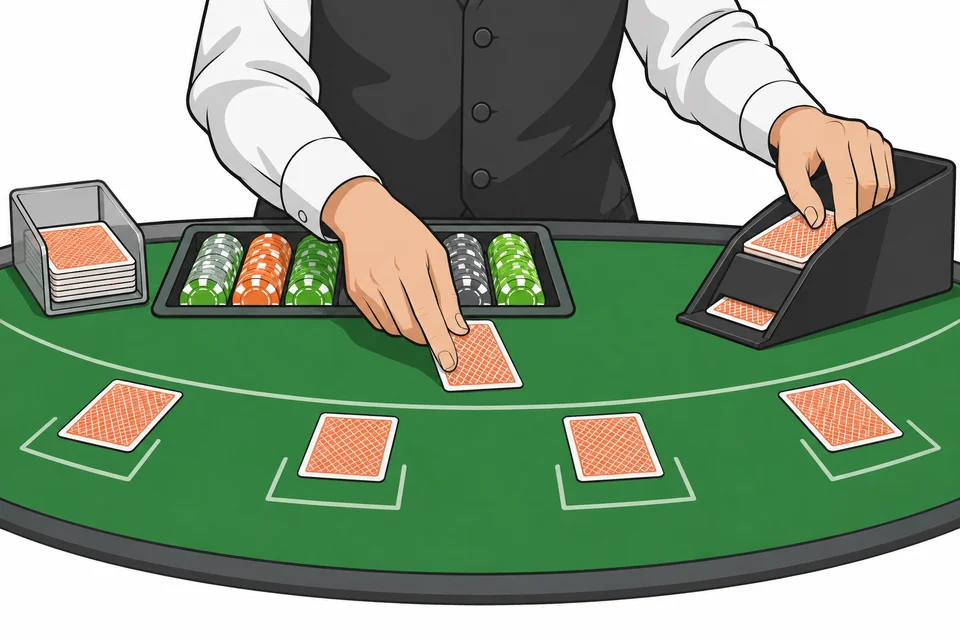
The person dealing puts two cards, face down, under the shoe. The player who has placed the biggest bet is dealt two cards, also face down. Then, the player takes a look at the cards and gives them back to the one who is dealing. Next, the dealing player turns over the cards and one of the casino dealers announces the totals. A third card is then drawn for either hand only if the fixed drawing rules require it. Then, the dealers pay out the winning wagers.
It is important to note that unlike Pai Gow, in the game of Baccarat, the dealer cannot be held liable for the financial losses of the other players.



Mini Baccarat has the same rules applicable to Big Table Baccarat although there are a few differences between them.
In Mini Baccarat, the dealer is in charge of turning over the cards, which accelerates the game action. However, Mini Baccarat is suitable for mass players too because of the lower table limits. In most cases, it has the same odds as the Big Table Baccarat, but they slightly change if the cards are dealt from a six-deck shoe.
The third variation is Midi Baccarat, and it is also suitable for high rollers. The size of the table is larger and the game is to be found in high limit rooms.
Rules
In most cases, as many as eight decks of cards are necessary for the game of Baccarat. The value of all face cards and 10s is zero, while the cards 2-9 are counted as their actual value. The ace is equal to 1. The dealer is required to turn over one card at the start of each new shoe in order to determine the number of the cards that would be burned.
Then, the cut card is placed 16 cards from the bottom of the shoe. The hand is finished when the cut card appears and the dealer is supposed to play one more hand before staring the new shoe.
Players have to bet on the “player”, “banker” or a “tie”. Depending on the table you have joined, you might also be allowed to bet on a player or banker pair.
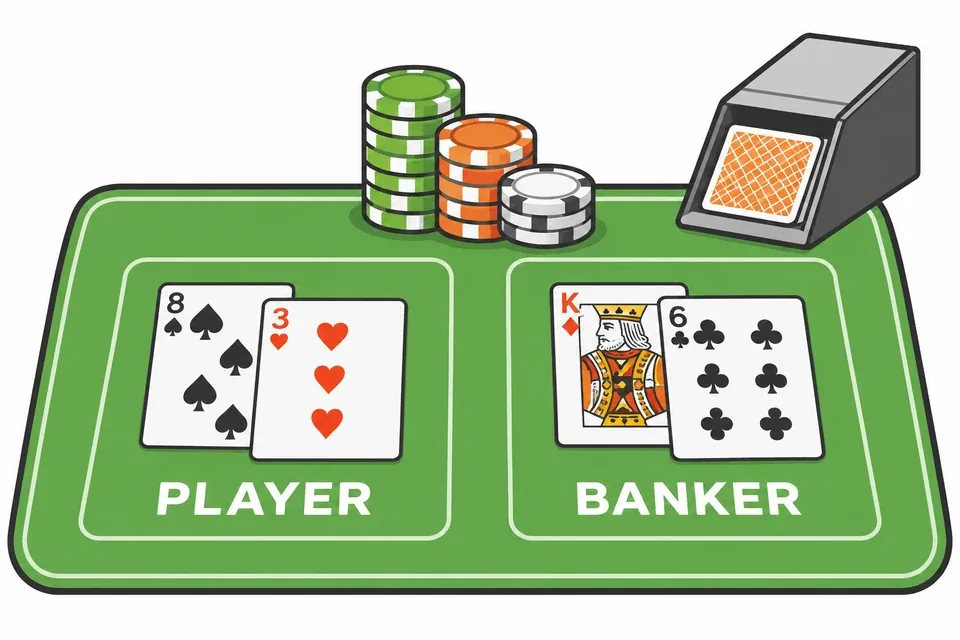
When all bets are down, the dealer gives two cards to the player and two cards to the banker. The value of the hand is the right digit of the total of the cards and the hand with the higher value wins.
For instance, if you have been dealt a 7 and an 8, that makes a total of 15, and therefore, the score is 5. It is essential to note that the scores are always in the range between 0 and 9. The option of “busting” is eliminated. The result is a tie when the cards of both the banker and the player have the same value.
In some cases, the dealer or the player might receive an additional third card provided that the following rules are obeyed.
The first rule, that actually overrides all the other rules, states that no third card is dealt if either the player or the banker has a total of 8 or 9, and both hands stand.
In case the player’s total is 5 or less, the player is supposed to hit. If the total is 6 or 7, the player stands. If the player stands, the banker hits provided that the total is 5 or less.
Winning bets on banker or player are paid 1:1, but you have to be informed that a 5% commission is charged on bank bets, in which case the odds slightly change from 0.95 to 1. You will notice that the dealer keeps track of the commission you owe with small laminated markers. The commission is collected at the end of each shoe.
As for the tie bets, the payout might vary from casino to casino. Yet, in most cases, they are paid 8:1 or 9:1. If the hand ends a tie, the player and the banker get a refund of their bets. Once the player places a bet, it cannot be amended. The player and the banker’s hands are dealt in accordance with the established rules.

Baccarat Odds
In brief, odds refer to a player’s chances of winning or losing a bet against the house. In point of fact, Baccarat is one of the casino games with the lowest house edge. Although in the past, Baccarat was a pretty complicated game, the contemporary rules are simplified and players just have to choose one out of three betting options.
The rules of the game have been established with the aim of creating a small house edge on player’s and banker’s bet and higher edge on tie bets.
The house edge on Banker bet is 1.06%, while the house edge on Player bet is 1.24%.
The house edge on tie bets jumps to 14.36% when ties pay 8:1 (about 4.84% at 9:1), but the payout is more generous than the payout on player and banker bets.
The odds for a player’s hand to win in a game of Baccarat are 44.62% and the chance for the banker hand to win is 45.86%. The chance for a hand to end a tie is 9.52%.
If you do not include the chance of getting a tie in your calculations, the banker wins about 50.68% of decided hands. The low house edge makes Baccarat a preferred game by both high rollers and mass players. However, you should not underestimate the importance of the aforementioned 5% commission you are required to pay to the house.
If you are determined to win big, you are advised to bet on Banker or Player instead of opting for a tie bet.
According to other calculations, the player wins 49.32% of all non-tie bets, while the banker wins 50.68%.
Let’s presume you wager 100 credits and you expect to lose 50.68 and to win 49.32. If you take 49.32 out of 50.68, you get 1.36, which is the house edge on decided bets; because ties push, the edge per bet placed is 1.24%.
As for the banker odds, they can be calculated as follows.
Let’s presume you are wagering 100 credits without neglecting the fact that you owe a 5% commission on your winning bets. Therefore, you win 0.95 credits for every credit you wager. As stated above, the banker is expected to win 50.68% of all bets, so if you multiply 50.68 by 0.95, you get 48.15. The player is expected to lose 49.32% of all bets, so if you deduct 48.15 out of 49.32, you get a difference of 1.17, which is the edge on decided banker bets, or 1.06% per bet placed once ties are included.
As far as tie bets are concerned, they happen about 9.52% of the time, which means the true odds are about 9.5 to 1. When you divide 100 by 9.52, you get about 10.5. However, you have to keep in mind that you will also receive your original bet back, so the true odds are about 9.5 to 1.
In other words, an 8:1 tie bet wins 8 units 9.52% of the time and loses 1 unit 90.48% of the time, an expected loss of about 14.36% per bet. Although the house has a serious advantage of 14.36%, some players are still willing to make a tie bet because of the considerably higher payout. However, the player and banker bets are much more favorable regardless of the 5% commission they are subject to.