 Breathtaking. This is the word that best describes the so-called integrated resorts – the latest trend in both the gambling and tourism industries. Generally speaking, these are large properties that feature luxury hotel, casino, food and beverage, entertainment, and a number of other facilities and attractions. What distinguishes the integrated resorts from the regular gambling and hospitality complexes is the fact that they are much larger and much more expensive to build and operate. They are in a way the haute couture of gambling and entertainment as a whole.
It has been generally acknowledged that the term ‘integrated resort’ was coined by Sheldon Adelson, Chairman and Chief Executive Officer of gambling operator Las Vegas Sands Corp., in the 1990s. Back then, Mr. Adelson referred to his company’s Las Vegas properties as integrated resorts in order to differentiate them from the rest of the gambling venues located on the Strip, which was the world’s biggest and most popular gambling hub at that time.
Later on, Las Vegas introduced the integrated resorts model in Macau where it proved to be quite successful and was implemented by other operators as well. Singapore was the next country to have such luxury complexes built within its borders. Marina Bay Sands and Resorts World Sentosa, the country’s two integrated resorts, were an instant success, drawing hundreds of thousands of international tourists, particularly from the Asia-Pacific region, and generating millions of dollars in revenue.
In fact, Asian high rollers, especially the ones from Mainland China, are among the most frequent visitors to such properties. This particular group is known for its expensive taste and for being keen on spending huge amounts of money on gambling as well as on other entertainment options. And it could be said that to a great extent, the contemporary integrated resorts are designed to cater to every single whim of the gambling customer from the Asian-Pacific region.
A Brief Overview of the Philippine Tourism and Gaming Industries
Following the success of the integrated resorts in Macau and Singapore, Philippine officials decided that the introduction of such properties in the country would most definitely prove to be a major boost to both its tourism and gambling industries.
Situated in the western Pacific Ocean, the Philippines is a Southeast Asian island country comprising more than 7,000 islands. Given its location and climate as well as its numerous beaches, excellent diving spots, rainforests, etc., it definitely has a lot to offer to both domestic and international tourists. In fact, the country’s tourism industry is one of the most important contributors to its economy, annually driving millions of foreign visitors.
According to the latest figures released on the official website of the Philippine Department of Tourism, a total of 2.6 million international tourists entered the country during the first half of the year. In comparison, the number of foreign visitors for the same period a year ago was 2.4 million. Tourism activities generated earnings of PHP111.1 billion, up 1.2% as compared to the figures posted for the first half of 2014.
This June, as many as 390,486 international visitors traveled to the country. A breakdown of the tourists who entered the Philippines during the said 30-day period and how much they spent shows Korean visitors were the biggest spenders. Visitor earnings from them amounted to PHP5.4 billion. US tourists spent as much as PHP3.8 billion in June. Visitor earnings from Taiwanese amounted to PHP758 million. Japanese tourists contributed a total of PHP747 million and Chinese ones spent PHP733 million in June. In other words, people from the Asia-Pacific region represent the biggest portion of the country’s international visitors and they tend to spend quite a lot while in the Philippines.
Manila was the region that received the most June arrivals. A total of 273,626 foreign tourists, or 70.1% of all arrivals, came to the city during the said month.
As for the country’s gambling industry, it could be said that it has always been quite vibrant with its respective ups and downs occurring occasionally. Currently, it is experiencing certain difficulties as major gambling operators posted a decrease in net profit for the first half of the year.
For instance, Travellers International Hotel Group Inc., which runs Resorts World Manila, the country’s first integrated resort posted a 46.5% decline in its net profit for the period in review. Bloomberry Resorts Corp., developer and operator of Solaire Resort & Casino, reported a net loss for the year’s second quarter ended June 30. Yet, net revenue increased in year-on-year terms.
Cristino Bong Naguiat, Jr., Chairman of PAGCOR, the state-owned gambling regulator, attributed the relatively poor results to the fact that the operators that provide they services within the country’s borders have been spending substantial amounts of money on business expansions. The official also noted that despite the decrease in net profits, the Philippine gambling industry has still reported a growth in revenue and has every chance to generate $3 billion by the end of 2015, up 20% from the previous financial year.
In July, PAGCOR posted information about the overall financial performance of the country’s gambling venues during the first half of the year ended June 30. Revenue from gaming operations amounted to PHP21.8 billion ($466.4 million). Gambling options such as slot machines and table games, accounted for more than 70% of the proceeds.
The figures show that more than six years after the Philippines’ first integrated resort opened doors and now that three such properties are operational, those have clearly caught the attention of foreign tourists and gambling customers. But here is how it all started.

The Philippines’ First Foray into the Integrated Resorts’ Kaleidoscopic World
It was more than a decade ago when Philippine gambling officials first introduced their plans for the so-called Entertainment City, a 100-hectare gaming and entertainment complex located in the Manila Bay area. It is to feature a total of four integrated resorts, with two of those already being operational, more than 5,000 hotel rooms as well as numerous other entertainment, food and beverage, retail, and other luring options.
Although Solaire Resort & Casino, operated by Bloomberry Resorts and Hotels, Inc., opened doors in March 2013 thus becoming the first integrated resort in Entertainment City, the property was not the first one of this kind in the country. Alliance Global Group Inc. and Genting Hong Kong Ltd., a subsidiary of Malaysian gambling giant Genting Group, built together the so-called Resorts World Manila in Pasay, Metro Manila. The property had its soft opening on August 28, 2009.
The resort features three luxury hotels operated under the Remington, Marriot, and Maxims brands. All three combined have more than 1,500 hotel rooms. The integrated resort also features a 30,000-square-foot casino with a number of gambling options both for mass market players and high rollers. Numerous restaurants and bars, a dazzling shopping center, a theater, and a cinema are also among the entertainment opportunities offered to visitors of the complex. Resorts World Manila was the sole integrated resort in the region for three and a half years and it could be said that it proved to be quite successful.
Entertainment City – Manila’s Centerpiece
As mentioned above, it was more than ten years ago when country officials started first discussions over the establishment of an entertainment complex that would offer a number of gaming, retail, entertainment, accommodation, dining, and other options, and would turn into a key tourist destination and significantly boost local economy.
And this is how the idea about the so-called Entertainment City was formed. Philippine officials revealed that it will be home to four integrated resorts, two of which are already operational and the other two are expected to open doors by 2018. Each resort developer is required to invest no less than $1 billion on the construction of its property.
In addition, each integrated resort has been promised gross floor area of no less than 250,000 square meters. The gaming area of each project cannot be more than 7.5% of the overall gross floor area. A thematic attraction worth more than $20 million and retail spaces of no less than 20,000 square meters are also among the requirements that developers need to meet.
Generally speaking, Entertainment City is a 100-hectare complex located on the Manila waterfront and not far from international airports and other key locations. The property is expected to annually welcome more than 1 million tourists. Furthermore, at least 40,000 people will be employed directly once all four resorts are fully operational.

Solaire Resort & Casino
As mentioned above, Solaire Resort & Casino, the first integrated resort in Manila’s Entertainment City, opened doors on March 18, 2013. The $1.2-billion property was developed and is operated by Bloomberry Resorts and Hotels. The company was awarded a provisional license by PAGCOR in 2009. Construction commenced in July 2010 and a topping out ceremony for the hotel tower was held on July 2012.
The multi-million-dollar complex was designed by legendary Las Vegas-based architect Paul Steelman of Steelman Partners LLC. The prominent architecture firm is known as being in charge of the designs of City of Dreams Macau, The Star in Sydney, and Resorts World Las Vegas.
Solaire Resort & Casino spreads over 8.3 hectares of land in Entertainment City. Initially, the venue featured a five-star hotel with 500 rooms offering panoramic views of Manila Bay, one of the Philippines most popular landmarks, a grand ballroom with as many as 1,000 seats, numerous live entertainment, leisure, dining, and retail options.
An 18,500-square-meter casino also opened doors in March 2013. It offered and still offers players a total of 300 gaming tables, with blackjack, roulette, craps, and other popular table games being included, as well as 1,200 slot machines. A 6,000-square-meter VIP salon welcomes high rollers from all over the world.
Phase 1A of the complex was launched on November 22, 2014. More than 300 suite rooms were added as well as luxury restaurants and a night club. In addition to this, another parking building was opened, a 60,000-square-meter retail space, and the 1,760-seat fan-shaped Theatre of Solaire.
In August 2015, Solaire Resort & Casino also launched the so-called Poker King Club Manila, which is set to become one of the Philippines’ best poker venues.

City of Dreams Manila
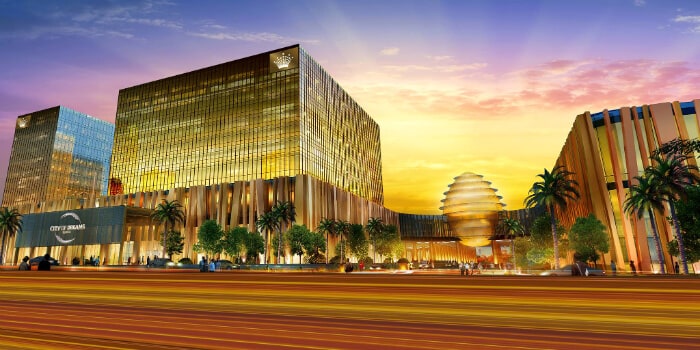
City of Dreams Manila is the second integrated casino complex to open doors in Entertainment City. The $1.3-billion property had its soft opening on December 14, 2014 and was officially launched on February 2, 2015. It would not be an exaggeration to say that City of Dreams Manila is among the most ambitious contemporary hotel, casino, and entertainment projects.
Architecture firm ASYA Design Partners was responsible for the design of the golden glass buildings of the complex, which has been strategically placed near the Ninoy Aquino International Airport and a number of other key destinations in Metro Manila.
City of Dreams Manila is owned and operated by Melco Crown Philippines, a joint venture between Philippine real estate developer Belle Corporation and gambling operator Melco Crown Entertainment. And Melco Crown Entertainment itself is a joint venture between Australian businessman James Packer’s Crown Resorts and his fellow Lawrence Ho’s Melco International Development.
To start with the integrated resort’s casino, it spreads over 1,700 square meters. The venue features about 1,700 electronic table games, 1,700 slot machines, and a total of 380 gaming tables run by live dealers. A PokerStars poker room, which has already played host to prestigious tournaments, and a Signature Club that offers private gaming experience to those who are willing to pay for it are also among the opportunities that visitors are welcome to explore.
City of Dreams Manila features six hotel towers, operated under the Crown, Nobu, and Hyatt brands and offering more than 900 luxury rooms. It is interesting to note that the resort’s Nobu Hotel is actually the first one of the popular brand to open doors in Asia. It offers visitors the opportunity to stay at its 321 trendsetting rooms and to get a taste of the exclusive dining experience of the well-known Nobu Restaurants brand.
The Crown Towers hotel features 260 luxury rooms and the more “business/leisure traveler-focused” Hyatt City of Dreams Manila has 365 rooms at its visitors’ disposal.
The $1.3-billion Melco Crown Philippines property also offers numerous dining options, with both European and traditional Asian cuisine offerings. As for City of Dreams Manila’s entertainment options, they are truly unique. DreamPlay, known to be the first branded family entertainment center in Manila, CenterPlay, a luxury lounge within the casino, and the popular Chaos and Pangaea nightclub brands are only few of the opportunities featured at City of Dreams Manila.
In fact, the two night clubs are located within the so-called Fortune Egg, a dome-like structure, which is the centerpiece of the resort and according to the developer, is to turn into one of Manila’s landmarks.
Manila Bay Resorts
Integrated resort number three is yet to be launched but it could be said from what has been revealed about it that it would be as modern and luxurious as Solaire Resort & Casino and City of Dreams Manila. The property is developed and will be operated by Tiger Resorts Leisure and Entertainment, affiliate of gaming company Universal Entertainment, which is owned by Japanese businessman Kazuo Okada.
Manila Bay Resorts has faced a number of setbacks since the moment it was first announced that the complex was to be built. In the first place, Tiger Resorts experienced serious difficulties in finding a Philippine partner for its $2-billion project for the construction of the integrated resort. Under the country’s laws, a foreign company can own no more than 40% of the land on which a given property is to be built.
At first, Tiger Resorts was to work together with Philippine real estate developer Century Properties. However, a dispute between the two companies resulted in the latter withdrawing from the project. Earlier this year, it was announced that the Japanese operator has eventually found a local partner – All Seasons Hotel and Resort Corporation headed by Philippine businessman Antonio Cojuangco.
In fact, Manila Bay Resorts was expected to open doors in the spring of 2014, under an agreement between Tiger Resorts and PAGCOR. However, the gambling operator requested a one-year extension of the deadline as it had “increased the scale of the project.” The integrated resort could not be completed by March 2015 as well. According to the latest information revealed by Tiger Resorts and the Philippine gambling regulator, Phase 1 of Manila Bay Resorts will be completed and launched in December 2016. Yet, PAGCOR fined the gambling operator $2.2 million for the project delay.
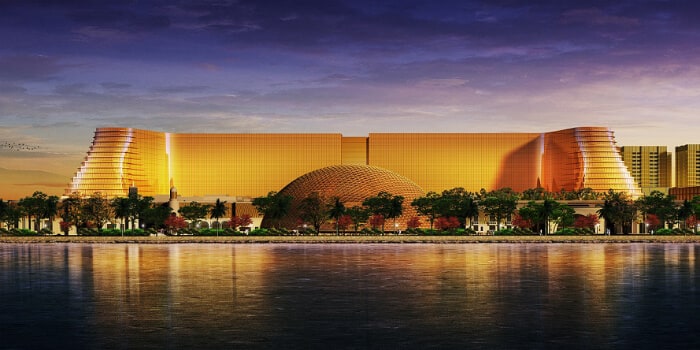
Manila Bay Resorts is to be located on a 40-hectare lot in Entertainment City. The casino itself will spread over 30,000 square meters and will feature 3,000 slot machines and 500 gaming tables. Apart from the gambling options, Phase 1 of the luxury complex will also offer two 500-room hotels operated by prominent brands, the names of which have not been revealed yet. Residential apartments, office buildings, and numerous food and beverage, retail, and entertainment options will also be included. Tiger Resorts and its local partner also announced that the integrated resort will feature an opera house. A spectacular water fountain will be among the property’s highlights.
The resort’s developer has previously pointed out that they want to pay more special attention to the non-gaming options that it is to offer. This is why those will cover about 30 hectares of the entire complex.
Tiger Resorts said in July that up to that point, the amount of $750 million had been spent and the property was 60% complete. The company and its local partner have already started planning Phase 2 of the project. As mentioned above, Manila Bay Resorts will be operational as of December 2016, thus becoming the third integrated resort within Manila’s Entertainment City.
Architecture firms GF & Partners Architects and Pimentel Rodriguez Simbulan & Partners have been hired to take care of the property’s design, which judged by the released renderings, will be a tiny city of gold on the Manila waterfront.
Resorts World Bayshore
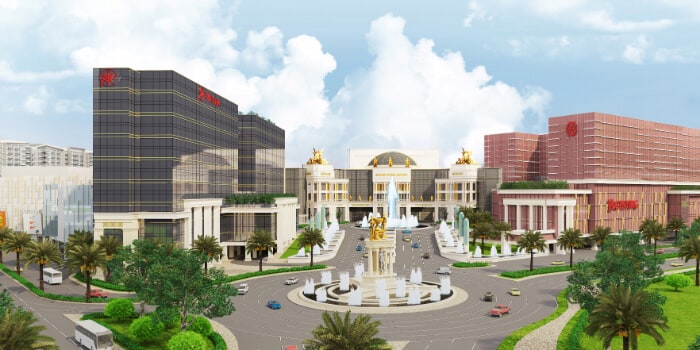
Resorts World Bayshore will be Entertainment City’s fourth integrated resort. However, the information that has been revealed about the property, which is developed by local Alliance Global Group Inc. and Genting Hong Kong Ltd., is not that much.
It had first been announced that the complex would open doors in 2016. Later on, developers said that it would be fully operational by 2017. According to the latest information, Resorts World Bayshore will be launched sometime in 2018.
Phase 1 of the $1.1-billion project will feature a casino floor with numerous gambling options, three luxury hotels, two of which will be operated under the Okura and Westin Hotels and Resorts brands, and a number of entertainment, dining, and other exciting opportunities for visitors.
Construction work on the 31-hectare property started last October and Phase 1 is expected to cover no more than one-third of the entire lot.
Alliance Global and Genting Hong Kong have already been working together on a joint project – the so-called Resorts World Manila, the Philippines first integrated resort.
Conclusion
To sum up, it could not be said whether Entertainment City will prove to be a successful and profitable endeavor until all venues are fully operational, which is expected to happen by the end of 2018. Yet, one thing is for sure, all four of them will feature everything that is likely to attract the attention of well-to-do customers from the Asia-Pacific region. This, in turn, may result in millions of visitors entering the Philippines and millions of dollars being contributed to the country’s economy.