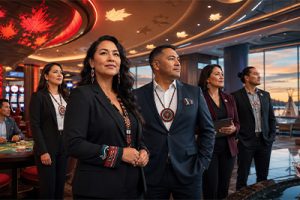
 First Nations communities are becoming more involved in Canada’s casino industry as Indigenous organizations continue purchasing gaming properties across the country. The recent acquisitions mark a growing effort by communities to take direct ownership of commercial operations and create long-term sources of revenue.
In British Columbia, the Snuneymuxw First Nation has emerged as one of the most active Indigenous groups in the casino market. Through its economic development organization, Petroglyph Development Group, the Vancouver Island nation has acquired five casino properties from Great Canadian Entertainment over the past two years.
The purchases include Casino Nanaimo, River Rock Casino Resort and Great Canadian Casino Vancouver. The acquisitions represent a major step in Snuneymuxw’s plans to become directly involved in casino ownership while also regaining control of lands connected to its history.
Casino Nanaimo became the first significant property acquired by the nation. As part of that agreement, the land where the casino operates was returned to Snuneymuxw First Nation and is part of the nation’s xwsol’lexwel village.
“It’s important to the nation for us to be reacquiring these sites by whatever means necessary,” Simpson said of that acquisition. “In this transaction, we’re paying market value for land that was taken from us, which is bittersweet, but we’re really happy to have it brought back to us.”
Indigenous Groups Expand Casino Holdings in British Columbia
Other First Nations in British Columbia have followed similar paths as casino ownership continues to change across the province.
The Tsleil-Waututh Nation acquired the casino operations at Hastings Racecourse & Casino, while the Ts’elxwéyeqw Tribe took ownership of Elements Casino Chilliwack. The Semiahmoo First Nation also purchased Elements Casino Surrey at Fraser Downs.
These agreements will result in Great Canadian Entertainment transferring eight of its nine British Columbia casinos to First Nations groups. The only remaining property from its former provincial portfolio will be Chances Dawson Creek.
The transactions reflect a broader move by Indigenous communities to develop independent business operations and generate income that can support community priorities. Gaming has become one area where First Nations organizations are building direct involvement in commercial activity.
Alberta Casinos See New Indigenous Ownership
A similar pattern has developed in Alberta, where Indigenous groups have expanded their role in the casino sector through large-scale purchases.
At the end of 2024, Indigenous Gaming Partners acquired the casino operations of Edmonton-based Pure Canadian Gaming in partnership with Sonco Gaming. The agreement included Pure Casino Edmonton, Pure Casino Yellowhead, Pure Casino Calgary and Pure Casino Lethbridge.
Indigenous Gaming Partners represents five rural Nova Scotia First Nations. The group continued growing its holdings in March when Pure Casino Entertainment purchased Gamehost Inc. That deal added several properties, including Deerfoot Inn & Casino in southeast Calgary, Rivers Casino and Entertainment Centre in Fort McMurray, and Great Northern Casino in Grande Prairie, along with several hotels.
The acquisitions have created additional revenue opportunities for the communities connected to Indigenous Gaming Partners. Michael Peters, chairman of IGP and CEO of Glooscap Ventures, said the first Pure Canadian Gaming purchase generated new income for member First Nations.
Glooscap First Nation received more than $600,000 during the six months between the acquisition of the first group of Pure Canadian Gaming casinos and the end of the 2024-25 fiscal year. The community used those funds to support areas such as housing and healthcare.
Alberta’s regulated online gaming market has also opened another avenue for Indigenous casino operators. Pure has registered the Pure Casino digital brand for customers throughout the province, while River Cree Resort and Casino is preparing to launch its own licensed online platform.
Casino Ownership Gives First Nations Greater Control Over Revenue
Industry representatives say the increase in Indigenous ownership reflects a change in how First Nations communities participate in gaming.
Anthony Novac, President of IGP partner Sonco Gaming, said Indigenous groups have more opportunities to enter the sector through ownership. Peters said owning gaming businesses gives communities greater control over how earnings are used.
“Ownership changes the conversation,” Peters said. “It creates long-term revenue, provides more influence over decision-making, and allows for more room to align business goals with community priorities. First Nations have a long history of being involved in gaming and have operated casinos successfully. What we are seeing now is an expansion of those opportunities beyond reserve lands and into broader commercial markets.
“Gaming is part of a larger economic story. Indigenous communities increasingly have the governance capacity, the capital partnerships and the strategic experience to lead major transactions. That is good for our communities, and it is also good for the industry as a whole.”
As conversations continue around possible federal law changes related to First Nations authority over gambling, recent acquisitions by groups such as Snuneymuxw First Nation and Pure Casino Entertainment show how Indigenous communities are taking a larger role in Canada’s gaming industry.
Source:
First Nations Casino Ownership Grows Across Canada, casinoreports.ca, July 31, 2026.