
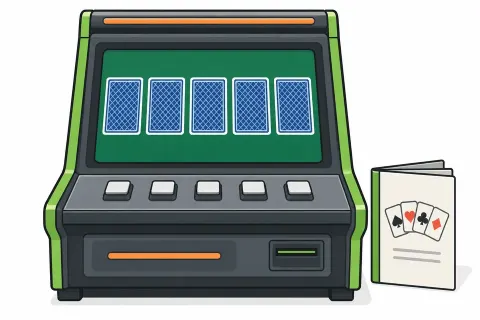
 Video Poker is played on a machine that looks pretty much like a regular slot machine in which from 1 to 5 coins are inserted in order to the player to be given access to their favourite poker game. Currency and tickets are also accepted to place a wager.
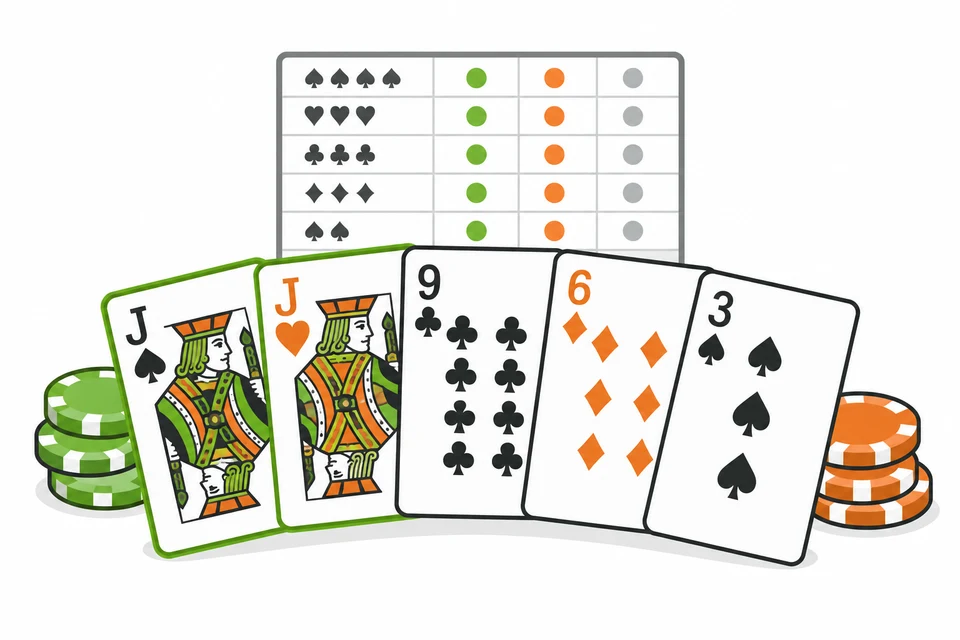
Then, the player is dealt a total of five cards that are given to them with their faces up on the screen. The order of the five cards is unknown, as they are dealt by a Random Number Generator (RNG). Then, the player needs to make a decision of each of the cards whether to keep them or discard them.
Five cards produce 32 possible hold-or-discard choices. In a conventional single-deck draw, discarding n cards leaves C(47,n) equally likely unordered replacement combinations—not 47 divided by n. The video poker mathematics guide explains how these combinations are used to compare expected payouts.
Top Rated Online Casinos for the Ohio

Liberty Slots Casino
Sign Up100% up to
$259

Slots.lv
Sign Up100% up to
$2,000
+ 20 Spins

Bovada Casino
Sign Up100% up to
$1,000

Shazam Casino
Sign Up250% up to
$2,500

Lincoln Casino
Sign Up100% up to
$100
+ 25 Spins

Red Stag Casino
Sign Up275% up to
$550
+ 100 Spins

Sloto'Cash Casino
Sign Up200% up to
$2,000
+ 100 Spins

Vegas Casino Online
Sign Up400% up to
$500

Everygame Classic Casino
Sign Up200% up to
∞
+ 50 Spins

Everygame Casino
Sign Up125% up to
$1,000

Casino Extreme
Sign Up200 Spins

Lucky Tiger Casino
Sign Up250% up to
$1,000

Casino Brango
Sign Up250% up to
$1,000
+ 500 Spins

Rich Palms Casino
Sign Up250% up to
∞

Highway Casino
Sign Up250% up to
$2,500

Miami Club Casino
Sign Up100% up to
$100

Yabby Casino
Sign Up202% up to
∞

Uptown Aces
Sign Up250% up to
$2,500

PlayCroco Casino
Sign Up$ 50

Fair Go Casino
Sign Up200% up to
∞

DuckyLuck Casino
Sign Up500% up to
$/€2,500
+ 150 Spins

Las Vegas USA Casino
Sign Up400% up to
$500

Ignition Casino
Sign Up$ 425

Slots Plus
Sign Up400% up to
$500

Sun Palace Casino
Sign Up400% up to
$500

Slots And Casino
Sign Up500% up to
∞
+ 150 Spins

Slots Empire
Sign Up230% up to
$7,500

El Royale Casino
Sign Up230% up to
∞

Black Lotus Casino
Sign Up300% up to
$7,000
+ 45 Spins

Slotsroom Casino
Sign Up200% up to
$2,000
+ 200 Spins

Gold Prize Casino
Sign Up50% up to
$1,000

Casino Max
Sign Up300% up to
$3,000

Lucky Creek
Sign Up200% up to
$/€7,500

Spinfinity Casino
Sign Up300% up to
$3,000

Jackpot Capital
Sign Up$ 50

NewVegas Casino
Sign Up400% up to
$3,000

Slotastic
Sign Up250% up to
∞

Ripper Casino
Sign Up150% up to
$1,500

Las Atlantis Casino
Sign Up$ 2,500

LadyLuck Casino
Sign Up100 Spins

Grand Eagle
Sign Up200% up to
$5,500
+ 30 Spins

Ozwin Casino
Sign Up200% up to
$2,000
+ 50 Spins

Treasure Mile
Sign Up250% up to
$/€5,000

Roaring 21 Casino
Sign Up300% up to
$3,000

Grande Vegas
Sign Up150% up to
$300

Cherry Jackpot
Sign Up300% up to
$3,000

Wicked Plays
Sign Up300% up to
$1,000

JuJu Vegas
Sign Up150% up to
∞

BetOnline Casino
Sign Up100 Spins

RedCherry Casino
Sign Up100% up to
$100

Jazz Casino
Sign Up200% up to
$2,000
+ 100 Spins

Grand Rush
Sign Up200% up to
$4,000
+ 40 Spins

BetMGM Casino NJ
Sign Up100% up to
$1,000
Payout Schedule of Jacks and Better
Players should always remember that pay schedules are important. It is not always easy to get oriented in a certain pay-off table, but players are recommended to always make clear what the pay-off would be for every hand in the game of Jacks or Better in a certain casino, regardless if it comes to a land-based or an online one.
When it comes to payout for Jacks and Better, there is a difference between the Royal Flush hand and the Straight Flush hand. In addition, the term “full-pay” machine is used to highlight the fact there are some video poker machines that feature payout schedules that are less favourable.
Players should also be aware of the fact that they need to bet the maximum amount of five coins in order to qualify for the maximum pay-off granted by the Royal Flush hand.
 Dealer Tricks to Boost House Edge
 Blackjack Counting Missing Cards
 Baccarat Main Bets
 Roulette Math
 Video Poker Math
A common 9/6 Jacks or Better pay table returns 800 for 1 for a royal flush at the qualifying maximum-coin wager, 50 for 1 for another straight flush, and 25 for 1 for four of a kind. These are pay-table awards, not probabilities. In an unordered five-card deal, there are four royal flushes, 36 other straight flushes and 624 four-of-a-kind hands.
The same example pay table returns 9 for 1 for a full house, 6 for 1 for a flush, 4 for 1 for a straight and 3 for 1 for three of a kind. Their five-card deal counts are 3,744, 5,108, 10,200 and 54,912 respectively, excluding higher-ranked categories where appropriate. The payout schedule is chosen by the game; it is not derived directly from these counts.
There are 123,552 two-pair hands and 337,920 hands with exactly one pair of jacks, queens, kings or aces in an unordered five-card deal. The example pay table returns 2 for 1 and 1 for 1 respectively. “For 1” includes the stake: a 1-for-1 award returns the wager without a net profit. Final-hand probabilities after optimal draws differ from these initial-deal counts.
Major Math Issues
The paramount math issue when it comes to the game of Jacks or Better is for the player to determine which cards to hold and which to discard considering their initial five-card hand. Basically, this decision would be based on the cards of which the player’s hand consists of.
No matter if it comes to a player who does not have enough experience or not, they have to make the decisions for themselves, by evaluating the cards they have as well as the chances to complete their hand in a way that boosts its rank. They should also remember not to rely too much on their intuition in such situations but to stay with cool mind and carefully consider what to do.
For each dealt hand, the optimal hold maximizes the expected payout under the actual pay table. A general rule such as “always keep a four-card flush over three cards to a royal” is not reliable without checking the exact cards and awards.