

 The doubling-up system, usually called a Martingale, increases the stake after each loss on an even-money bet. A win recovers previous losses and produces a profit equal to the starting stake only if the player can afford every required bet and the casino accepts it.
A staking system changes the distribution of session results, not the underlying probabilities or payouts. It cannot create a positive expectation in an ordinary negative-expectation casino game.
For the examples below, assume a fair single-zero roulette wheel with independent spins. This is a mathematical model, not proof that any particular physical wheel has been tested.
On a red bet, 18 of the 37 pockets win and 19 lose, including zero. The probability of a loss on each spin is therefore 19/37, regardless of the previous sequence.

Top Rated Online Casinos for the Ohio

Liberty Slots Casino
Sign Up100% up to
$259

Slots.lv
Sign Up100% up to
$2,000
+ 20 Spins

Bovada Casino
Sign Up100% up to
$1,000

Shazam Casino
Sign Up250% up to
$2,500

Lincoln Casino
Sign Up100% up to
$100
+ 25 Spins

Red Stag Casino
Sign Up275% up to
$550
+ 100 Spins

Sloto'Cash Casino
Sign Up100% up to
$500

Vegas Casino Online
Sign Up400% up to
$500

Everygame Classic Casino
Sign Up200% up to
∞
+ 50 Spins

Everygame Casino
Sign Up125% up to
$1,000

Casino Extreme
Sign Up200 Spins

Lucky Tiger Casino
Sign Up250% up to
$1,000

Casino Brango
Sign Up500% up to
$/€100
+ 500 Spins

Miami Club Casino
Sign Up100% up to
$100

Rich Palms Casino
Sign Up250% up to
∞

Highway Casino
Sign Up250% up to
$2,500

Yabby Casino
Sign Up202% up to
∞

Uptown Aces
Sign Up250% up to
∞

DuckyLuck Casino
Sign Up500% up to
$/€2,500
+ 150 Spins

PlayCroco Casino
Sign Up300% up to
∞
+ 60 Spins

Fair Go Casino
Sign Up200% up to
∞

Drake Casino
Sign Up300% up to
$2,000

Las Vegas USA Casino
Sign Up400% up to
$500

Ignition Casino
Sign Up200% up to
$100

Slots Plus
Sign Up400% up to
$500

Sun Palace Casino
Sign Up400% up to
$500
+ 25 Spins

Gold Prize Casino
Sign Up50% up to
$1,000

Casino Max
Sign Up300% up to
$3,000

El Royale Casino
Sign Up230% up to
∞

Slots And Casino
Sign Up500% up to
∞
+ 150 Spins

Slotsroom Casino
Sign Up200% up to
$2,000
+ 200 Spins

Black Lotus Casino
Sign Up300% up to
$7,000
+ 45 Spins

Slots Empire
Sign Up230% up to
$7,500

Lucky Creek
Sign Up200% up to
$/€7,500

NewVegas Casino
Sign Up400% up to
$3,000

Spinfinity Casino
Sign Up300% up to
$3,000

Jackpot Capital
Sign Up$ 50

Ripper Casino
Sign Up150% up to
$1,500

Las Atlantis Casino
Sign Up$ 2,500

Slotastic
Sign Up400% up to
∞
+ 20 Spins

Grand Eagle
Sign Up200% up to
$5,500
+ 30 Spins

Cherry Jackpot
Sign Up400% up to
∞
+ 20 Spins

LadyLuck Casino
Sign Up100 Spins

Grande Vegas
Sign Up150% up to
$300

Roaring 21 Casino
Sign Up400% up to
∞
+ 20 Spins

Ozwin Casino
Sign Up200% up to
$2,000
+ 50 Spins

Treasure Mile
Sign Up200% up to
$/€4,000
+ 50 Spins

Wicked Plays
Sign Up300% up to
$1,000

BetOnline Casino
Sign Up100 Spins

Grand Rush
Sign Up100% up to
$1,000

RedCherry Casino
Sign Up100% up to
$100

Jazz Casino
Sign Up200% up to
$2,000
+ 100 Spins

BetMGM Casino NJ
Sign Up100% up to
$1,000
The Doubling-up System Principles
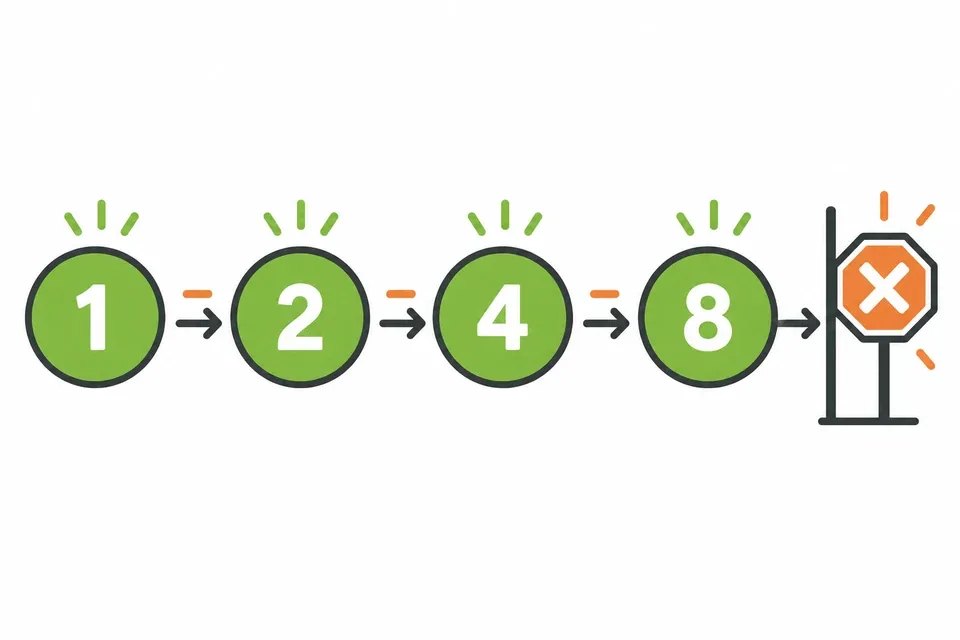 With a starting stake of one unit, the sequence of bets after losses is 1, 2, 4, 8, 16 and so on. Bankroll and table limits determine how many steps can actually be played.
After n consecutive losses, the amount lost is 2^n − 1 units, and the next required stake is 2^n units. Ten losses therefore cost 1,023 units and require a further 1,024-unit bet to continue.
A table limit does not guarantee that the accumulated loss is affordable. The player can exhaust their own budget before reaching the table maximum.
Deuces Wild Math
Doubling-up Casino System Math
Optimal Betting
Random Events in Casino Games
Casino Card Games Math
Doubling does not alter the house edge on a red bet. Occasional large losing cycles can outweigh many cycles that each win only the initial one-unit stake.
An unlimited-bankroll version is not a practical plan. Real players have finite funds, and each additional doubling requires much more money.
The chance of n consecutive losses from a specified starting point is (19/37)^n in this single-zero example. It is not the ratio of the maximum bet to the minimum bet. Across repeated cycles, the chance of encountering at least one failed cycle increases.
The Problem with Doubling up
The distinction between a payout and the chance of receiving it is explained in our guide to odds and probabilities.
The law of large numbers does not make a win due after losses. Each fair spin retains its probabilities. A plan based on waiting for a recovery can require a larger stake than either the budget or the table permits.
To evaluate a capped cycle, include both the small gain if a win arrives before the limit and the full accumulated loss if all allowed bets lose. Leaving out the failed cycle gives a misleading impression of profitability.
For a different mathematical question—sizing bets when a genuine positive expectation exists—see optimal betting. That analysis does not turn ordinary roulette into a positive-expectation game.