
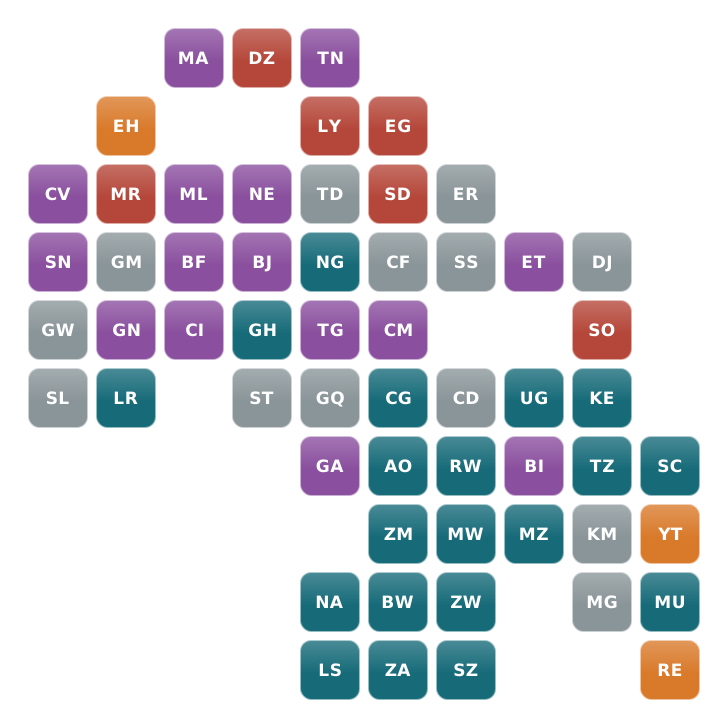
In short: It depends on the country. A growing group of African states, led by Kenya, Ghana, Tanzania and Uganda, license online betting and casino games, and Mauritius has legislated to do so from 2027; others reserve gambling to a national lottery, allow online sports betting but not online casinos, or prohibit gambling altogether. Many countries still have no online framework at all, so check the individual country guide before relying on any operator’s status.
Key points
- Africa has no common gambling regime: the 57 jurisdictions covered here range from full online licensing to outright criminal prohibition.
- English-speaking East and Southern African states mostly use licensing systems with a dedicated regulator, though several only license online sports betting, not online casino games.
- In much of French-speaking West and Central Africa, gambling is channelled through a state lottery holding a legal monopoly, sometimes working with private partners under its control.
- Libya, Sudan, Somalia, Mauritania and Algeria prohibit private gambling; Egypt admits only foreign visitors to its hotel casinos.
- A large group of smaller states has no gambling statute, no regulator and no online licence category, which leaves online play unregulated rather than authorised.
- Taxation has moved fast since 2025, with new levies on deposits and withdrawals, higher winnings taxes and, in a few places, cuts.
- Réunion and Mayotte follow French law, under which online casino games are banned; Western Sahara is a disputed territory, covered neutrally in its own guide.
Gambling models at a glance
- Licensing regimes with a dedicated regulator (20)
- State monopolies and national lotteries (15)
- Prohibition (6)
- Minimal or no framework (13)
- Territories (3)
Licensing regimes with a dedicated regulator 20
Private operators licensed through a specialist authority.
State monopolies and national lotteries 15
Gambling channelled through a state-owned or state-controlled operator.
Minimal or no framework 13
No gambling act, no dedicated regulator and no online licence category.
Territories 3
French overseas departments where French law applies, and Western Sahara.
How gambling is regulated across Africa

Most African gambling laws fall into one of five broad models. The labels below are simplifications, and several countries combine elements of more than one.
Licensing regimes with a dedicated regulator
The most developed markets license private operators through a specialist authority. Kenya replaced its 1966 statute with the Gambling Control Act, 2025, which created the Gambling Regulatory Authority and a separate online casino licence; the 2026 licensing regulations are being challenged in court over their fees. Ghana licenses online betting and casino games through the Gaming Commission under the Gaming Act 2006, while lotteries remain reserved to the National Lottery Authority. Tanzania licenses internet casinos and online sports betting under its Gaming Act and the 2022 Internet Gaming Regulations, which require a primary server on the Mainland. Uganda‘s regulator issues a single licence that covers both physical and online activity, although a presidential freeze on new licences dating from 2019 has not been formally lifted. Rwanda, Liberia, Seychelles and Angola also operate licensing systems that include online gambling, and the Republic of the Congo adopted a new law in 2024 that requires approvals for online games and created a regulator, the ARJHA, in 2025.
Federal or devolved systems add a further layer. In South Africa, gambling is a shared national and provincial competence: each of the nine provinces licenses casinos and bookmakers, while the National Gambling Board oversees national standards. In Nigeria, a Supreme Court judgment of November 2024 held that lotteries and games of chance are matters for the 36 states, so licences are territorial and Lagos runs the most developed regime.
Several Southern African states license land-based gambling and betting but have no route for online casino games. These include Botswana, Namibia, Zambia, Zimbabwe, Eswatini, Lesotho and Malawi. Mozambique uses state concessions for hotel-linked casinos and licences for betting, and approved a separate online casino concession regime in July 2026. Mauritius has licensed casinos, betting and the national lottery since 2007 and created licences for online casino operators in its Finance Act 2026.
State monopolies and national lotteries
Many countries channel gambling through a state-owned or state-controlled operator. In Côte d’Ivoire, a 2020 law concedes lotteries, betting and online games to LONACI, with an independent regulator, the ARJH. Senegal (LONASE), Burkina Faso (LONAB), Niger (LONANI) and Togo (LONATO) follow a similar pattern, as does Mali, where the mixed-economy PMU-Mali is the only officially authorised body. Gabon moved from licensing to a state monopoly in December 2025, creating La Gabonaise des Jeux. Burundi‘s state lottery, LONA, grants concessions to private partners, and Guinea reserves retail lottery and betting to its state lottery while letting a regulator authorise online betting. Benin combines a general prohibition with exceptions for its lottery company and operators authorised by decree, and Cameroon grants concessions and ministerial authorisations. Cabo Verde reserves casinos and social games to concession holders.
In North Africa, Morocco reserves sports betting, lotteries and horse-race betting to three state-controlled companies and has no independent regulator. Tunisia relies on two decree-laws from 1974, a state sports betting company and casinos open only to foreign visitors. Ethiopia has run a state lottery since 1961; after licensing private sports betting under lottery law, it revoked all betting licences in December 2025.
Prohibition
Libya prohibits gambling and, since 2022, criminalises online gambling for operators and players alike. Sudan‘s Criminal Act 1991 makes gambling an offence for players as well as organisers. Somalia‘s federal authorities treat gambling as prohibited nationwide, though authority is split among the federal government, member states and other areas. Mauritania has no lawful gambling market and began work on a draft law to criminalise gambling in October 2026. Algeria prohibits private gambling and bars electronic gambling transactions, leaving only state sports betting and horse-race betting. Egypt criminalises gambling in general but allows hotel casinos for non-Egyptians.
Minimal or no framework
A large group of countries has no gambling act, no dedicated regulator and no online licence category. In Chad, gambling is handled mainly through budget laws; in South Sudan, the Penal Code penalises unlicensed gaming houses and a 2024 finance act introduced gaming taxes, but no regulator exists. Eritrea, Djibouti, Comoros, Equatorial Guinea, Guinea-Bissau, São Tomé and Príncipe and the Central African Republic have little or no published gambling law beyond casino authorisations or general criminal provisions. Sierra Leone and The Gambia tax betting without a consolidated licensing statute, and The Gambia briefly banned all gambling between 2015 and 2017. Madagascar still relies on a 1971 law, and the DR Congo operates on ministerial orders while a gambling bill has been before Parliament since 2025.
Inherited statutes remain common. Zambia’s betting law dates from 1957, Eswatini’s casino law from 1963 and its general prohibition from the Crimes Act 1889, and Zimbabwe still licenses bookmakers under a statute written mainly for horse racing.
Territories
Réunion and Mayotte are French overseas departments, so French law applies: gambling is prohibited in principle, the Autorité nationale des jeux (ANJ) licenses online sports betting, horse-race betting and poker, and online casino games are banned. Western Sahara is a territory whose international status is disputed. Its guide notes that Morocco administers the larger part of the territory, west of the berm, where Moroccan gambling rules are applied, and takes no position on sovereignty.
Online gambling
Only a minority of African countries offer a full licensing route for online casino games. Kenya, Ghana, Tanzania, Uganda, Rwanda, Liberia, Seychelles, Angola and the Republic of the Congo license online gambling, and Mauritius and Mozambique adopted online casino regimes in 2026 whose details were still being implemented in October 2026. A second group, including South Africa, Zambia, Malawi, Eswatini and Cameroon, licenses online sports betting (and in Cameroon’s case online poker) but provides no route for online casino games. South Africa’s National Gambling Act prohibits “interactive games”, and a 2008 amendment that would have licensed them has never been brought into force.
Where a state lottery holds a monopoly, online gambling is lawful only through that operator or its approved partners: Côte d’Ivoire, Senegal, Burkina Faso, Niger, Gabon and Morocco are examples. In July 2026 Senegal’s lottery published a list of 17 authorised platforms and declared all others clandestine, and Burkina Faso’s government adopted a decree in March 2026 intended to give its lottery exclusive rights over online games of chance.
Elsewhere, online gambling is either prohibited (Libya, Sudan, Somalia, Mauritania, Algeria) or simply unregulated. In unregulated markets, offshore sites are widely used but players have no local regulator to complain to and no access to self-exclusion. Several guides note that the absence of enforcement does not make such play lawful or protected.
Enforcement against unlicensed operators varies widely. Ghana’s Gaming Commission asked the communications regulator to restrict 11 sites in January 2025; Uganda’s regulator blocks sites with telecoms operators; Angola’s regulator can ask the communications authority to block domains; and regulators in Côte d’Ivoire, the Republic of the Congo and the French territories have legal powers to order blocking. In Morocco, a January 2026 court order requiring telecoms operators to block unauthorised betting sites was annulled on appeal in February 2026. Payment controls are increasingly common: Uganda requires all stakes and payouts to pass through a central payments gateway, Gabon requires a single state-designated payment platform, Cameroon routes online gaming top-ups through a designated integrator, and Burundi has set up payment monitoring with local providers.
Regional cooperation remains limited. The Gambling Regulators African Forum (GRAF), founded in 2003, brings together regulators mainly from Eastern and Southern Africa to share information and promote common standards; its 16th annual conference was held in South Africa in November 2025. Bilateral arrangements also exist, such as the memorandum of understanding signed by Lesotho’s Casino Board and Botswana’s Gambling Authority in May 2025. Anti-money-laundering bodies in the FATF network, including ESAAMLG, GIABA, GABAC and MENAFATF, evaluate how casinos and gaming businesses are supervised, and several evaluations have found that no supervisor has been designated. In the Comoros, internet gaming licences issued under an Anjouan island act are disputed by the Union authorities.
Taxes and player protection
Tax design differs sharply. Some countries tax operators’ gross gaming revenue, for example Ghana (20%), Tanzania (25%) and Rwanda (40% since 2025). Others have moved to taxes collected on the player’s money as it enters or leaves an account: Kenya introduced a 5% excise duty on deposits and a 5% withholding tax on withdrawals from July 2025, Zambia introduced a 5% levy on online deposits and withdrawals from January 2026, and Burundi set 10% levies on deposits, withdrawals and operators’ gross profit in August 2026.
Taxes on winnings have generally risen. Uganda applies a 15% withholding tax on net winnings alongside a unified 30% gaming tax from July 2026; Malawi raised its winnings tax to 15% at the end of 2025; Senegal introduced a 20% levy on winnings and a 20% levy on gaming revenue under a 2025 law; and The Gambia’s winnings tax reportedly rose to 50% in 2026. Ghana moved the other way, abolishing its 10% withholding tax on winnings in April 2025, and Benin cut its land-based casino tax rate from 25% to 15% for 2025. Several of these changes led to disputes, including litigation over Kenya’s licence fees, a challenge to Zambia’s excise duty and suspensions of betting services in Mali.
Player protection is uneven. Kenya’s 2025 Act provides for self-exclusion and limits broadcast gambling advertising to outside 6 am to 10 pm except during live sport; Lagos launched a self-exclusion registry in August 2025; Malawi restricts broadcast gambling advertising to between 21:00 and 06:00; and Ghana’s advertising guidelines ban celebrity endorsements. Mauritius added a self-exclusion duty covering online play in 2026, and Réunion and Mayotte benefit from France’s national self-exclusion scheme, which lasts at least three years. In many other countries, the guides found no national self-exclusion register or gambling helpline.
Recent developments (2025–2026)
- August 2025: Kenya’s Gambling Control Act, 2025 was signed and commenced, replacing Cap. 131; licensing regulations followed on 30 June 2026 and their fees remained before the courts in October 2026.
- December 2025: Nigeria’s Senate passed the Central Gaming Bill (the House had passed it in July 2025), but the President declined to sign it, leaving regulation with the states.
- 15 December 2025: Ethiopia’s Lottery Service revoked all remaining sports betting licences.
- 30 December 2025: Gabon adopted ordinances creating La Gabonaise des Jeux and a state gambling monopoly; earlier permissions expired from April 2026.
- February 2026: A Moroccan appeal court annulled an order requiring telecoms operators to block unauthorised betting sites.
- 1 July 2026: Uganda’s unified 30% gaming tax and 15% withholding tax on winnings took effect.
- July–August 2026: Mozambique approved an online casino concession regime (15 July), and Mauritius’s Finance Act 2026 created online gambling licences (12 August).
- October 2026: Mauritania’s government examined a draft law to criminalise gambling and betting; no text had been published.
Country-by-country summary
| Country | Legal model | Online gambling | Regulator |
|---|---|---|---|
 Kenya | Licensing (Gambling Control Act 2025) | Licensed | Gambling Regulatory Authority |
 Nigeria | State-level licensing; Sharia states prohibit | Licensed (state level, e.g. Lagos) | State regulators, e.g. LSLGA |
 Ghana | Licensing; lottery reserved to NLA | Licensed | Gaming Commission of Ghana |
 Tanzania | Licensing (Gaming Act, Mainland) | Licensed | Gaming Board of Tanzania |
 South Africa | Provincial licensing under national Act | Betting only (online casino prohibited) | National Gambling Board; provincial boards |
 Uganda | Licensing; new-licence freeze since 2019 | Licensed | NLGRB |
 Morocco | State monopolies; Penal Code | State operator only | No single regulator; ministries |
 Zambia | Licensing under fragmented old statutes | Betting only | Betting Control and Licensing Board |
 Zimbabwe | Licensing (premises-based) | Not licensed (no framework); local bookmakers take online bets | Lotteries and Gaming Board |
 Egypt | Prohibition; foreigners-only hotel casinos | Not licensed (no framework) | Ministry of Tourism (casinos) |
 Namibia | Licensing (2018 Act) | Prohibited (casino); betting unclear | Gambling Board of Namibia |
 Mauritius | Licensing (GRA Act 2007) | Not yet licensed (2026 regime phased in from 2027) | Gambling Regulatory Authority |
 Botswana | Limited licensing by tender | Not licensed (no framework) for casino | Gambling Authority |
 Rwanda | Licensing (Law 58/2011) | Licensed | MINICOM by law; RDB in practice |
 Mozambique | Concessions and licences | Licensed (betting; casino regime approved 2026) | General Inspectorate of Games (IGJ) |
 Malawi | Licensing (2022 Act) | Betting only | MAGLA |
 Cameroon | State concessions and authorisations | Licensed (betting and poker only) | Minister in charge of games |
 Algeria | Prohibition with state monopoly | Prohibited | None; state bodies only |
 Ethiopia | State lottery; betting licences revoked | State operator only (lottery) | Ethiopian Lottery Service |
 Tunisia | State betting monopoly; 1974 decree-laws | Not licensed (no framework) | No independent regulator |
 Côte d’Ivoire | State concession (LONACI) | State operator only | ARJH |
 Senegal | State monopoly (LONASE) | State operator only (with partners) | LONASE; no independent regulator |
 Angola | State right delegated by licence | Licensed | Instituto de Supervisão de Jogos |
 Seychelles | Licensing (Gambling Act 2014) | Licensed | Financial Services Authority |
 DR Congo | Ministerial authorisations; bill pending | Betting only (authorised); casino unclear | Ministry of Finance; CSJA (transitional) |
 Madagascar | Discretionary authorisation (1971 law) | Not licensed (no framework) | No independent regulator |
 Eswatini | Prohibition with licensed exceptions | Betting only | Gaming Board |
 Lesotho | Casino licensing (1989 Order) | Not licensed (no framework) | Casino Board |
 Benin | Prohibition with exceptions (LNB, decrees) | Not licensed (no framework); LNB or authorised firms | CSJ supervision unit |
 The Gambia | Fragmented, executive-driven | Not licensed (no framework) | Gambia Tourism Board (casinos) |
 Sierra Leone | Loose licensing; no gambling statute | Not licensed (no framework); taxed | No single regulator |
 Togo | State monopoly (LONATO) | Not licensed (no framework) | No independent regulator |
 Liberia | Licensing | Licensed | National Lottery Authority |
 Cabo Verde | State concessions | Not licensed (none issued yet) | Inspeção Geral de Jogos |
 Burkina Faso | State monopoly (LONAB) plus authorisations | State operator only | Ministry of Economy and Finance |
 Gabon | State monopoly (GDJ) since 2025 | State operator only (with partners) | La Gabonaise des Jeux |
 Mali | State-linked operator (PMU-Mali) | Not licensed (no framework) | None; PMU-Mali as gatekeeper |
 Guinea | Retail monopoly plus licensing | Betting only (authorised) | ARSJPA |
 Republic of the Congo | Monopoly plus approvals (2024 law) | Licensed | ARJHA |
 Niger | State monopoly (LONANI) | State operator only | LONANI |
 Equatorial Guinea | Government authorisation (1995 law) | Not licensed (no framework) | No dedicated regulator |
 Chad | Fiscal toleration; no gambling act | Not licensed (no framework) | Ministry of Finance and Budget |
 Mauritania | Prohibition | Prohibited | None |
 Réunion | French law (overseas department) | Follows French law | ANJ |
 Guinea-Bissau | Discretionary casino licensing | Not licensed (no framework) | Ministry of Tourism |
 São Tomé and Príncipe | Tourism-linked casino licensing | Not licensed (no framework) | Department of Tourism |
 Comoros | No framework (residual) | Not licensed (no framework) | None at Union level |
 Djibouti | Case-by-case authorisation | Not licensed (no framework) | Ministry of the Interior |
 Burundi | State concessions (LONA) | Betting only (LONA concessions) | LONA |
 Mayotte | French law (overseas department) | Follows French law | ANJ |
 Western Sahara | Disputed territory; Moroccan rules applied | State operator only (Moroccan monopolies) | No independent regulator |
 Libya | Prohibition | Prohibited | None |
 Sudan | Prohibition (Criminal Act 1991) | Prohibited | None |
 South Sudan | Unlicensed venues an offence; taxed | Not licensed (no framework) | None; revenue authority taxes |
 Somalia | Prohibition | Prohibited | None |
 Eritrea | No framework | Not licensed (no framework) | None |
 Central African Republic | Authorisation regime (Penal Code) | Not licensed (no framework) | None documented |
For other regions, see the country directory.
Sources and further reading
Each country guide linked above lists its own primary sources.
- Financial Action Task Force, FATF warns of emerging risks in gaming and gambling and publishes new risk indicators (2026; accessed 14 October 2026).
- National Gambling Board (South Africa), Gambling Regulators African Forum (GRAF) (n.d.; accessed 14 October 2026).
- International Association of Gaming Regulators, GRAF Conference (2025; accessed 14 October 2026).
- GIABA, Mesures de lutte contre le blanchiment de capitaux et le financement du terrorisme: Guinée, 2ème rapport de suivi renforcé (2025; accessed 14 October 2026).
- EY Global Tax News, West Africa | Taxation of Gaming and Betting industry in Ghana and Nigeria (2025; accessed 14 October 2026).
- Vixio, Country-by-country technical compliance requirements for African gambling markets (2026; accessed 14 October 2026).
- Inside Asian Gaming, FATF analysis finds financial crime risk in gambling most prevalent across land-based casinos, online casinos and sports betting (2026; accessed 14 October 2026).
Last reviewed: 14 October 2026.