
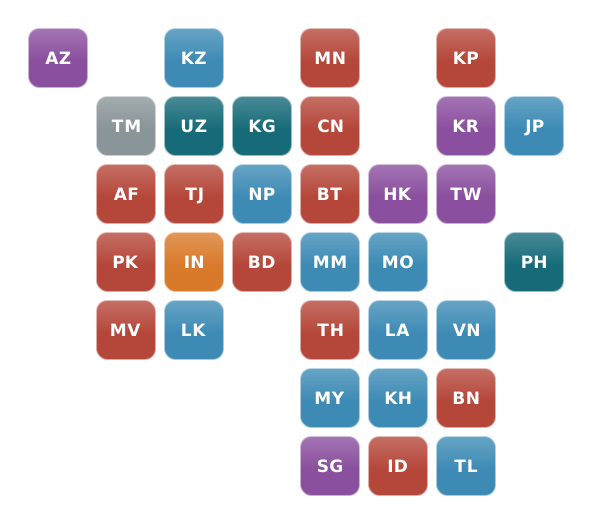
In short: Asia has no common approach to gambling. Of the 33 countries and territories covered here, twelve prohibit it outright, and the rest mostly allow state-run lotteries and betting, or casinos limited to visitors, resorts or designated zones, often closed to their own citizens. Licensed online gambling is confined to the Philippines, Uzbekistan and Kyrgyzstan (where only foreign nationals may play), while India banned online money games nationwide in 2025. Rules and penalties differ widely, so check the individual country guide before relying on any summary. For Gulf and Levant countries, see our separate Middle East and Gulf overview.
Key points
- Prohibition is the most common model. Afghanistan, Bangladesh, Bhutan, Brunei, China (mainland), Indonesia, the Maldives, Mongolia, North Korea, Pakistan, Tajikistan and Thailand license no private casinos, betting or online gambling, although several keep a state lottery or a narrow licensed exception.
- Only three jurisdictions license online gambling for players: the Philippines through PAGCOR, Uzbekistan through the National Agency of Perspective Projects (NAPP), and Kyrgyzstan, where only foreign nationals aged 21 or over may be customers.
- Hong Kong, Singapore, South Korea, Taiwan and Azerbaijan allow gambling only through state-run or designated operators, and online play is limited to those operators’ own products.
- Many land-based casino markets are aimed at visitors. Cambodia, Myanmar and Nepal bar their own citizens, Macau operates under six concessions running to 2032, and Japan’s only approved casino resort, in Osaka, is targeted to open in autumn 2030.
- India has no single national code. States regulate land-based gambling, while the Promotion and Regulation of Online Gaming Act, 2025 bans online money games nationwide; a constitutional challenge was pending before the Supreme Court as of 14 October 2026.
- As of October 2026, several measures were still pending, including Philippine bills for a total online ban, a Maldives Penal Code amendment sent to committee in January 2026, Nepal’s Integrated Tourism Bill and Bangladesh’s implementing rules.
- In most countries players, not only operators, can be penalised, and many authorities block gambling websites and freeze linked accounts.
Gambling models at a glance
- Licensed online markets (3)
- State-run lotteries, betting and tightly limited casinos (5)
- Casinos for visitors or in resorts, with no online licence (11)
- State-level rules with a national online money-game ban (1)
- Prohibition (12)
- No clear framework (1)
Licensed online markets 3
Online gambling is licensed nationally; in Kyrgyzstan for foreign players only.
State-run lotteries, betting and tightly limited casinos 5
Gambling only through state-run or designated operators, with few or no casinos.
Casinos for visitors or in resorts, with no online licence 11
Casinos in resorts or designated zones, often closed to citizens; no online licence.
State-level rules with a national online money-game ban 1
States set land-based rules; online money games banned nationwide since 2025.
Prohibition 12
Gambling is prohibited, apart from a state lottery or a narrow exception in some countries.
No clear framework 1
Gambling is licensable on paper, but no operator or specific law could be identified.
How gambling is regulated across Asia

The 33 jurisdictions covered here fall into six broad groups. A few have built licensing systems for online gambling, some limit gambling to state-run or designated operators, and many allow casinos only for visitors, in purpose-built resorts or in designated zones. One country combines state-level rules with a national online ban, a large group prohibits gambling entirely, and one has no clear framework in practice.
Licensed online markets
The Philippines licenses online casino games through the Philippine Amusement and Gaming Corporation (PAGCOR), which is both operator and regulator and operates under Presidential Decree No. 1869 (1983), as amended by Republic Act No. 9487 (2007). Players must be at least 21 and pass identity checks before depositing. Philippine offshore gaming operators (POGOs) were banned by Executive Order No. 74 from 31 December 2024 and by Republic Act No. 12312, signed on 23 October 2025.
Uzbekistan permits lotteries, internet games of chance and bookmaking from 1 January 2025 under Presidential Decree No. UP-68 of 19 April 2024, but only under a licence from the National Agency of Perspective Projects (NAPP) and only for players aged 18 or over. Gaming halls and casinos remain prohibited, and unlicensed organisation of gambling is a crime under Article 278 of the Criminal Code. Kyrgyzstan re-legalised six forms of gambling under Law No. 50 of 30 June 2022, with ten-year licences. Article 15 bars Kyrgyz citizens from being clients of gambling establishments, and foreign clients must be at least 21.
State-run lotteries, betting and tightly limited casinos
In Hong Kong, the Gambling Ordinance (Cap. 148) prohibits all gambling except social gambling, activities licensed under the Ordinance and betting authorised under the Betting Duty Ordinance (Cap. 108). The Hong Kong Jockey Club is the sole authorised operator of horse race betting, football betting and the Mark Six lottery, and no casino licence exists. Singapore consolidated its gambling statutes in the Gambling Control Act 2022 (Act 17 of 2022), administered by the Gambling Regulatory Authority (GRA). Singapore Pools is the only operator licensed to provide remote gambling, and two casinos operate.
South Korea makes gambling an offence under Articles 246 to 249 of the Criminal Act but permits six sectors created by special statutes and overseen by the National Gambling Control Commission (NGCC). Seventeen casinos admit foreigners only, and Kangwon Land, authorised by a 1995 special act now extended to 2045, is the only casino open to nationals. Taiwan limits lawful gambling to the Public Welfare Lottery and the Sports Lottery. Its Offshore Islands Development Act (2009) allows casinos on outlying islands after a local referendum, but no casino has been licensed.
Azerbaijan closed its casinos in 1998, and since 1 January 2022 Article 244-1 of the Criminal Code has made organising gambling games a crime. Lotteries are a state monopoly under Law No. 594-IIQ of 5 March 2004. A law approved in July 2025 permits casinos only on artificial land areas in the Caspian Sea, for players aged 21 and over; as of January 2026 no casino licence had been reported as issued.
Casinos for visitors or in resorts, with no online licence
In Macau, casino gaming is governed by Law 16/2001, substantially amended by Law 7/2022, and supervised by the Gaming Inspection and Coordination Bureau (DICJ). Six companies hold concessions from 1 January 2023 to 31 December 2032, and the minimum age for casino entry is 21. Cambodia licenses casinos for foreign customers only, under the Law on the Management of Commercial Gambling (promulgated 14 November 2020), through the Commercial Gambling Management Commission of Cambodia (CGMC). Laos treats gambling as a criminal offence unless the state authorises it (Article 141 of the Penal Code), and casinos operate under government investment concessions aimed at foreign visitors. Myanmar‘s Gambling Law 2019 defines a casino as a place where only foreigners may gamble.
Vietnam regulates casinos under Decree 03/2017/ND-CP, as amended by Decree 145/2024/ND-CP, and under Resolution 8/2025/NQ-CP of 26 November 2025 eligible Vietnamese citizens aged 21 or over may gamble at three named resorts. Nepal authorises casinos under the Tourism Act 1978 and the Casino Regulations 2082 BS (2025); Nepali citizens are barred. Sri Lanka moved to a single regulator with the Gambling Regulatory Authority Act, No. 17 of 2025, in operation since 1 December 2025; online gambling regulations had not been issued by October 2026. Malaysia prohibits gambling except where licensed or exempted under federal law, and Resorts World Genting holds the only casino licence, first granted in 1969.
Japan criminalises gambling under Articles 185 to 187 of the Penal Code except for products created by special statutes: public-sports betting, local-government lotteries and licensed integrated resort casinos. Osaka’s is the only resort approved so far. Kazakhstan permits casinos only in government-designated zones under the Law “On Gambling Business” of 12 January 2007; new zones from 11 September 2026 admit only foreigners. Timor-Leste regulates social and entertainment games under Decree-Law No. 6/2016, which excludes casinos from its scope, and supervises them through the General Gaming Inspectorate (IGJ).
State-level rules with a national online money-game ban
India has no single national gambling code. Gambling is primarily a state subject, and land-based casinos operate lawfully only under specific state authorisation, notably in Goa and Sikkim. The Promotion and Regulation of Online Gaming Act, 2025 (assent 22 August 2025) bans offering, advertising and facilitating payments for online money games, with prison terms of up to three years for offering them. The Online Gaming Rules, 2026 took effect on 1 May 2026 and set up the Online Gaming Authority of India. As of 14 October 2026 a consolidated constitutional challenge was pending before the Supreme Court.
Prohibition
In Afghanistan, Article 22 of the Law on the Propagation of Virtue and Prevention of Vice (2024) requires inspectors to prevent gambling, and the de facto authorities’ Penal Code for Courts, circulated in early 2026, provides four months’ imprisonment for a gambler. Bangladesh replaced the Public Gambling Act, 1867 with the Gambling Prevention Act, 2026, in force from 1 July 2026; taking part is itself an offence. Bhutan prohibits gambling in almost all its forms under sections 393 to 395 of its Penal Code 2004, and the government-owned Bhutan Lottery is the only lawful product. Brunei relies on the Common Gaming Houses Act (Chapter 28), which contains no licensing regime; the only route to lawful gaming is a written exemption order by the Sultan in Council.
In China, gambling on the mainland is prohibited except for two state lotteries, and Article 303 of the Criminal Law punishes gambling for profit and operating a casino. Macau and Hong Kong have their own gambling laws. Indonesia prohibits all gambling under a new Criminal Code (Law No. 1 of 2023) that took effect on 2 January 2026, and in Aceh gambling is also an offence under Sharia law. The Maldives licenses no gambling; according to press reports the Penal Code contains no gambling offence, and an amendment accepted at first reading on 5 January 2026 was sent to committee. Mongolia has prohibited paid prediction games, betting games and online gambling since 1 July 2025.
North Korea has no identifiable gambling regulator or licensing law, and its 2009 Criminal Law translation punishes gambling with short-term labour. Pakistan punishes gaming-houses and gaming under the Prevention of Gambling Act 1977 and has no licensing route. Tajikistan has treated casino operations as illegal since Presidential Decree No. 328 of 20 July 2000, but totalisators, bookmakers’ offices and lotto games are lawful under a licence. Thailand applies the Gambling Act of 1935, which prohibits gambling other than the government lottery and horse-race betting. The Entertainment Complex Bill, proposing five licensed casino resorts, was withdrawn in July 2025.
No clear framework
Turkmenistan lists gambling as licensable under Law No. 202-III of 25 June 2008 on licensing. The Eurasian Group on Combating Money Laundering (EAG) stated in 2023 that no casinos are operating, and the guide could not identify a specific legal act banning casinos. No online operator is licensed.
Online gambling
Licensed online gambling for players exists in only three places. In the Philippines it is available through PAGCOR licensees, and in Uzbekistan through NAPP licensees, which are required to host their servers in the country. In Kyrgyzstan online and electronic casinos are lawful under the 2022 law only when licensed and only for foreign nationals aged 21 or over; two online casino licences were reported in November 2023, neither yet operating at that time. Timor-Leste, by contrast, revoked all online gambling and betting licences in October 2025.
Elsewhere, lawful remote play is confined to designated operators and their own products. In Hong Kong the only lawful remote betting is on Hong Kong Jockey Club products through its accounts, and in Singapore only Singapore Pools may provide remote gambling. South Korea’s Betman is the only lawful online sports betting service, and Taiwan’s sports lottery statute expressly permits internet sales by the issuer. Azerbaijan allows online play only through state-backed lotteries and sports betting, with online casinos expressly excluded. In Kazakhstan, online casinos are prohibited, while licensed bookmakers and totalisators may accept remote bets through the state-run Unified Accounting System, which began a pilot on 11 September 2025. Bhutan’s state lottery runs its own online games, and on the mainland of China internet lottery sales have required Ministry of Finance approval since a multi-ministry notice of April 2015.
Players are not exempt in most countries. Singapore fines participation in unlicensed remote gambling by up to S$10,000, up to six months’ imprisonment, or both. Online casino gambling from Japan is illegal for players as well as operators: 279 people were arrested in online gambling cases in 2024, 162 of them players, and the total rose to 317 in 2025. Other penalties are severe: Indonesia punishes distributing or making accessible electronic gambling content with up to ten years’ imprisonment and a fine of up to Rp10 billion, and Macau’s Law 20/2024 punishes unauthorised online gambling operations with one to eight years’ imprisonment. In Malaysia, the Court of Appeal held in October 2023 that online gambling is an offence under the Common Gaming Houses Act 1953. In Thailand online gambling is illegal for organisers and participants alike.
Website blocking and payment controls are widespread. India reported about 8,400 betting and gambling websites and apps blocked by March 2026, and Nepal’s telecoms authority reported 223,568 blocked sites and apps by 24 July 2026. Indonesia’s Ministry of Communication and Digital reported about 3.45 million gambling sites and items of content blocked since October 2024 as of May 2026, while Pakistan’s telecoms authority cited 260 blocked sites and apps by September 2025. Sri Lanka’s telecoms regulator was reported to have ordered 24 unlicensed gambling websites blocked in August 2026, and the Maldives has blocked online betting sites on police instructions since July 2024. Singapore’s police have been responsible for blocking unlawful gambling websites, advertisements and payment transactions since 1 January 2025. In June 2026 Bangladesh’s Finance Minister reported that about 55,000 mobile financial service accounts linked to online gambling and digital hundi had been suspended or frozen.
Several guides link illegal gambling to online scam operations. Cambodia, Laos, Myanmar and Timor-Leste have all carried out raids or closures since 2025, and Cambodia’s authorities suspended casinos on suspicion that scams were run from licensed premises.
Taxes and player protection
Gaming taxes vary widely and, in most prohibition countries, do not exist. Macau concessionaires pay a 35% special gaming tax on gross gaming revenue (GGR) plus contributions of 2% and 3%, about 40% in total. Cambodian casinos pay 7% of GGR on mass-market gaming and 4% on VIP gaming, and since 1 January 2025 also 10% VAT on GGR. Singapore taxes casino GGR in tiers, with 8% and 12% for premium play and 18% and 22% for mass-market play. Vietnam has applied special consumption tax of 35% to casinos and electronic prize-winning games, and 30% to betting, since 1 January 2026. Malaysia raised casino duty to 35% of GGR and the annual casino licence fee to RM150 million in Budget 2019. Japan’s integrated resort casinos will pay a 30% levy on GGR. Uzbekistan charges a 4% turnover tax on revenue net of winnings, and Hong Kong charges betting duty on the operator at 72.5% to 75% of net stake receipts on horse racing, 50% on football betting and 25% on lottery proceeds. Kazakhstan and Kyrgyzstan tax gaming units at fixed amounts rather than as a share of GGR.
Other jurisdictions tax visitors or winnings. Sri Lanka charges a casino entrance levy of US$100 per entry to its citizens from 1 January 2026, and raised its gross collection levy on betting and gaming from 15% to 18% on the same date. India’s GST on online money gaming, casinos, betting, horse racing and lotteries rose from 28% to 40% on 22 September 2025. In the Philippines, PAGCOR pays a 5% franchise tax on gaming revenue, and jackpot winnings face a final withholding tax of 20% for citizens and resident aliens. Bhutan has applied 20% withholding tax on gambling winnings since 1 January 2026, Mongolia taxes lottery winnings at 40%, and China taxes lottery winnings as occasional income at 20%, with winnings of up to 10,000 yuan from a single purchase exempt. In Uzbekistan, winnings from licensed games are exempt from personal income tax, and Brunei has no personal income tax and so no tax on winnings.
Player protection is uneven. Macau’s DICJ administers self-exclusion and family-requested exclusion orders, and the Social Welfare Bureau runs a 24-hour counselling hotline. Hong Kong’s Ping Wo Fund finances four counselling centres and a hotline, and South Korea’s Korea Problem Gambling Agency runs the 1336 helpline. The Philippines keeps a National Database of Restricted Persons for self-exclusion and family exclusion, and Kazakhstan offers self-exclusion for six months to ten years, while Uzbekistan’s register allows self-exclusion for six months to five years. By contrast, the guides for Bangladesh, Brunei, Mongolia, Tajikistan and Turkmenistan found no national self-exclusion scheme or dedicated gambling helpline.
Recent developments (2025–2026)
- 1 January 2025, Uzbekistan and Cambodia: Licensed lotteries, internet games of chance and bookmaking became permitted in Uzbekistan under Decree No. UP-68, and Cambodia began charging 10% VAT on casino GGR.
- 1 January 2025, Singapore: The Singapore Police Force took over responsibility for blocking unlawful gambling websites, advertisements and payment transactions.
- July 2025, Thailand: The Entertainment Complex Bill, proposing five licensed casino resorts, was withdrawn.
- 22 August 2025, India: The Promotion and Regulation of Online Gaming Act, 2025 received assent, banning online money games nationwide, and GST on gaming rose to 40% from 22 September 2025.
- 11 September 2025, Kazakhstan: The state-run Unified Accounting System for remote sports bets began its pilot.
- 25 September 2025, Japan: The amended Basic Act on Countermeasures against Gambling Addiction began to prohibit operating illegal online casino sites and directing people to them.
- October 2025, Timor-Leste: Government Resolution No. 54/2025 revoked all online gambling and betting licences and prohibited new ones.
- 23 October 2025, Philippines: Republic Act No. 12312 banning POGOs was signed.
- 26 November 2025, Vietnam: Government Resolution 8/2025/NQ-CP widened access to casinos for eligible Vietnamese citizens.
- 1 December 2025, Sri Lanka: The Gambling Regulatory Authority Act, No. 17 of 2025 came into operation.
- 31 December 2025, Macau: The deadline for satellite casinos to close or be taken over expired.
- 1 January 2026: The revised Public Security Administration Punishments Law took effect in China, Bhutan began a 20% withholding tax on gambling winnings and Vietnam began applying its new special consumption tax rates. Indonesia’s new Criminal Code followed on 2 January 2026.
- 5 January 2026, Maldives: The People’s Majlis accepted a Penal Code amendment on gambling at first reading and sent it to committee.
- 14 April 2026, Hong Kong: The government suspended the launch of basketball betting, citing the growth of prediction markets.
- 1 May 2026, India: The Promotion and Regulation of Online Gaming Rules, 2026 took effect, setting up the Online Gaming Authority of India.
- 1 July 2026, Bangladesh: The Gambling Prevention Act, 2026 came into force; implementing rules had not been published by 7 October 2026.
- July 2026, Uzbekistan: According to trade press, NAPP issued its first four licences, to two companies.
- 11 September 2026, Kazakhstan: New gambling zones admitting only foreigners took effect.
- September to October 2026, Cambodia: The Prime Minister described the number of casinos as excessive on 16 September 2026, and online gambling streamed from casinos was ordered suspended from early October 2026.
- October 2026, Philippines: Bills for a total online gambling ban filed in 2025 had not been enacted, and PAGCOR continued to license online gaming.
Country-by-country summary
| Country | Legal model | Online gambling | Regulator |
|---|---|---|---|
 Afghanistan | Prohibition | Prohibited | None; morality inspectors, police and courts enforce |
 Azerbaijan | State lotteries and sports betting; casinos only in the Caspian Sea (2025 law) | State-backed channels only; online casinos banned | No single regulator; Ministry of Economy |
 Bangladesh | Prohibition (Gambling Prevention Act, 2026) | Prohibited | None; Ministry of Home Affairs and BTRC enforce |
 Bhutan | Prohibition; state lottery only | Prohibited (state lottery’s own games aside) | None; Department of Law and Order |
 Brunei | Prohibition | Prohibited | None; Royal Brunei Police Force |
 Cambodia | Casinos for foreigners only | Not licensed (illegal from end of 2019) | CGMC |
 China (mainland) | Prohibition; two state lotteries | Prohibited | None dedicated; Ministry of Finance (lotteries) |
 Hong Kong | Single authorised operator (Hong Kong Jockey Club) | Operator’s own products only | Home and Youth Affairs Bureau; Betting and Lotteries Commission |
 India | State law plus national online ban | Online money games banned | Online Gaming Authority of India; no national gambling regulator |
 Indonesia | Prohibition | Prohibited | None; police and Komdigi (blocking) |
 Japan | Public-sports betting, local lotteries; resort casinos planned | Not authorised; illegal | Casino Regulatory Commission; National Police Agency |
 Kazakhstan | Casinos in designated zones | Online casinos banned; licensed remote sports bets | Committee for the Regulation of Gambling Business and Lotteries |
 Kyrgyzstan | Licensed gambling for foreign nationals only | Licensed (foreign nationals aged 21+) | Financial Market Regulation and Supervision Service |
 Laos | Casino concessions | No authorised operator found | None single; concessions, Ministry of Finance (lotteries) |
 Macau | Six casino concessions | No licence; unauthorised online gambling an offence | DICJ |
 Malaysia | Single casino licence; limited licensed exceptions | Not licensed; an offence | None independent; Minister of Finance licenses |
 Maldives | Nothing licensed; Penal Code amendment pending | Not licensed; sites blocked since July 2024 | None; CAM blocks sites |
 Mongolia | Prohibition (since 1 July 2025) | Prohibited | None; National Police Agency |
 Myanmar | Casinos for foreigners only | No operator licensed | None dedicated; Union Government authorises casinos |
 Nepal | Casinos for foreign passport holders | Not licensed; prohibited by directive | Department of Tourism; NTA blocks sites |
 North Korea | Prohibition under Criminal Law | Not authorised | None identified |
 Pakistan | Prohibition (1977 Act) | Prohibited; sites blocked | None; provincial police, PTA blocks sites |
 Philippines | Licensed; operator and regulator combined | Licensed (PAGCOR) | PAGCOR |
 Singapore | Licensed casinos and a single remote operator | Singapore Pools only | Gambling Regulatory Authority |
 South Korea | Six statutory sectors | Betman only (sports betting) | National Gambling Control Commission |
 Sri Lanka | Licensed casinos and betting under 2025 Act | Licensable; regulations not issued | Gambling Regulatory Authority |
 Taiwan | Two state lotteries | Issuer’s internet lottery sales only | None single; Ministry of Finance, Ministry of Sports |
 Tajikistan | Casinos illegal; licensed betting and lotto | Online casino cannot be licensed | None independent; Ministry of Finance (lotteries) |
 Thailand | Prohibition except government lottery and horse racing | Illegal | None licenses private operators; Government Lottery Office |
 Timor-Leste | Gaming under Decree-Law 6/2016; casinos outside its scope | Licences revoked in 2025 | General Gaming Inspectorate (IGJ) |
 Turkmenistan | Licensable in law; no casinos operating | No operator licensed | None dedicated; Ministry of Finance and Economy licenses |
 Uzbekistan | Licensed online games and bookmaking; casinos prohibited | Licensed (NAPP) | NAPP |
 Vietnam | Casinos in resorts; citizens in pilots | Not licensed | None independent; Ministry of Finance |
For more guides, browse the full country directory.
Sources and further reading
Each country guide linked above lists its own primary sources.
- Home and Youth Affairs Bureau (Hong Kong), Policy Responsibilities: Gambling (accessed 6 October 2026).
- Gaming Inspection and Coordination Bureau (Macau), Law 16/2001: Legal framework for the operation of games of fortune in casinos (accessed 6 October 2026).
- Attorney-General’s Chambers (Singapore), Gambling Control Act 2022 (Act 17 of 2022) (accessed 5 October 2026).
- National Gambling Control Commission (South Korea), Gambling policies (accessed 6 October 2026).
- Ministry of Justice (Japan), Act on Development of Specified Integrated Resort Districts (Act No. 80 of 2018) (accessed 14 October 2026).
- Lawphil Project, Republic Act No. 12312: Anti-POGO Act of 2025 (2025).
- Government of Bangladesh, Gambling Prevention Act, 2026 (Act No. 98 of 2026) (accessed 7 October 2026).
- PRS Legislative Research, The Promotion and Regulation of Online Gaming Bill, 2025 (2025; accessed 5 October 2026).
- State Audit Board (BPK), Indonesia, Undang-Undang Nomor 1 Tahun 2023 tentang Kitab Undang-Undang Hukum Pidana (Criminal Code) (accessed 5 October 2026).
- Parliament of Sri Lanka, Gambling Regulatory Authority Act, No. 17 of 2025 (2025).
- President of the Republic of Uzbekistan, Decree No. UP-68 of 19.04.2024 on measures to improve the regulation of the organisation and conduct of lotteries and games based on risk (accessed 6 October 2026).
- Paragraph, Kazakhstan Law No. 219-III of 12 January 2007 “On Gambling Business”, consolidated text as of 25 August 2026 (accessed 6 October 2026).
- Legalinfo (Mongolia), Law on Permits and Notifications, consolidated text, Article 1.5.20 (accessed 6 October 2026).
- Attorney General’s Chambers (Brunei Darussalam), Laws of Brunei, Chapter 28: Common Gaming Houses (accessed 7 October 2026).
Last reviewed: 31 October 2026.