
In short: It depends on the island. A few Caribbean jurisdictions license online gambling, notably Curaçao, Antigua and Barbuda, the Dominican Republic and, since 2025, Nevis, while others such as the Cayman Islands, Cuba and Bermuda prohibit it and many more have no online framework at all. French and US territories follow the rules of Paris or Washington alongside local law, so check the individual country guide before relying on any general statement.
Key points
- The Caribbean has no common gambling law. The region mixes independent states, British Overseas Territories, autonomous countries of the Kingdom of the Netherlands, French overseas collectivities and US territories, each with its own legal starting point.
- Only a handful of jurisdictions run working online licensing regimes. Several of them, including Curaçao, Antigua and Barbuda and Nevis, issue licences mainly for operators serving customers abroad rather than local residents.
- Curaçao replaced its 1993 master-licence system with the National Ordinance on Games of Chance (LOK), in force since 24 December 2024, and a new regulator, the Curaçao Gaming Authority.
- Land-based casinos are often tied to hotels or resorts, and several jurisdictions (the Bahamas, Grenada, Saint Lucia, Turks and Caicos) restrict or bar local residents from casino play.
- Many smaller states rely on a state lottery and old or partly commenced statutes, with no regulator for online play and no national self-exclusion scheme.
- Anti-money laundering supervision, assessed by the Caribbean Financial Action Task Force (CFATF), is often the most developed part of the framework.
- 2025–2026 brought significant change: a new regulator and law in the Dominican Republic, remote gambling reform in Trinidad and Tobago, a new online regime in Nevis, and lottery debates in the Cayman Islands.
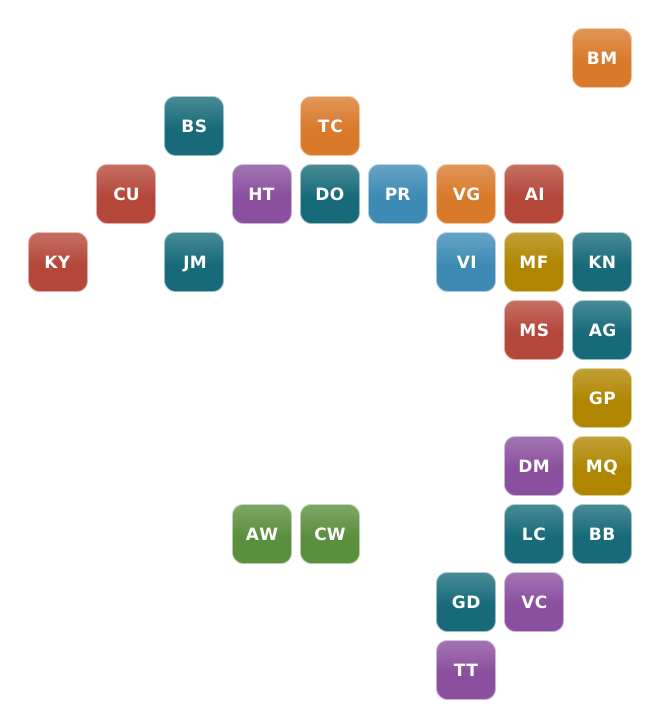
Gambling models at a glance
- Independent states with licensing regimes (8)
- State lotteries, mixed and informal models (4)
- Prohibition models (4)
- British Overseas Territories (3)
- Dutch Caribbean (2)
- French overseas territories (3)
- US territories (2)
Independent states with licensing regimes 8
Independent states that license casinos, betting or online operators.
State lotteries, mixed and informal models 4
State lotteries alongside licensed betting and informal or mixed arrangements.
Prohibition models 4
No lawful public gambling, or only narrow exceptions.
British Overseas Territories 3
UK gambling law does not extend here; each territory legislates for itself.
Dutch Caribbean 2
Autonomous countries within the Kingdom of the Netherlands, each with its own gambling rules.
US territories 2
Own statutes, with US federal laws such as the Wire Act also applying.
How gambling is regulated across the Caribbean

The region’s legal map largely follows its constitutional map. Independent states write their own gambling laws, often building on statutes inherited from the colonial period. Overseas territories and autonomous countries may legislate for themselves, follow the law of a metropolitan state, or combine the two.
Independent states with licensing regimes
The Dominican Republic has the region’s most extensive private market. Casinos, slot halls, lottery shops and sports betting shops are licensed, and online casino and betting licences have been available since April 2024 for operators using a .do domain. Law 86-26, promulgated on 2 October 2026, replaces the 1964 casino framework and creates a new regulator, the General Directorate of Games of Chance (DGJA). The state-owned Lotería Nacional operates alongside the private network.
The Bahamas runs a two-track system under the Gaming Act 2014: resort casinos serve visitors, while residents, who are barred from casinos, gamble through locally owned gaming houses that also offer online play to registered domestic customers. The Gaming Board for The Bahamas regulates both.
Jamaica licenses betting, gaming machines and lotteries through the Betting, Gaming and Lotteries Commission (BGLC), and casinos within integrated resorts through the Casino Gaming Commission. Antigua and Barbuda has licensed online gaming and wagering since 1994 under the Financial Services Regulatory Commission (FSRC), with land-based gambling under the Gambling Act 2016. Saint Kitts and Nevis licenses gaming federally under the Gaming Control Act 2021, with the FSRC as Gaming Commission, and Nevis has its own online regime under the Nevis Online Gaming Ordinance 2025.
Grenada combines the Casino Gaming Act 2014 and Gaming Act 2016 with a state-owned National Lotteries Authority (NLA). Saint Lucia uses a limited licensing model under the Gaming, Racing and Betting Act, with Cabinet making final decisions and casino licences tied to large hotels or employers. Barbados permits lottery, pool betting, bingo, club gaming and licensed machines, but bans banking games and has no authorised land-based casinos.
State lotteries, mixed and informal models
In Trinidad and Tobago the national lottery is a state monopoly run by the National Lotteries Control Board (NLCB), betting is licensed, and casino-style gaming takes place in registered private members’ clubs. The Gambling (Gaming and Betting) Control Act 2021 created a Gambling Control Commission, but most of its licensing powers have not yet been proclaimed. Saint Vincent and the Grenadines concentrates lawful commercial gambling in its National Lotteries Authority, and Dominica relies on its National Lotteries Commission, with internet gaming licences historically issued case by case by government. In Haiti the state lottery (LEH) claims authority over all games of chance, but much of the dominant borlette numbers trade operates informally.
Prohibition models
Cuba offers no lawful public gambling: the Penal Code of 2022 treats organising games of chance as a criminal offence, although the informal bolita numbers game remains widespread. The Cayman Islands prohibits almost all gambling under the Gambling Act (2016 Revision), with exceptions for shipboard casinos in international waters and charitable raffles. Anguilla prohibits casinos and allows only lotteries approved case by case by the Governor in Council, and Montserrat has no gambling statute or regulator, relying on a general Penal Code provision.
British Overseas Territories
UK gambling legislation does not extend to the British territories, which legislate for themselves. Their approaches differ widely. Besides Cayman, Anguilla and Montserrat, the British Virgin Islands passed the Gaming and Betting Control Act 2020 to replace a criminal prohibition, but the Commission it creates has not been formed and no licences have been issued. The Turks and Caicos Islands license casinos, gaming machines and a national lottery under older ordinances while the Gaming Control Ordinance 2018 is brought into force in stages. Bermuda lies in the North Atlantic rather than the Caribbean but is commonly grouped with the British Caribbean territories; it legalised casino gaming in 2014, though no casino has opened, and its Gaming Commission mainly licenses cruise ship casinos.
Dutch Caribbean
Curaçao, Aruba and Sint Maarten are autonomous countries within the Kingdom of the Netherlands, and each sets its own gambling rules; Dutch licensing does not apply there. Aruba licenses casinos at designated resort hotels on a discretionary basis through the Minister of Justice and has no independent regulator yet. Curaçao’s role as an online licensing centre is covered below. Dutch Sint Maarten, covered in the Saint Martin guide, licenses casinos under its own rules and is preparing a gaming authority.
French overseas territories
In Guadeloupe, Martinique and French Saint-Martin, national French gambling law applies. Gambling is prohibited in principle with statutory exceptions: FDJ lotteries, PMU horse-race betting, casinos authorised by the Interior Ministry in qualifying communes, and licensed online sports betting, horse-race betting and poker. Guadeloupe and Martinique each have two casinos; French Saint-Martin has none. The Autorité nationale des jeux (ANJ) regulates the online market.
US territories
Puerto Rico and the US Virgin Islands regulate gambling under their own statutes, with federal laws such as the Wire Act and the Unlawful Internet Gambling Enforcement Act (UIGEA) applying alongside. Puerto Rico licenses hotel casinos, route machines, lotteries and, since Act 81-2019, sports betting through the Puerto Rico Gaming Commission. The US Virgin Islands licenses casinos in a designated zone on St Croix through the Virgin Islands Casino Control Commission (VICCC), while the Virgin Islands Lottery runs lottery games and video lottery terminals.
Online gambling
Online gambling in the Caribbean falls into four broad groups.
Export-oriented licensing. Curaçao, Antigua and Barbuda and Nevis license operators that mainly serve players in other countries. Antigua’s regime dates from 1994, and the country’s long-running World Trade Organization dispute with the United States (DS285) over cross-border gambling services remained unresolved in January 2025. Nevis’s regulator, the Nevis Online Gaming Authority (NOGA), listed 11 licences in October 2026 and requires licensees to block players located in Saint Kitts and Nevis. Whether a licensee may lawfully serve a given foreign market depends on that market’s own law.
Curaçao’s 2024 reform. Until 2024, a small number of master-licence holders issued sub-licences to large numbers of websites under a 1993 ordinance, with limited direct state supervision. The LOK abolished master licences and introduced direct business-to-consumer and business-to-business licences issued by the Curaçao Gaming Authority (CGA), which replaced the Gaming Control Board on 24 December 2024. Licensees pay fixed annual fees rather than a gross gaming revenue tax, must offer responsible gambling tools and alternative dispute resolution, and are subject to AML regulations issued in January 2025. The guide notes reported capacity pressures at the regulator, a move of ministerial responsibility to the Minister of Justice in August 2025, and a postponement of the local substance requirement to 1 April 2027. A Curaçao licence does not make a service lawful in countries that require their own licence.
Domestic online licensing. The Dominican Republic licenses online casinos and betting for operators using a .do domain; Law 86-26 treats operating outside this framework as a serious infringement. The Bahamas allows residents to play online only through licensed gaming houses, with face-to-face account opening. Puerto Rico licenses online sports, eSports and fantasy betting for people physically on the island but has no category for online casino games. Grenada reserves e-gaming to the state-owned NLA. In the French territories, online sports betting, horse-race betting and poker are licensed by the ANJ, while online casino games are not authorised anywhere in France.
No working online framework, or prohibition. Most other jurisdictions have no online licence category. Jamaica has authorised three local licensees to offer online gaming pending new legislation. Trinidad and Tobago has begun to activate remote gambling provisions but had issued no licence by October 2026. The BVI and Turks and Caicos have statutes that cover internet gaming but have not commenced licensing, and the US Virgin Islands’ 2001 Internet Gaming Act has never been fully implemented. Bermuda goes further: since August 2021 offering unlicensed remote gaming to people in Bermuda, and placing an unlicensed wager, are both offences. The Cayman Islands and Cuba treat commercial gambling as criminal.
Blocking and payments. Outside the French territories, where the ANJ can order the blocking of illegal sites, the country guides found little evidence of website blocking, blocklists or payment restrictions in the region, and few or no reported prosecutions of individual players. Enforcement generally targets operators and land-based illegal gambling. Players using unlicensed sites usually have no local regulator to complain to.
Regional cooperation. There is no regional gambling regulator. The CFATF, the FATF-style regional body, evaluates casinos and online gaming as part of its mutual evaluations, and in September 2026 the Financial Action Task Force published new gambling risk indicators, including on illegal offshore online operators. Haiti remained on the FATF increased-monitoring list after the October 2026 plenary. In the Dutch Caribbean, Dutch officials and the Netherlands Gambling Authority have supported reform in Curaçao, Aruba and Sint Maarten, and Aruba plans a new gaming authority, the Kansspelautoriteit Aruba.
Taxes and player protection
Tax models vary as much as the legal ones. Several jurisdictions tax operators on gross revenue or gross profit: Jamaica charges 10% on casino gross profit, Saint Lucia 8% of gaming revenue, the US Virgin Islands up to 12% of casino gross revenue, and Turks and Caicos 30% of adjusted gross receipts on gaming machines from 1 October 2025. The Dominican Republic taxes online gaming at 10% of monthly gross sales, and casinos in the French territories pay a progressive state levy plus a communal levy. Curaçao instead charges fixed licence fees. The Cayman Islands, Montserrat and Cuba levy no gambling taxes because no lawful commercial sector exists.
Taxes on winnings are less common. Grenada withholds 15% on prizes above EC$10,000, and the Dominican Republic withholds 25% on lottery prizes and 15% on slot winnings. Jurisdictions without personal income tax, such as the Cayman Islands, Bermuda, Turks and Caicos and Saint Kitts and Nevis, do not tax winnings as income, and occasional players in the French territories are generally not taxed on winnings.
Player protection is uneven. National self-exclusion schemes operate in the French territories through the ANJ, in the Dominican Republic under Resolution 184-2026, and in Puerto Rico, which joined the US National Voluntary Self-Exclusion Program (NVSEP) in June 2026. The US Virgin Islands and Turks and Caicos run casino exclusion programmes, Bermuda has had a problem gambling helpline since March 2023, and Curaçao requires online licensees to offer self-exclusion and deposit limits. Elsewhere, the country guides frequently found no national self-exclusion register or gambling helpline. Minimum ages are generally 18, though Saint Kitts and Nevis sets 21 for casinos and Trinidad and Tobago’s Parliament passed a bill in 2026 to raise the age to 25, with assent not recorded by mid-October. Restrictions on residents entering casinos are a common protective measure in tourism-oriented jurisdictions.
Recent developments (2025–2026)
- 30 April 2025: A non-binding referendum in the Cayman Islands returned 51.24% in favour of a national lottery; the question was referred to the Law Reform Commission, whose final report is expected in January 2027.
- 1 July 2025: Nevis’s online gaming regulations took effect and NOGA opened applications; NOGA’s register listed 11 licences by 8 October 2026.
- 23 January 2026: Curaçao postponed the LOK’s local substance requirement to 1 April 2027; in September 2026 the CGA disclosed unauthorised access to its online gaming portal.
- April 2026: Jamaica’s Senate approved the Casino Gaming (General) Regulations, 2025, following House approval in February.
- June 2026: Puerto Rico joined the NVSEP self-exclusion register, and Act 108-2026 restricted how operators may use player data.
- 6 August 2026: Dominica’s 2026–2027 Budget Address announced an online gaming industry and a new Gaming Authority; no bill had been located by mid-October.
- 15 September – 2 October 2026: Trinidad and Tobago proclaimed section 76 of the 2021 Act and Parliament approved the Remote Gambling Order, 2026, with full implementation targeted for 1 January 2027.
- 2 October 2026: The Dominican Republic promulgated Law 86-26, creating the DGJA; implementing regulations are due within 90 days.
Country-by-country summary
| Country | Legal model | Online gambling | Regulator |
|---|---|---|---|
 Anguilla | Prohibition; lottery permits | Not licensed (no framework) | Governor in Council |
 Antigua and Barbuda | Licensing | Licensed (mainly export) | FSRC |
 Aruba | Discretionary hotel-casino licences | See guide | Minister of Justice (no regulator yet) |
 Bahamas | Licensing; residents barred from casinos | Licensed (residents via gaming houses) | Gaming Board for The Bahamas |
 Barbados | Restricted licensing; no casinos | Not licensed (no framework) | Betting and Gaming Committee |
 Bermuda (North Atlantic) | Restricted licensing | Prohibited (unlicensed remote gaming) | Bermuda Gaming Commission |
 British Virgin Islands | Licensing Act not yet operational | Not licensed (no framework) | Commission not yet formed |
 Cayman Islands | Prohibition | Prohibited | None (police enforcement) |
 Cuba | Prohibition | Prohibited | None |
 Curaçao | Licensing (LOK 2024) | Licensed (mainly export) | Curaçao Gaming Authority |
 Dominica | State lottery; ad hoc licences | See guide (reform announced) | National Lotteries Commission |
 Dominican Republic | Licensing; state lottery | Licensed (.do domain) | DGJA (Law 86-26) |
 Grenada | Licensing; state lottery | State operator only (NLA) | Minister of Finance; Gaming Commission |
 Guadeloupe | French law | Follows French law (no online casinos) | ANJ; Interior Ministry |
 Haiti | State lottery claim; largely informal | Not licensed (no framework) | LEH |
 Jamaica | Licensing | Not licensed (no framework); interim local authorisations | BGLC; Casino Gaming Commission |
 Martinique | French law | Follows French law (no online casinos) | ANJ; Interior Ministry |
 Montserrat | Default prohibition | Not licensed (no framework) | None |
 Puerto Rico | US territory; sector licensing | Betting only (on-island) | Puerto Rico Gaming Commission |
 Saint Kitts and Nevis | Licensing (federal and Nevis) | Licensed (Nevis, export only) | FSRC; NOGA |
 Saint Lucia | Limited licensing | Not licensed (no framework); remote betting provided for | Gaming, Racing and Betting Authority |
 Saint Martin | French law; Sint Maarten separate | Follows French law (French side) | ANJ; Sint Maarten government |
 Saint Vincent and the Grenadines | State lottery | Not licensed (no framework) | NLA (operator); FIU (AML) |
 Trinidad and Tobago | Mixed; state lottery, clubs | Not licensed (no framework); reform under way | NLCB; Gambling Control Commission |
 Turks and Caicos Islands | Licensing of set products | Not licensed (no framework); 2018 Part III not commenced | Gaming Control Commission |
 US Virgin Islands | US territory; casino zone licensing | Prohibited without licence; none issued | VICCC |
Sources and further reading
Each country guide linked above lists its own primary sources.
- Financial Action Task Force, FATF warns of emerging risks in gaming and gambling and publishes new risk indicators (2026; accessed 14 October 2026).
- Securities Commission of The Bahamas, Financial Action Task Force Public Statement on list of Jurisdictions under Increased Monitoring June 2026 (2026; accessed 14 October 2026).
- Financial Action Task Force, Jurisdictions under Increased Monitoring – October 2026 (30 October 2026).
- Caribbean Financial Action Task Force, Mutual Evaluation of Saint Lucia: 4th Follow-Up Report (2024; accessed 14 October 2026).
- Turks and Caicos Islands Financial Services Commission, The 4th Round Mutual Evaluation of the Turks and Caicos Islands undertaken by the Caribbean Financial Action Task Force (2017; accessed 14 October 2026).
- Office of the United States Trade Representative, Measures Affecting the Cross-Border Supply of Gambling and Betting Services (n.d.; accessed 14 October 2026).
- Curaçao Gaming Authority, Online Gaming (n.d.; accessed 14 October 2026).
- Curaçao Chronicle, Dutch Justice Ministry and Gaming Authority discuss gambling reforms in Curaçao, Aruba and Sint Maarten (2025; accessed 14 October 2026).
For other jurisdictions, see the country directory.
Last reviewed: 1 November 2026.