In short: It depends on the member state. There is no single EU gambling licence: each of the 27 countries sets its own rules, and most now license private online operators, while a few keep online gambling as a state monopoly or allow only betting. A licence from one member state does not make an operator lawful in another, so check the country guide before relying on any site.
Key points
- The EU has no harmonising gambling directive. Each member state chooses its own model, within the limits set by the Treaty freedoms and the case law of the Court of Justice of the EU (CJEU).
- Most member states run national licensing systems for online casino games and betting, among them Spain, Sweden, the Netherlands, Denmark and Italy.
- Some states license only betting (and in France poker) online and prohibit online casino games, for example France and Cyprus.
- Online casino games are a state monopoly in Austria and Poland. Finland keeps its monopoly until 30 June 2027 and opens a licensing system on 1 July 2027.
- Blocking lists of unlicensed websites are widespread, and many states also oblige payment providers to refuse transactions with blacklisted operators.
- Most states run a national self-exclusion register that covers all licensed online operators. Advertising rules range from near-total bans (Italy, Belgium) to general duties of moderation (Sweden).
- In 2026 the CJEU confirmed, in Case C-440/23, that EU law does not preclude a national ban on online casino games.
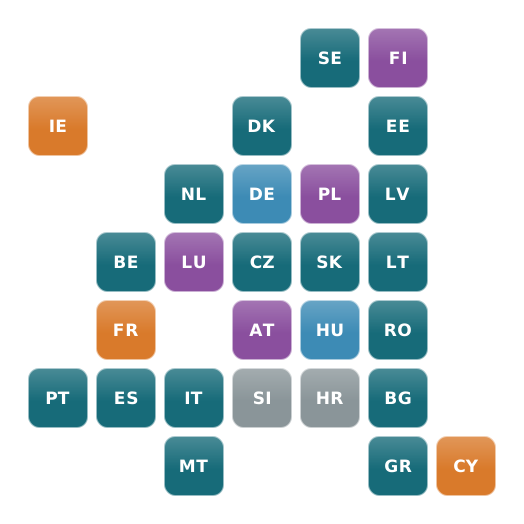
EU gambling models at a glance
- Open national licensing (16)
- Mixed and federal systems (2)
- Betting-only online markets (3)
- State monopolies and prohibition-based systems (4)
- Frameworks that are unclear or still developing (2)
Open national licensing 16
A national licence open to any company that meets the conditions, usually covering online casino games and betting. Lotteries mostly stay with the state.
Mixed and federal systems 2
Different rules for different games or regions: national and state-level rules in Germany, and monopoly, concessions and licences in Hungary.
Betting-only online markets 3
Online betting is licensed, but online casino games are prohibited or not yet licensed.
State monopolies and prohibition-based systems 4
Online casino games are available lawfully only through a state-owned or single concession operator.
How gambling is regulated across the European Union

Member states fall into a few broad groups, although many combine features, such as a licensed online market alongside a state lottery.
Open national licensing
The most common model is a national licence, open to any company that meets the statutory conditions, covering online casino games and betting. Lotteries usually stay with a state or state-linked operator. Spain licenses online gambling at state level under Law 13/2011, with no cap on licensees, while its regions regulate land-based venues. Sweden has licensed online casino, betting and bingo since 1 January 2019 and reserves lotteries and value machines to the state operator Svenska Spel. Denmark opened online casino and betting to licensed competition under its 2010 Gambling Act, with lotteries reserved. The Netherlands licenses online casino, betting and poker under the Remote Gambling Act, while land-based casino games and the large lotteries stay with state-linked operators.
The same broad model applies in Estonia, Latvia, Lithuania, Bulgaria, Romania, Slovakia, the Czech Republic, Greece and Portugal. In each, lotteries are wholly or partly reserved to the state or a public-interest body (in Portugal, the Santa Casa da Misericórdia de Lisboa; in Slovakia, the state company TIPOS). Malta also uses open licensing, but its Gaming Act covers services supplied from Malta to players abroad as well as within Malta, which makes it a hub for operators serving other markets.
Belgium is described by its regulator as a closed licensing system: online licences are add-ons (“plus” licences) to land-based casino, arcade or betting licences, and the minimum age has been 21 since 1 September 2024. Italy treats gambling as a state reserve run through concessions awarded by tender, rather than licences available at any time.
Mixed and federal systems
Germany regulates gambling mainly through the 2021 Interstate Treaty among its 16 states. The joint authority (GGL) licenses online sports betting, virtual slots and poker nationwide, while online casino table games are left to each state: six use a state monopoly, Schleswig-Holstein has awarded concessions, North Rhine-Westphalia provides for them, and the rest have no framework yet. Hungary keeps lotteries and most betting as a state monopoly but opened remote betting to licensed Hungarian and EEA operators on 1 January 2023; online casino games may be offered only by holders of a land-based casino concession.
Betting-only online markets
France starts from a general prohibition with statutory exceptions. Since 2010 it has licensed online sports betting, horse-race betting and poker, but online casino games remain prohibited and exclusive rights cover lotteries and pool horse-race betting. Cyprus licenses only online sports and event betting; online casino games, poker and betting exchanges cannot be licensed. Ireland is moving from older statutes to a single regime under the Gambling Regulation Act 2024: betting licences opened in February 2026, while gaming (including online casino) and lottery licensing are due in later phases.
State monopolies and prohibition-based systems
Austria runs a federal monopoly under its Gambling Act. Online casino-style games count as “electronic lotteries” and are available lawfully only through the single lottery concession holder; a reform draft was notified to the Commission on 4 August 2026. Poland reserves online casino games to the state-owned Totalizator Sportowy but licenses private online betting. Finland reserves gambling to the state company Veikkaus until 30 June 2027; from 1 July 2027 its Gambling Act (10/2026) opens online casino games and betting to licensed operators. Luxembourg starts from a general ban with exceptions: the Loterie Nationale offers lotteries and online sports betting, there is one land-based casino, and there is no licensing route for private online operators.
Frameworks that are unclear or still developing
The guides for Croatia and Slovenia describe older or incomplete frameworks. Croatia’s Games of Chance Act (2009, amended in 2025) requires Croatian authorisation for online gambling, with the state organisation Hrvatska Lutrija controlling several game types. Slovenia licenses land-based casinos and keeps the national lottery in state hands, but the guide could not confirm how its planned online licensing has been implemented.
EU law and gambling
There is no sector-specific EU legislation on gambling services, and no harmonising directive. The European Commission states that member states organise their gambling services autonomously, provided they respect the fundamental freedoms of the Treaty on the Functioning of the European Union (TFEU) as interpreted by the CJEU (European Commission). Gambling is also excluded from the scope of the Services Directive (2006/123/EC) and the e-Commerce Directive (2000/31/EC).
The key provision is Article 56 TFEU on the freedom to provide services. The CJEU has accepted that national restrictions on cross-border gambling can be justified by public-interest objectives such as consumer protection, the fight against addiction, and the prevention of fraud and crime, but only if they are suitable, proportionate and pursued in a consistent and systematic way. Member states are not obliged to recognise licences granted in another member state. The Commission’s case-law page lists the leading judgments, including Cases C-243/01 (2003), C-338/04 and others (2007), C-42/07 (2009), C-49/16 (2017) and C-3/17 (2018) (European Commission). Cases C-49/16 and C-3/17 both concerned Hungary’s licensing rules. More recently, the Court held in C-440/23 (16 April 2026) that EU law does not preclude national bans on online casino games, and that it does not preclude players’ claims for restitution of stakes.
In July 2014 the Commission adopted Recommendation 2014/478/EU on principles for the protection of consumers and players of online gambling services and the prevention of minors from gambling. It is not binding, but it sets out principles on registration and identity checks, player accounts, deposit limits, self-exclusion, and responsible advertising and sponsorship (EUR-Lex). On 7 December 2017 the Commission decided to close all open infringement procedures and complaints in the gambling sector, leaving disputes over national restrictions largely to national courts (European Commission). It has since supported cooperation between national regulators, including a voluntary European reporting standard (EN 17531) adopted by the European Committee for Standardization in 2021.
Anti-money-laundering law is the main area of binding EU rules that applies directly to gambling. The Fourth Anti-Money Laundering Directive ((EU) 2015/849) made providers of gambling services obliged entities, with customer due diligence on transactions of €2,000 or more, and allowed member states to exempt certain low-risk gambling services, but not casinos (EUR-Lex). The Anti-Money Laundering Regulation ((EU) 2024/1624), part of the 2024 package that also created a new EU authority, replaces most of these rules with directly applicable provisions from 10 July 2027 (EUR-Lex).
The most visible dispute between member states concerns Article 56A of Malta’s Gaming Act, added in 2023 by Act XXI (Bill No. 55). It restricts actions in Malta against Maltese licensees over gaming that is lawful under Maltese law and directs Maltese courts to refuse recognition or enforcement of related foreign judgments. Players in other member states, notably Germany and Austria, have obtained judgments for the return of losses from operators unlicensed in those countries. On 18 June 2025 the Commission sent Malta a letter of formal notice, considering the provision incompatible with the Brussels I bis Regulation on the recognition of judgments (European Commission Representation in Malta). Malta’s position is that the provision adds no grounds for refusal beyond those already in Brussels I bis. In April 2026 an Advocate General’s opinion in C-683/24 proposed that the reference was inadmissible or, alternatively, that Article 56A was manifestly incompatible with EU recognition rules; the opinion is not binding and the judgment was pending at the time of review. In C-198/24 (21 May 2026) the Court referred to Article 56A without ruling on its compatibility with EU law. See the Malta guide for details.
Online gambling
Across the EU, the general rule is that an operator needs a licence from each member state whose residents it serves. Belgium, Bulgaria, Estonia, Finland, Italy, the Netherlands, Romania, Slovakia and Sweden all treat a foreign licence as no authorisation to serve local players. Malta’s own regulator says the same in reverse: a Maltese licence makes an operator lawful in Malta, not elsewhere.
Licensed online casino games are available in around two-thirds of member states. France and Cyprus license betting but prohibit online casino games; Ireland currently licenses betting while its gaming licences are prepared; Poland and Austria reserve online casino games to state-controlled operators; Finland does so until mid-2027; Luxembourg has no private licensing route. In Germany, nationwide licences cover virtual slots and poker, but table games depend on the state, and in Hungary online casino games are tied to land-based concessions.
Enforcement relies mainly on blocking lists. Greece’s blacklist held 14,444 entries and Cyprus’s 22,415 sites by the end of March 2026; Poland’s domain register passed 55,000 entries in May 2026; Hungary’s listed 6,682 entries at 30 September 2026. Italy, Latvia, Finland, Poland and Romania also require payment providers or internet providers to act against blacklisted operators. Malta has no technical blocking and publishes a list of unauthorised websites instead, while Austria has no statutory blocking at present but plans it as part of its reform.
The position of players varies. Playing with an unlicensed operator is an offence in Germany, Italy, Poland, Cyprus and Greece (where Law 5313/2026 introduced prison terms, with heavier penalties for repeat offenders), and is prohibited for players in Latvia. In Sweden, Denmark, Spain, Portugal and Ireland, the guides describe offences aimed at operators rather than players. Courts in several states now handle claims by players to recover losses from unlicensed operators, which is where EU case law has been most active.
Regulators cooperate through administrative arrangements supported by the Commission and through the Gaming Regulators European Forum, but there is no EU-level gambling regulator.
Taxes and player protection
Most member states tax operators on gross gaming revenue (stakes minus prizes), at widely differing rates. Online rates for 2026 include 37.8% in the Netherlands, 35% in Greece, 30% in Romania, 28% in Denmark, 25% in Bulgaria, 22% in Sweden, 20% in Spain and 15% in Latvia. Estonia cut its remote gambling tax to 5.5% from 1 March 2026, although the government said in August 2026 it would revisit the cut. Germany is an exception, taxing sports betting, virtual slots and online poker at 5.3% of stakes, and Portugal taxes fixed-odds betting at 8% of stakes. Malta raised its gaming tax on Malta-resident players from 5% to 15% for casino-type games and 10% for other types from 1 October 2026.
Players’ winnings from licensed operators are usually tax-free, as in Denmark, Sweden (above a small threshold), the Netherlands and Portugal. Exceptions include Greece, which taxes online casino winnings above a €100 session allowance at 20% or 30%; Romania, which withholds 4%, 20% or 40%; and Poland, which withholds 10% on larger wins. Several states, including Denmark, Finland, Hungary and Sweden, tax winnings from unlicensed operators.
National self-exclusion registers that cover all licensed online operators exist in most member states, including Denmark (ROFUS), Sweden (Spelpaus), the Netherlands (Cruks), Germany (OASIS), Italy, Spain (RGIAJ), Portugal, Belgium, Estonia, Latvia, Lithuania, Greece and Slovakia. Finland’s and Ireland’s registers are being set up, and Romania’s covered only land-based operators at the time of review. Germany and Spain apply deposit limits across all operators, and Belgium caps online play at €200 a week by default.
Advertising rules diverge sharply. Italy has banned gambling advertising and sponsorship since 2019, Belgium applies a general ban in principle from September 2024, Poland prohibits most gambling advertising, and Latvia generally bans it outside venues. Bulgaria banned gambling advertising on television, radio, print and online in 2024. Ireland’s new Act provides for a daytime broadcast watershed, Romania limits television advertising to night-time hours, and Sweden requires marketing to be moderate.
Recent developments (2025–2026)
- 13 November 2025: New nine-year online concessions took effect in Italy, with 52 concessions awarded to 46 concessionaires.
- 1 January 2026: Online gambling tax rose to 37.8% in the Netherlands and to 15% in Latvia.
- 9 February 2026: Ireland‘s Gambling Regulatory Authority opened betting licence applications.
- 1 March 2026: Finland began accepting licence applications ahead of the end of its monopoly on 30 June 2027.
- 16 April 2026: The CJEU ruled in C-440/23 that EU law does not preclude national bans on online casino games.
- 1 May 2026: A ban on gambling with credit took effect in Sweden.
- 23–25 June 2026: Spain approved cross-operator deposit limits, and Greece published Law 5313/2026 on illegal gambling and higher taxes on online casino winnings.
- 4 August 2026: Austria notified a draft reform to the European Commission, proposing a central exclusion register and blocking powers.
Country-by-country summary
| Country | Legal model | Online gambling | Regulator |
|---|---|---|---|
 Austria | Federal monopoly, concessions | State operator only | Federal Ministry of Finance |
 Belgium | Closed licensing system | Licensed (“plus” licences) | Gaming Commission |
 Bulgaria | Licensing; state lottery monopoly | Licensed | National Revenue Agency |
 Croatia | Mixed state and authorised operators | Licensed (Croatian authorisation); see guide | See guide |
 Cyprus | Betting licensing; casino concession | Betting only; online casino prohibited | National Betting Authority |
 Czech Republic | Licensing | Licensed | Ministry of Finance |
 Denmark | Partial liberalisation | Licensed | Spillemyndigheden |
 Estonia | Open licensing | Licensed | Tax and Customs Board (EMTA) |
 Finland | Monopoly to June 2027, then licensing | State operator only (licensing from July 2027) | National Police Board |
 France | Prohibition with licensed exceptions | Betting only, plus poker; casino prohibited | ANJ |
 Germany | Interstate treaty; state-level casino rules | Licensed; table games vary by state | GGL and state authorities |
 Greece | Online licensing; land-based exclusive rights | Licensed | Hellenic Gaming Commission |
 Hungary | Monopoly, concessions and licences | Licensed; casino tied to land concessions | SZTFH |
 Ireland | Licensing (2024 Act, phased) | Betting only; gaming licences pending | GRAI |
 Italy | State reserve via concessions | Licensed (concessions) | ADM |
 Latvia | Licensing | Licensed | State Revenue Service (VID) |
 Lithuania | Licensing | Licensed | Gaming Control Authority |
 Luxembourg | General ban with exceptions | State operator only (lottery and betting) | Ministry of Justice |
 Malta | Open licensing, including export | Licensed | Malta Gaming Authority |
 Netherlands | Licensing; state-linked land-based | Licensed | Kansspelautoriteit (Ksa) |
 Poland | State monopoly plus betting permits | Betting only; casino state monopoly | Ministry of Finance |
 Portugal | Online licensing; land-based concessions | Licensed | SRIJ |
 Romania | Licensing; state lottery monopoly | Licensed | ONJN |
 Slovakia | Licensing; state lottery | Licensed | ÚRHH |
 Slovenia | Land-based licensing; state lottery | See guide | Ministry of Finance |
 Spain | State online licensing; regional land-based | Licensed | DGOJ |
 Sweden | Licensing; state-reserved segment | Licensed | Spelinspektionen |
Sources and further reading
Each country guide linked above lists its own primary sources. For individual countries, see also the country directory.
- European Commission, Online gambling (accessed 14 October 2026).
- European Commission, Gambling case law (accessed 14 October 2026).
- European Commission, Commission work in the field of online gambling services (accessed 14 October 2026).
- EUR-Lex, Commission Recommendation 2014/478/EU on principles for the protection of consumers and players of online gambling services and for the prevention of minors from gambling online (2014; accessed 14 October 2026).
- European Commission, Commission closes infringement procedures and complaints in the gambling sector (2017; accessed 14 October 2026).
- EUR-Lex, Directive (EU) 2015/849 on the prevention of the use of the financial system for the purposes of money laundering or terrorist financing (2015; accessed 14 October 2026).
- EUR-Lex, Regulation (EU) 2024/1624 on the prevention of the use of the financial system for the purposes of money laundering or terrorist financing (2024; accessed 14 October 2026).
- European Commission Representation in Malta, Il-Kummissjoni tappella lil MALTA tikkonforma mar-regoli tal-UE dwar il-ġurisdizzjoni, ir-rikonoxximent u l-infurzar tas-sentenzi fil-kwistjonijiet ċivili u kummerċjali (in Maltese) (2025; accessed 14 October 2026).
- Court of Justice of the European Union, Case C-49/16 (judgment of 22 June 2017) (2017; accessed 14 October 2026).
- Court of Justice of the European Union, Case C-3/17 (judgment of 28 February 2018) (2018; accessed 14 October 2026).
Last reviewed: 14 October 2026.