In short: Latin America has no common gambling law: each of the 22 countries and territories covered here sets its own rules, and they range from national online licensing to land-based casinos only. Mexico, El Salvador, Nicaragua, Paraguay, Peru and Suriname license online gambling at national level, while Colombia, Panama and Uruguay run state-controlled systems with different online arrangements. Argentina, Ecuador and French Guiana operate split systems. In Brazil, a provisional measure of 25 September 2026 prohibited fixed-odds betting after a licensed market that began in January 2025. Rules are changing quickly, so check the individual country guide before relying on any summary.
Key points
- There are six broad models: national online licensing, state-controlled systems, provincial or split systems, land-based gambling only, Brazil’s 2026 prohibition, and countries with no specific or clearly identified framework.
- Mexico, El Salvador, Nicaragua, Paraguay, Peru and Suriname allow online gambling under a licence or permit. Colombia and Panama authorise private online operators within a state-controlled framework, and Uruguay authorises a single sports betting channel.
- Belize, Costa Rica, Honduras, Chile, Bolivia and Guyana license land-based gambling but have no online licence. Belize has kept a moratorium on online licences since at least May 2024.
- Brazil’s Provisional Measure 1,394 prohibits fixed-odds betting. Its licensed sites went offline on 6 October 2026, and challenges were pending before the Federal Supreme Court when the Brazil guide was last updated on 20 October 2026.
- Blocking of unlicensed websites is widely used, including in Colombia, Chile, Paraguay, Peru, Uruguay, El Salvador and Panama, and the Uruguay guide also reports payment-level blocking.
- Taxes differ sharply and several are in flux: Mexico’s special gambling tax rose to 50% on 1 January 2026, and Colombia’s online gambling taxes have been the subject of decrees, court rulings and a reform bill.
- Reform bills or drafts were pending in October 2026 in Mexico, Argentina, Chile, Guyana, Honduras, Costa Rica and Guatemala, among others. The guides record them as pending, not enacted.
Gambling models at a glance
- National online licensing (6)
- State monopolies and state-run systems (3)
- Provincial and split systems (3)
- Land-based gambling only (6)
- Brazil's 2026 reversal (1)
- Limited or unclear frameworks (3)
National online licensing 6
Online gambling is lawful through a national licence, permit or concession.
State monopolies and state-run systems 3
Gambling belongs to the state, which runs it or authorises operators under contract.
Provincial and split systems 3
Authority split between provinces, by product, or under another state’s law.
Land-based gambling only 6
Casinos or lotteries licensed on land; no online licence exists.
Brazil's 2026 reversal 1
A licensed online market opened in 2025 and was prohibited in September 2026.
Limited or unclear frameworks 3
No specific licensing regime could be identified for most forms of gambling.
How gambling is regulated across Latin America

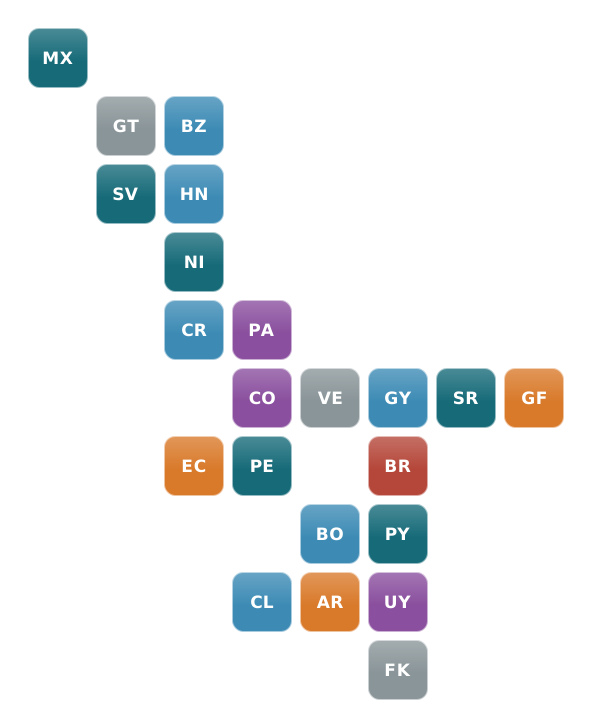
The 22 jurisdictions fall into six broad groups. Some have built national licensing systems that include online play. Others keep gambling under state control, sometimes through concessions to private operators. A few divide authority between provinces and the central state or are governed by the national law of another state. Many license land-based casinos only, one country has just reversed an online licensing regime, and several have no specific framework that the guides could identify. The guides were last updated between 6 and 21 October 2026, and the descriptions below are as of those dates.
National online licensing
Mexico works through permits. The Federal Gaming and Raffles Law (Ley Federal de Juegos y Sorteos) of 1947 prohibits games of chance and games with wagers except where the Secretariat of the Interior (SEGOB) grants a permit. Online betting is lawful only through SEGOB permit holders under Article 85 of the Regulation, and there is no stand-alone online licence. SEGOB acts through its Gambling and Raffles Bureau, and the National Lottery (LOTENAL) is state-owned.
El Salvador regulates gambling under the Lotería Nacional de Beneficencia (LNB) Organic Law (Legislative Decree 251 of 21 December 2021) and an implementing regulation published on 22 July 2022. The LNB is regulator and operator at once, licences run for up to ten years, and the law lets the LNB order internet providers to block unauthorised sites. In Nicaragua, Law No. 766 of 2011, as amended by Law No. 884 of 2014, allows holders of an operator licence to offer internet games, but Executive Decree No. 06-2015 restricts this to Category A venues with prior written authorisation. The Ministry of Finance and Public Credit (MHCP) licenses and enforces, and the guide found no public register of authorised online operators.
Paraguay permits gambling only under a concession or authorisation granted under Law No. 1016/1997, as amended by Law No. 7438/2025 (promulgated 3 January 2025) and regulated by Decree No. 3846/2025. CONAJZAR awards national concessions by public tender. Online casino is a recognised national game that needs a concession, although the guide describes the status of online casino concessions as unclear, and a national sports betting concession awarded in 2022 is exclusive until 2028.
Peru opened a regulated online market in February 2024 under Law No. 31557 of 2022, amended by Law No. 31806 of 2023, and Supreme Decree 005-2023-MINCETUR. The Peruvian authority MINCETUR authorises, supervises and sanctions operators through its Directorate General of Casino Games and Slot Machines. Suriname replaced laws dating from 1939 and 1962 with a Gambling Act, a Lottery Act and an amended Gaming Supervision and Control Act, all enacted on 13 September 2023. The Gaming Control Board Suriname supervises gambling, and online casino licences are capped at three.
State monopolies and state-run systems
In Colombia, Article 336 of the 1991 Constitution makes games of chance a state monopoly whose revenue must go to health services, and Law 643 of 2001 sets the regime. Coljuegos administers national games, including online games, through concession contracts. Its register, modified on 13 October 2026, listed 14 authorised online operators.
Panama provides in Article 297 of its Constitution that games of chance may be exploited only by the state. Decree-Law No. 2 of 1998 restructured the Junta de Control de Juegos (JCJ), which authorises casinos, slot halls, sports betting, bingo, racing and internet gaming under contracts, with internet gaming licensed since Resolution No. 65 of 2002. Law 527 of 2026 lets the JCJ order the blocking of unlicensed sites.
Uruguay keeps casinos in state hands through the Dirección General de Casinos, with private concessions awarded by public tender, and lotteries and quinielas through the Dirección Nacional de Loterías y Quinielas (DNLQ). Articles 244 and 245 of Law No. 19.535 (2017) and Decree No. 366/017 prohibit any online gambling service without prior state authorisation. The DNLQ lists Supermatch as the only authorised channel for sports betting, and no operator holds authorisation for online casino games.
Provincial and split systems
Argentina leaves gambling to the provinces and the City of Buenos Aires under Article 121 of the Constitution, and there is no national licence for online gambling. Article 301 bis of the Criminal Code (Law 27,346, December 2016) punishes unauthorised operation with three to six years. By July 2025, according to a Yogonet survey cited in the guide, 20 of 24 jurisdictions had regulated online gambling. The national Lotería Nacional was dissolved by Decree 95/2018.
Ecuador splits by product. Casinos and gaming halls have been prohibited since the referendum of 7 May 2011, and Article 236 of the Organic Comprehensive Penal Code (COIP) punishes running them with one to three years. Online sports betting, however, is lawful for operators holding a licence from the national sports authority. Online casino games are not covered, and in May 2026 the State Attorney General’s Office stated that games of chance are unlawful in any form, including digital.
French Guiana is governed by Article 73 of the French Constitution, so national French law applies by default, including the Code de la sécurité intérieure and Law No. 2010-476 of 12 May 2010 on online gambling. Gambling is prohibited in principle, with statutory exceptions. Online sports and horse-race betting and poker are open to approved operators, and online casino games are not authorised. The territory has no regulator of its own, and the national Autorité nationale des jeux (ANJ) can order blocking.
Land-based gambling only
Belize licenses casinos under the Gaming Control Act (Chapter 152), with a Gaming Control Board and casino licences tied to four- or five-star hotels with at least 50 rooms. A moratorium on online gaming licences has applied since at least May 2024, and in June 2025 the government stated that no online gaming company is licensed from Belize. Costa Rica works from the Ley de Juegos (Law No. 3 of 1922), which prohibits games in which loss or gain depends on chance, subject to later exceptions. Casinos may operate only inside hotels, the Junta de Protección Social (JPS) holds the exclusive right to lotteries and sports betting, and there is no licence for online gambling. Law 9050 taxes casinos and electronic bet-processing companies but is not a gaming licence.
Honduras relies on Decree No. 488 of 1977 (the Casino Law), as amended, and no law licenses online gambling. A draft online casino law (October 2024) and a player protection bill (September 2026) were at an early stage in October 2026. Chile governs casinos under Law No. 19.995 of 2005, which caps casino permits at 24 and states that a casino permit never covers online games of chance. The Supreme Court ordered six internet providers to block unauthorised betting sites on 30 September 2025, and an online betting bill (Boletín 14.838-03) was approved in general by the Senate on 13 August 2025 but was not law in October 2026.
Bolivia applies Law No. 060 of 2010, amended by Law No. 717 of 2015, with the Autoridad de Fiscalización del Juego (AJ) as the only body that may license, supervise and sanction operators. The AJ states that no online betting or casino site is authorised. Guyana is governed mainly by the Gambling Prevention Act (Cap. 9:02), as amended by Act No. 5 of 2007, which allows casinos in new hotels or resorts with at least 150 rooms and no more than three casino premises licences per region. Existing law does not license online gambling. The Gaming Authority Bill 2026 (Bill No. 12 of 2026) was read for the first time in late July 2026 and was not law at the 14 October 2026 review.
Brazil’s 2026 reversal
Brazil reversed course in 2026, moving from regulation to prohibition. Law 13,756 of 2018 created fixed-odds betting, Law 14,790 of 2023 regulated it and extended it to online games, and the licensed market ran from 1 January 2025 through authorised .bet.br sites. Provisional Measure 1,394 of 25 September 2026 prohibits the operation, offer, intermediation and advertising of fixed-odds betting. Sites had to go offline on 6 October 2026, and federal and state authorisations end on 25 October 2026. The measure contains no penalty for bettors and orders balances to be returned through the banking system.
The older Criminal Misdemeanours Act (Decree-Law 3,688/1941) still treats unauthorised games of chance as an offence, and the guide notes that Article 50(2) provides a fine for anyone found taking part in an unauthorised game, including online, so enforcement against players is unclear. Several constitutional challenges were pending before the Federal Supreme Court (STF), and no court had suspended the measure when the guide was reviewed on 20 October 2026. This situation may change; see the country guide for the latest position.
Limited or unclear frameworks
Guatemala criminalises houses of games of chance under Articles 477 and 478 of the Penal Code, and lotteries, raffles and bingos are lawful only with a permit. The guide found no regulator or licensing system for casinos, sports betting or online gambling, and whether the Penal Code applies to foreign websites is unsettled. Bill 6645 amending the Penal Code received a favourable committee report on 4 November 2025, with no plenary vote reported by 7 October 2026.
The Falkland Islands legislate for themselves under their 2008 Constitution, and the UK Gambling Act 2005 does not apply there. A Lotteries Ordinance and received English gaming statutes apply, but the guide could identify no licensing regime for casinos, online casinos or remote betting, and no gambling regulator. Venezuela has a 1997 law that created the Comisión Nacional de Casinos (CNC) and limits casinos to five-star hotels in declared tourist zones. The CNC publishes a list of online casinos and online bingo platforms with authorisations (28 casinos and 3 bingo platforms as of October 2026), but the guide found no statute or published regulation establishing an online licensing regime.
Online gambling
Online gambling is lawful only where a licence, permit or concession exists. In Mexico it is available only through SEGOB permit holders, and foreign online operators without a Mexican establishment have had to register for tax since 1 January 2026, with temporary access blocking as the sanction. In Peru, online casino games and sports betting are lawful through MINCETUR-authorised operators on registered platforms, and players must be 18 or over and register with ID. In Suriname the only lawful routes are a licensed online casino or a licensed online lottery, and Article 6 prohibits offering online casino services in Suriname regardless of where the operator is located, so a foreign licence does not authorise service there. Colombia allows adult Colombian residents to hold one account per operator, and any online operator without a Coljuegos contract is operating illegally.
In Argentina, licensed operators may offer casino games, sports betting and poker to people located in a province, with geolocation and identity checks, generally on .bet.ar domains. Ecuador licenses online sports betting only, and Uruguay authorises a single sports betting site. Of the remaining countries, the guides report no online licence in Belize, Costa Rica, Honduras, Chile, Bolivia and Guyana, and an unclear position in Guatemala, the Falkland Islands and Venezuela. Several guides add that they found no penalty for players, including those for Brazil, Chile and Nicaragua.
Blocking is a common enforcement tool. Coljuegos reported 46,228 blocking orders between 2022 and July 2026. Peru’s MINCETUR reported 86 platforms blocked as of 2 October 2026, although the guide notes that blocking counts refer to different periods. In Chile, Subtel issued blocking orders for 42 domains on 1 September 2026 and 37 on 21 September 2026. Paraguay’s CONAJZAR has ordered blocking of unauthorised sites since September 2025, and French Guiana, as part of France, is covered by ANJ orders: 232 orders covering 1,337 URLs in 2024. Uruguay extended payment blocking by the Central Bank to payment service providers in July 2024.
Taxes and player protection
Mexico’s special tax on gambling (IEPS) is 50% from 1 January 2026, up from 30%; permit holders also pay 1% or 2% of net gaming revenue. In Brazil, the tax on operators’ gross gaming revenue was 12% under Law 14,790 and is set by Complementary Law 224 of 26 December 2025 at 13% in 2026, 14% in 2027 and 15% in 2028, with a 15% income tax on bettors’ net prizes. Peru charges 12% on net revenue plus a 1% Selective Consumption Tax on each bet. Colombia charges online operators 15% of gross gaming revenue as exploitation rights, and games must return at least 83% of stakes to players.
Colombia’s other online gambling taxes have been unsettled. A 19% VAT was imposed by emergency decree in 2025 and again for 2026, and the Constitutional Court declared the decree that reimposed it (Decree 1474) unconstitutional on 15 April 2026 and ordered refunds. Decree 0240 of March 2026 created a 16% consumption tax on online gross gaming revenue, reported to be in effect in September 2026, and a tax reform bill filed on 20 July 2026 proposed making 19% VAT permanent from 2027. For the incoming administration’s position, see the Colombia guide.
Elsewhere, Bolivia levies a 30% gambling tax on operators’ gross income and a 15% participation tax on players. Chile charges casinos a 20% specific gaming tax on gross gaming revenue, and its online betting bill proposes the same rate for online platforms. Ecuador applies a 15% single income tax on bets received minus prizes paid, with 15% withholding on players’ winnings. Argentina’s federal tax on online bets is 5% for registered domestic operators, or 2.5% if they meet investment and employment conditions. Paraguay applies an 8% final withholding on cash prizes of PYG 500,000 or more, Uruguay’s operators withhold 12% of prizes, and Venezuela withholds 16% or 34% of players’ prizes depending on the game. The Falkland Islands have no gambling-specific tax.
Player protection is uneven. Brazil launched a centralised self-exclusion platform on gov.br on 12 December 2025, and an ordinance of 30 September 2025 barred recipients of Bolsa Família and the Continuous Cash Benefit from betting. Panama has a Responsible Gaming Section within the JCJ and a self-exclusion form. In Uruguay, DNLQ Resolution 15/2026 of 9 January 2026 requires a visible responsible gambling section on online portals. Peru keeps a register of persons barred from casinos and slot halls. By contrast, the guides for Belize, Guyana and the Falkland Islands found no national self-exclusion scheme or helpline, and the Colombia guide says no single national self-exclusion register exists. Minimum ages vary: 18 in Peru and Nicaragua, 21 in Honduras and Suriname.
Recent developments (2025–2026)
The items below are dated as in the country guides, which were last updated between 6 and 21 October 2026. Several are pending matters, and we do not predict outcomes.
- October 2026, Mexico: The government’s draft reform of the 1947 law was reported as awaiting evaluation by the National Security Cabinet before going to Congress. No bill had been presented as of 21 October 2026.
- 13 October 2026, Colombia: Coljuegos modified its register of authorised online operators, which listed 14.
- 6 October 2026, Brazil: The Attorney General’s Office asked the Federal Supreme Court to keep Provisional Measure 1,394 in force, and licensed betting sites went offline. On 2 October 2026 a justice had given the Attorney General’s Office 72 hours to respond to the constitutional challenges.
- 28 September 2026, Peru: A bill to change the 1% Selective Consumption Tax was reactivated as Bill 00389/2026-2031-CD; it is pending and the tax remains in force.
- 25 September 2026, Brazil: Provisional Measure 1,394 prohibited fixed-odds betting.
- 25 September 2026, Honduras: A deputy introduced a Law on Player Protection and Responsible Gambling, at an early stage.
- 1 and 21 September 2026, Chile: Subtel issued blocking orders for 42 and then 37 domains.
- Late July 2026, Guyana: The Gaming Authority Bill 2026 was read for the first time in the National Assembly. No second reading had been reported by 14 October 2026.
- 20 July 2026, Colombia: The outgoing government filed a tax reform bill that would make 19% VAT on online gambling permanent from 2027.
- May 2026, Argentina: The national government sent the Senate a 21-article bill (3 to 6 years for unauthorised operators). The Chamber of Deputies bill passed on 27 November 2024 risks lapsing unless the Senate acts before ordinary sessions end in November 2026.
- May 2026, Panama: Law 527 was enacted; it was reported as sanctioned on 23 May and published in the Official Gazette on 28 May 2026. It lets the JCJ order blocking of unlicensed sites and creates a problem gambling fund.
- 15 April 2026, Colombia: The Constitutional Court declared Decree 1474 unconstitutional and ordered refunds.
- 1 January 2026, Mexico: The 50% special gambling tax and the registration regime for foreign online operators took effect.
- 26 December 2025, Brazil: Complementary Law 224 set the path for the tax on operators’ gross gaming revenue: 13% in 2026, 14% in 2027 and 15% in 2028.
- 11 December 2025, Suriname: A private member’s bill to ban online gambling was submitted to the National Assembly; a committee heard stakeholders on 18 February 2026.
Country-by-country summary
| Country | Legal model | Online gambling | Regulator |
|---|---|---|---|
 Argentina | Provincial and City of Buenos Aires regulation | Regulated by 20 of 24 jurisdictions (July 2025); no national licence | Provincial and city lottery bodies |
 Belize | Land-based casinos licensed | No licences issued; moratorium since at least May 2024 | Gaming Control Board |
 Bolivia | Land-based licensing | No site authorised, per the regulator | Autoridad de Fiscalización del Juego (AJ) |
 Brazil | Fixed-odds betting prohibited (2026) | Prohibited by Provisional Measure 1,394; sites offline 6 October 2026 | Secretariat of Prizes and Betting (Ministry of Finance) |
 Chile | Land-based casinos (cap of 24 permits) | Not licensed; bill pending | Superintendencia de Casinos de Juego |
 Colombia | State monopoly with concessions | Licensed (14 operators, October 2026) | Coljuegos |
 Costa Rica | JPS monopoly; casinos in hotels only | Not licensed | No single authority (JPS, Ministry of Public Security) |
 Ecuador | Casinos prohibited; sports betting licensed | Sports betting only | No dedicated regulator (national sports authority licenses) |
 El Salvador | National licensing under the LNB | Licensed | Lotería Nacional de Beneficencia (LNB) |
 Falkland Islands | No specific regime identified | No licensing identified | None identified |
 French Guiana | French national law | Sports and horse-race betting and poker only; no online casino | Autorité nationale des jeux (ANJ) |
 Guatemala | Penal Code ban; no licensing system | No licensing; position unsettled | No gambling regulator identified |
 Guyana | Land-based casinos in large hotels | Not licensed; bill pending | Gaming Authority |
 Honduras | Land-based casinos | Not licensed; bills at early stage | No independent regulator |
 Mexico | Federal permits | Permit holders only | SEGOB |
 Nicaragua | National casino and gaming-hall licensing | Restricted (Category A venues with authorisation) | Ministry of Finance and Public Credit (MHCP) |
 Panama | State-controlled; JCJ authorisation | Licensed | Junta de Control de Juegos (JCJ) |
 Paraguay | Concessions by tender | Concession required | CONAJZAR |
 Peru | National licensing | Licensed (since February 2024) | MINCETUR |
 Suriname | National licensing (Acts of 2023) | Licensed (online casino cap of three) | Gaming Control Board Suriname |
 Uruguay | State-run casinos and lotteries | One authorised sports betting site; others blocked | No independent regulator (DGC and DNLQ) |
 Venezuela | 1997 casino law; CNC | CNC lists authorisations; no statute found | Comisión Nacional de Casinos (CNC) |
For other regions, browse the full country directory.
Sources and further reading
Each country guide linked above lists its own primary sources.
- Cámara de Diputados (Mexico), Ley Federal de Juegos y Sorteos (1947; accessed 5 October 2026).
- Diario Oficial de la Federación via Cámara de Diputados, Decreto por el que se reforman y adicionan diversas disposiciones de la Ley del Impuesto Especial sobre Producción y Servicios (2025).
- Presidency of the Republic (Brazil), Medida Provisória nº 1.394, de 25 de setembro de 2026 (2026).
- Presidency of the Republic (Brazil), Lei nº 14.790, de 29 de dezembro de 2023 (2023; accessed 5 October 2026).
- Congress of Colombia (Alcaldía de Bogotá, Régimen Legal), Ley 643 de 2001, por la cual se fija el régimen propio del monopolio rentístico de juegos de suerte y azar (2001, as amended).
- Coljuegos, Operadores de juegos online autorizados (accessed 21 October 2026).
- Congress of the Republic / El Peruano, Ley Nº 31557, Ley que regula la explotación de los juegos a distancia y apuestas deportivas a distancia (2022).
- Biblioteca del Congreso Nacional / Superintendencia de Casinos de Juego, Ley Nº 19.995 que establece las bases generales para la autorización, funcionamiento y fiscalización de casinos de juego (2005, as amended; text updated to December 2023).
- Government of Panama (MEF), Decreto Ley No. 2 de 10 de febrero de 1998, por el cual se reestructura la Junta de Control de Juegos (1998).
- BaseLegal / Congress of Paraguay, Ley Nº 1016/1997, que establece el régimen jurídico para la explotación de los juegos de suerte o de azar (texto actualizado con la Ley Nº 7438/2025) (1997, consolidated 2025).
- Asamblea Legislativa de El Salvador, Ley Orgánica de la Lotería Nacional de Beneficencia, Decreto Legislativo No. 251 (2021; accessed 7 October 2026).
- Republic of Suriname (via SRiS), Wet Hazardspelen, S.B. 2023 no. 135 (2023).
- IMPO (Uruguay), Ley Nº 19535, artículo 244 (2017).
- Argentine Republic, Decreto 293/2022 – Impuesto indirecto sobre apuestas online (Boletín Oficial, 2 June 2022).
Last reviewed: 31 October 2026.