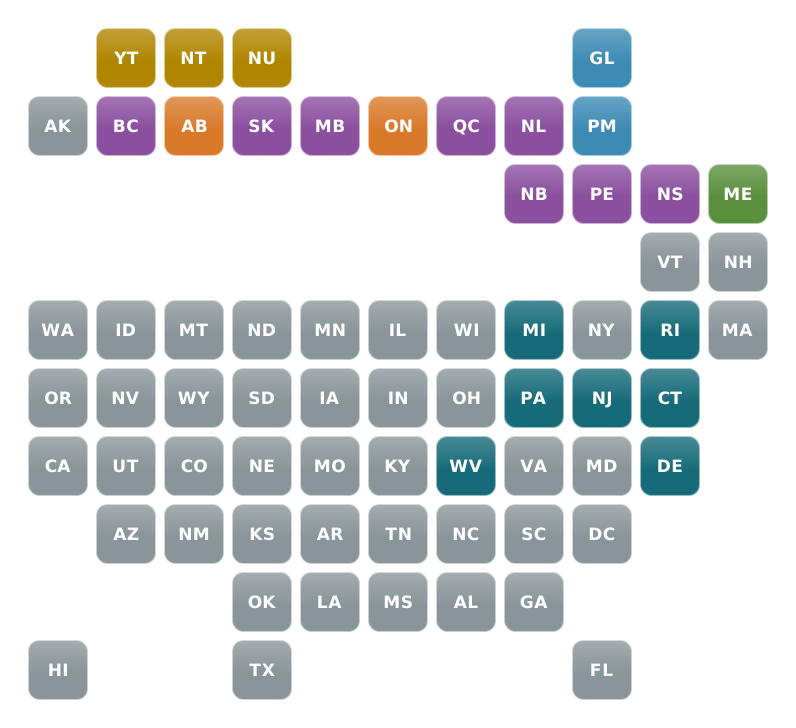
In short: Gambling law in the US and Canada is set by each state and province, within federal law, so neither country has a single national rule for online casinos. Seven US states (Connecticut, Delaware, Michigan, New Jersey, Pennsylvania, Rhode Island and West Virginia) have live state-regulated online casinos, Maine has authorised them but not launched, and the other 42 states and Washington, DC have no state-authorised online casino market. In Canada, Ontario (since 4 April 2022) and Alberta (since 13 July 2026) run regulated competitive markets, and the Canada guide says that in most provinces the model is a monopoly. Greenland has its own licensing act, and Saint Pierre and Miquelon follows French national rules. Rules are changing quickly, so check the relevant guide and regulator before relying on any summary.
Key points
- Our guides sort 66 places into seven groups: US states with licensed online casinos (7), Maine (authorised, not yet launched), states and Washington, DC with no state online casino market (43), Ontario and Alberta, provinces with a provincial operator (8), the three territories, and Greenland with Saint Pierre and Miquelon.
- The federal Wire Act (18 U.S.C. § 1084) and the Unlawful Internet Gambling Enforcement Act of 2006 (UIGEA) are aimed at people “engaged in the business of betting or wagering”, not at individual bettors. UIGEA’s intrastate exception is the federal basis for state-licensed online casinos.
- In Canada, section 207(1)(a) of the Criminal Code lets a provincial government “conduct and manage a lottery scheme in that province”, which is the legal basis for provincial online casinos. Single-event sports betting became lawful for provinces to offer on 27 August 2021.
- Seven US states had lawful online casinos in 2025, and their combined online casino revenue reached a record $10.73 billion that year, according to the American Gaming Association (AGA).
- By October 2026, at least 11 US states had enacted laws prohibiting or targeting sweepstakes platforms that mimic online casinos, and the legal status of sports prediction markets was still contested.
- Our Canada guide does not describe Yukon, the Northwest Territories or Nunavut individually, so this page does not state their position.
- Greenland licenses betting and online casino under its own act, while online casino games are not authorised in Saint Pierre and Miquelon.
Gambling models at a glance
- Licensed online casinos (US states) (7)
- Authorised, not yet launched (1)
- No state online casino market (43)
- Regulated competitive markets (Canada) (2)
- Provincial monopolies (8)
- Territories (3)
- Greenland and Saint-Pierre-et-Miquelon (2)
Licensed online casinos (US states) 7
State-licensed online casinos are live; each state lists its approved operators.
Authorised, not yet launched 1
The state has passed an online casino law, but the market has not opened.
No state online casino market 43
No state-authorised online casino; other gambling permission does not cover online casino games.
 AlabamaAlaskaArizonaArkansasCaliforniaColoradoDistrict of ColumbiaFloridaGeorgiaHawaiiIdahoIllinoisIndianaIowaKansasKentuckyLouisianaMarylandMassachusettsMinnesotaMississippiMissouriMontanaNebraskaNevadaNew HampshireNew MexicoNew YorkNorth CarolinaNorth DakotaOhioOklahomaOregonSouth CarolinaSouth DakotaTennesseeTexasUtahVermontVirginiaWashingtonWisconsinWyoming
Regulated competitive markets (Canada) 2
Private operators are licensed in a provincially managed online market.
Provincial monopolies 8
A provincial Crown corporation is the only lawful online operator.
Territories 3
Not described individually in our Canada guide; check with the territory.
Greenland and Saint-Pierre-et-Miquelon 2
Greenland licenses online casino under its own act; Saint Pierre and Miquelon follows French rules.
How gambling is regulated across the US and Canada

The US and Canada are both federations in which authority over gambling is divided. In the US, gambling has historically been regulated by the states, with federal law intervening mainly against organised crime and interstate activity. The Interstate Wire Act of 1961 targets businesses that use wire communications for interstate betting, the Indian Gaming Regulatory Act (IGRA) of 1988 created a federal framework for gaming on tribal lands, and UIGEA works through the payments system rather than by prohibiting gambling directly. In Canada, the Criminal Code treats gambling as a matter of criminal law, which is federal, and section 207(1)(a) allows a provincial government to “conduct and manage a lottery scheme in that province”. Each province then legislates for its own gambling market. In both countries, therefore, the practical question is which state or province you are in. The US guide and Canada guide are the place for detail, and the Greenland guide and the Saint Pierre and Miquelon guide cover the two other places included here. The seven groups below drive the colours on our map and the table at the end. The guides were last reviewed between 13 and 21 October 2026, and the descriptions are as of those dates.
Licensed online casinos (US states)
Seven states had live, state-regulated online casinos when the US guide’s map was last checked on 5 October 2026: Connecticut, Delaware, Michigan, New Jersey, Pennsylvania, Rhode Island and West Virginia. Authorisation comes from each state, and approval in one state does not carry over to another. The federal basis is the intrastate exception in UIGEA: under 31 U.S.C. § 5362(10)(B), bets made within a single state are excluded from the definition of unlawful internet gambling when they are expressly authorised by and placed in accordance with that state’s laws. The state’s rules must include age and location verification requirements, which is why regulated sites check where a player is.
The regulators differ. Connecticut’s is the Department of Consumer Protection’s Gaming Division, and the Delaware Lottery, Rhode Island Lottery and West Virginia Lottery are named for those three states. In Michigan the Gaming Control Board keeps a list of authorised operators and suppliers, the Pennsylvania Gaming Control Board publishes a list of licensed online gaming operators, and in New Jersey the Division of Gaming Enforcement (DGE) publishes the authorised internet gaming sites. Tribal gaming has its own federal framework: under IGRA, casino-style (Class III) gaming is lawful only if a tribal ordinance authorises it, it is located in a state that permits such gaming for any purpose by any person, organisation or entity, and it is conducted under a tribal-state compact. Tribal operators are central to some state online markets, and in Connecticut two tribes hold online casino licences.
Authorised, not yet launched
Maine is shown separately because authorisation is not the same as a live market. Its internet gaming law took effect on 11 January 2026 without the governor’s signature. The Maine Gambling Control Unit says application forms may be prepared, but that applications are not yet being accepted, and online casinos had not launched in the state by October 2026.
No state online casino market
The other 42 states and Washington, DC (43 jurisdictions in all) have no state-authorised market for online casino slots and table games. The US guide states that permission for sports betting, poker, lottery or physical casinos does not authorise online casino games, and that a foreign licence does not establish state authorisation. An offshore website that accepts US registrations, or holds a licence from another country, is not authorised by any US state. This page does not give a state-by-state sports betting status, because the US guide’s map covers online casino slots and table games only and does not classify sports betting, poker-only laws, lotteries or sweepstakes.
Players should not assume that using an unlicensed site is lawful. The principal federal statutes apply to people “engaged in the business of betting or wagering” and do not create offences for individual bettors, but state law is less uniform. The US guide gives Washington’s RCW 9.46.240 as an example of a statute that can reach individuals: it makes it a class C felony to knowingly transmit or receive gambling information by the internet, unless the activity is specifically authorised. Players on offshore sites also have no access to state complaint processes or state-mandated responsible gaming tools.
Regulated competitive markets (Canada)
Ontario and Alberta depart from the monopoly model while staying within section 207(1)(a). In Ontario, iGaming Ontario conducts and manages online gaming and contracts with private operators that provide the games, and the Alcohol and Gaming Commission of Ontario (AGCO) registers operators and sets standards under the Registrar’s Standards for Internet Gaming, made under the Gaming Control Act, 1992. From 4 April 2022, operators that had completed AGCO registration and signed agreements with iGaming Ontario could offer regulated games to eligible Ontarians. OLG.ca continues to operate alongside the private operators.
Alberta’s iGaming Alberta Act, passed in spring 2025 as part of Bill 48, created the Alberta iGaming Corporation to conduct and manage a competitive online market, with Alberta Gaming, Liquor & Cannabis (AGLC) as regulator. Operators must register with AGLC and players must be at least 18. AGLC opened registration in January 2026 and the market opened on 13 July 2026. Operators continue to join after launch, so lists of authorised sites should be checked with AGLC.
Provincial monopolies
The Canada guide says that “In most provinces the model is a monopoly”: a single public body sells all lawful online gambling, including casino games, lotteries and sports betting, to residents of the province, and it may use private technology suppliers while remaining the operator in law. It adds that “Lawful online gambling is offered through provincial corporations or, in Ontario and Alberta, through regulated competitive markets”. The guide names two examples. In British Columbia, PlayNow is run by the British Columbia Lottery Corporation (BCLC), which states that the profits of its play go back to the provincial government. In Quebec, Loto-Québec’s Espacejeux offers casino games, sports betting, poker, bingo and instant games.
This group also includes Saskatchewan, Manitoba, New Brunswick, Nova Scotia, Prince Edward Island and Newfoundland and Labrador, which the guide does not describe one by one. It names Atlantic Lottery Corporation and Manitoba Liquor and Lotteries only as appellants, with BCLC and Loto-Québec, in the Supreme Court of Canada case on international player pooling, and does not say which provinces they serve. Whether other provinces will follow Ontario and Alberta in admitting private operators, or keep their monopolies, is one of the two questions the guide says dominate current debate.
Territories
Yukon, the Northwest Territories and Nunavut are not described individually in our Canada guide, and this page does not state their position. The guide notes that the 2021 Criminal Code amendments allow provinces and territories to offer and regulate single-event sport betting, but that is a statement about federal law, not about any territorial scheme. Readers should check with the territorial authority.
Greenland and Saint-Pierre-et-Miquelon
Greenland has its own gambling legislation within the Danish realm. The Danish Gambling Act states that it “does not apply to the Faroe Islands and Greenland”, and the Act for Greenland on Certain Games has applied since 1 January 2012. Lotteries and horse and dog race betting are reserved for the Danish lottery company Danske Spil A/S, betting and online casino need a licence issued under the Greenland act (“A Danish licence on its own does not cover Greenland”), and no land-based casino can be licensed. In practice the Danish Gambling Authority grants licences and supervises compliance.
Saint Pierre and Miquelon has been a French overseas collectivity under Article 74 of the French Constitution since 2003, and gambling regulation remains in principle a national competence. FDJ lottery games are sold in licensed points of sale under a convention signed on 29 November 1994, FDJ’s online offer is open to residents aged 18 or over, and the Autorité nationale des jeux (ANJ) states that online casino games are not authorised. No casino operates in the archipelago, according to a June 2026 overview of overseas casinos. The guide found no official statement of exactly how the national gambling provisions are extended to the archipelago, so readers needing certainty should check Légifrance or the prefecture.
Online gambling
In the US, online casino play is lawful only where a state has authorised it, and state regulators publish the operators they have approved. The AGA reports that internet gaming revenue across the seven states grew by 27.6% to a record $10.73 billion in 2025, and online casino revenue of $1.01 billion in July 2026 alone. States with regulated markets act against unlicensed operators: on 14 August 2025, for example, the Michigan Gaming Control Board sent cease-and-desist letters to 15 unlicensed online gambling operators. The AGA estimates that unregulated gaming devices, offshore sportsbooks and illegal online casinos generate $53.9 billion in revenue annually, and the US guide notes that this is an industry estimate, not an official government statistic.
Social casinos let people play slot-style and table games with virtual coins that have no cash value and cannot be exchanged for prizes. Sweepstakes casinos use a similar format but run two currencies, one of which can be used in games yielding prizes redeemable for cash. Operators argue that a free alternative method of entry removes consideration, so the games are lawful promotions rather than gambling, and legislators, regulators and private plaintiffs increasingly challenge that view. By October 2026, at least 11 states had enacted laws prohibiting or targeting these platforms: California, Connecticut, Montana, New Jersey and New York in 2025, and Indiana, Iowa, Louisiana, Maine, Oklahoma and Tennessee in 2026. Ban bills failed in 2026 in Florida, Maryland, Massachusetts, Minnesota, Mississippi and Virginia, and the guide identified no federal law specifically addressing sweepstakes casinos. Sweepstakes platforms are not licensed as gambling operators, so players do not get the protections that come with a state gaming licence.
Prediction market platforms offering contracts on sporting outcomes have also tested the boundaries of state law. The AGA reports that 16 states took action against sports event contracts in 2025. Platforms argue that the contracts fall under the exclusive jurisdiction of the federal Commodity Futures Trading Commission (CFTC), which by May 2026 had itself sued Arizona, Connecticut, Illinois, New York and Wisconsin. The legal status of these products was still contested at the date of review (see the developments below).
In Canada, lawful online gambling is offered through provincial corporations or, in Ontario and Alberta, through regulated competitive markets. On 1 September 2026, iGaming Ontario’s directory listed 49 operators and 84 gaming websites, and the AGCO advises players to look for the iGaming Ontario logo. In peer-to-peer games such as poker, Ontario players currently play only against others in the Ontario market. The Court of Appeal for Ontario held by a 4-1 majority on 12 November 2025 that the Criminal Code would permit the regulated market to let players take part with players outside Canada. Provincial lottery corporations appealed, the Supreme Court of Canada heard the case on 7 October 2026 and reserved judgment, and no international player pooling has been implemented. Outside the provincial channels, offshore sites continue to serve Canadian players, who cannot use provincial complaint processes there and are not covered by provincial self-exclusion programmes. The guide found no official guidance treating play on an offshore site as an offence, and says its sources do not settle how the section 201(2) offence of being “found” in a common gaming house applies to it.
The Kahnawà:ke Gaming Commission regulates gaming in the Mohawk Territory of Kahnawà:ke, near Montréal, and issues interactive gaming authorisations under the Kahnawà:ke Gaming Law. This is not a provincial scheme: such an authorisation is not a provincial lottery scheme under section 207(1)(a), an AGCO registration or an iGaming Ontario operating agreement, so it does not by itself show that a site is part of any provincial regulated market.
In Greenland, online casino games and online betting are lawful when offered under a licence issued under the Greenland act, either to an operator that holds a Danish licence and has extended it to Greenland or to a small locally established operator. The Act’s penalty provisions are aimed at people who offer, arrange or facilitate gambling, and do not make it an offence for a player to take part, including with an unlicensed online operator. In Saint Pierre and Miquelon, lawful online gambling for residents consists of FDJ’s online lottery and instant games. Online sports betting, horse-race betting and poker are open to ANJ-licensed operators, but the guide could not verify which of them accept customers in the archipelago. In 2024 the ANJ president sent 232 blocking and delisting orders covering 1,337 URLs.
Taxes and player protection
Federal law treats gambling winnings in the US as taxable income, and the Internal Revenue Service states that “gambling winnings are fully taxable and you must report the income on your tax return”. Losses may be deducted only by taxpayers who itemise, up to the gambling income reported, and for tax years beginning after 31 December 2025 the deduction is limited to 90% of gambling losses. States tax licensed operators’ online casino revenue at rates set by each state’s legislation; the US guide gives no state rates. In Canada, much of the public return comes as profits paid to provincial governments rather than as a separate gambling tax. The Canada guide does not address the personal income tax treatment of winnings and tells readers to consult the Canada Revenue Agency.
In Greenland, licensed operators pay duty to the Danish state: 20% of gross gaming revenue on betting and online casino, and 15% of lottery winnings above DKK 200, paid by the licence holder. Denmark pays Greenland’s Self-Government a fixed annual sum, set at DKK 43.25 million (2015 level) from 2017. The Greenland guide could not find an official statement on whether other winnings are subject to Greenlandic income tax. In Saint Pierre and Miquelon the collectivity sets its own taxes, and the guide found no published local rule on gambling taxation or on the tax treatment of winnings.
Player protection is organised state by state, province by province and, in France, nationally. In the US each regulated state runs its own self-exclusion arrangements. Michigan administers an Internet Gaming and Sports Betting Responsible Gaming Database, Pennsylvania offers online enrolment in self-exclusion, and Connecticut publishes problem gambling help resources. The National Problem Gambling Helpline is reachable at 1-800-MY-RESET (1-800-697-3738). In Canada, provincial operators run their own programmes, and Ontario’s BetGuard tool, launched on 15 May 2026, lets Ontarians self-exclude from all provincially regulated online sports betting, casino and poker sites through one process. ConnexOntario offers help on 1-866-531-2600, 24 hours a day. In Greenland, free treatment is offered by the national addiction service Allorfik, and surveys from 2006 to 2010 found that 16% of men and 10% of women had been problem gamblers at some point in their lives. In France, the voluntary gambling ban managed by the ANJ is the main national tool, and the Saint Pierre and Miquelon guide says it should apply to FDJ online accounts held by residents of the archipelago.
Recent developments (2025–2026)
The items below are dated as in the guides, which were last reviewed between 13 and 21 October 2026. Several are pending matters, and we do not predict outcomes.
- By October 2026, US: At least 11 states had enacted laws prohibiting or targeting sweepstakes platforms that mimic online casinos.
- 7 October 2026, Canada: The Supreme Court of Canada heard the appeal on international player pooling and reserved judgment.
- September 2026, Pennsylvania: House Bill 2801, a sweepstakes casino ban with fines of $50,000 to $500,000, was filed; the legislative session ends on 30 November 2026.
- 1 September 2026, Ontario: iGaming Ontario’s directory listed 49 operators and 84 gaming websites.
- 28 August 2026, Nevada: The Ninth Circuit held, in KalshiEX v. Assad, that Nevada was likely entitled to apply its gaming laws to sports event contracts. That result conflicts with the Third Circuit’s April 2026 decision in KalshiEX v. Flaherty, and New Jersey’s petition asking the Supreme Court to review the Third Circuit ruling (No. 26-299) was pending at the date of review.
- 13 July 2026, Alberta: The licensed, regulated iGaming market opened.
- 19 May 2026, Minnesota: The CFTC sued Minnesota over a new state law making the operation of a prediction market a felony; a federal judge blocked that law before its 1 August 2026 effective date.
- 15 May 2026, Ontario: BetGuard, a centralised self-exclusion tool for regulated online gambling, was launched.
- 11 January 2026, Maine: The internet gaming law took effect without the governor’s signature; online casinos had not launched by October 2026.
- January 2026, Alberta: AGLC opened registration for operators.
- 12 November 2025, Ontario: The Court of Appeal for Ontario found, by a 4-1 majority, that international player pooling would be lawful under the Criminal Code (2025 ONCA 770); provincial lottery corporations appealed to the Supreme Court of Canada.
- 14 August 2025, Michigan: The Gaming Control Board sent cease-and-desist letters to 15 unlicensed online gambling operators.
- June 2025, France: The ANJ called for a “highly controlled” approach to any opening of online casino games, which remain unauthorised.
- 2025, US: Five states enacted explicit bans on sweepstakes casino platforms, 16 states acted against sports-based prediction markets, and online casino revenue in the seven regulated states reached $10.73 billion.
State and province summary
| Place | Legal model | Online gambling | Regulator |
|---|---|---|---|
| Alabama | State law; no online casino authorisation | Not licensed | — |
| Alaska | State law; no online casino authorisation | Not licensed | — |
| Arizona | State law; no online casino authorisation | Not licensed | — |
| Arkansas | State law; no online casino authorisation | Not licensed | — |
| California | State law; no online casino authorisation | Not licensed | — |
| Colorado | State law; no online casino authorisation | Not licensed | — |
| Connecticut | State-authorised online casino | Licensed: live state-regulated online casino market | Connecticut Department of Consumer Protection, Gaming Division |
| Delaware | State-authorised online casino | Licensed: live state-regulated online casino market | Delaware Lottery |
| District of Columbia | State law; no online casino authorisation | Not licensed | — |
| Florida | State law; no online casino authorisation | Not licensed | — |
| Georgia | State law; no online casino authorisation | Not licensed | — |
| Hawaii | State law; no online casino authorisation | Not licensed | — |
| Idaho | State law; no online casino authorisation | Not licensed | — |
| Illinois | State law; no online casino authorisation | Not licensed | — |
| Indiana | State law; no online casino authorisation | Not licensed | — |
| Iowa | State law; no online casino authorisation | Not licensed | — |
| Kansas | State law; no online casino authorisation | Not licensed | — |
| Kentucky | State law; no online casino authorisation | Not licensed | — |
| Louisiana | State law; no online casino authorisation | Not licensed | — |
| Maine | State law; internet gaming law enacted | Not yet licensed: authorised, but applications not yet being accepted | Maine Gambling Control Unit |
| Maryland | State law; no online casino authorisation | Not licensed | — |
| Massachusetts | State law; no online casino authorisation | Not licensed | — |
| Michigan | State-authorised online casino | Licensed: live state-regulated online casino market | Michigan Gaming Control Board |
| Minnesota | State law; no online casino authorisation | Not licensed | — |
| Mississippi | State law; no online casino authorisation | Not licensed | — |
| Missouri | State law; no online casino authorisation | Not licensed | — |
| Montana | State law; no online casino authorisation | Not licensed | — |
| Nebraska | State law; no online casino authorisation | Not licensed | — |
| Nevada | State law; no online casino authorisation | Not licensed | — |
| New Hampshire | State law; no online casino authorisation | Not licensed | — |
| New Jersey | State-authorised online casino | Licensed: live state-regulated online casino market | NJ DGE (Division of Gaming Enforcement) |
| New Mexico | State law; no online casino authorisation | Not licensed | — |
| New York | State law; no online casino authorisation | Not licensed | — |
| North Carolina | State law; no online casino authorisation | Not licensed | — |
| North Dakota | State law; no online casino authorisation | Not licensed | — |
| Ohio | State law; no online casino authorisation | Not licensed | — |
| Oklahoma | State law; no online casino authorisation | Not licensed | — |
| Oregon | State law; no online casino authorisation | Not licensed | — |
| Pennsylvania | State-authorised online casino | Licensed: live state-regulated online casino market | Pennsylvania Gaming Control Board (PGCB) |
| Rhode Island | State-authorised online casino | Licensed: live state-regulated online casino market | Rhode Island Lottery |
| South Carolina | State law; no online casino authorisation | Not licensed | — |
| South Dakota | State law; no online casino authorisation | Not licensed | — |
| Tennessee | State law; no online casino authorisation | Not licensed | — |
| Texas | State law; no online casino authorisation | Not licensed | — |
| Utah | State law; no online casino authorisation | Not licensed | — |
| Vermont | State law; no online casino authorisation | Not licensed | — |
| Virginia | State law; no online casino authorisation | Not licensed | — |
| Washington | State law; no online casino authorisation | Not licensed | — |
| West Virginia | State-authorised online casino | Licensed: live state-regulated online casino market | West Virginia Lottery |
| Wisconsin | State law; no online casino authorisation | Not licensed | — |
| Wyoming | State law; no online casino authorisation | Not licensed | — |
 Alberta | Regulated competitive market (Alberta iGaming Corporation conducts and manages) | Licensed: market opened 13 July 2026 | AGLC |
| British Columbia | Provincial lottery corporation model | State operator only: BCLC runs PlayNow | BCLC (operator) |
| Manitoba | Provincial lottery corporation model | State operator only: lawful online gambling is offered through a provincial corporation | — |
| New Brunswick | Provincial lottery corporation model | State operator only: lawful online gambling is offered through a provincial corporation | — |
| Newfoundland and Labrador | Provincial lottery corporation model | State operator only: lawful online gambling is offered through a provincial corporation | — |
| Northwest Territories | Not described in our Canada guide | Not described individually: check with the territorial authority | — |
| Nova Scotia | Provincial lottery corporation model | State operator only: lawful online gambling is offered through a provincial corporation | — |
| Nunavut | Not described in our Canada guide | Not described individually: check with the territorial authority | — |
| Ontario | Regulated competitive market (iGaming Ontario conducts and manages) | Licensed: private operators registered by AGCO since 4 April 2022 | AGCO |
| Prince Edward Island | Provincial lottery corporation model | State operator only: lawful online gambling is offered through a provincial corporation | — |
| Quebec | Provincial lottery corporation model | State operator only: Loto-Québec offers online games through Espacejeux | Loto-Québec (operator) |
| Saskatchewan | Provincial lottery corporation model | State operator only: lawful online gambling is offered through a provincial corporation | — |
| Yukon | Not described in our Canada guide | Not described individually: check with the territorial authority | — |
 Greenland | Own Act for Greenland on Certain Games, within the Danish realm | Online casino and betting lawful under a Greenland licence; a Danish licence alone does not cover Greenland | Danish Gambling Authority |
 Saint Pierre and Miquelon | French overseas collectivity; French national rules | No online casino permitted; FDJ online lottery open to residents aged 18 or over | ANJ (Autorité nationale des jeux) |
For other regions, browse the full country directory.
Sources and further reading
Our four guides are listed first. Each lists its own primary sources.
- Casino News Daily, Gambling in US: Laws and Online Gambling (last reviewed 21 October 2026).
- Casino News Daily, Gambling in Canada: Laws and Online Gambling (last reviewed 21 October 2026).
- Casino News Daily, Gambling in Greenland: Laws and Online Gambling (last reviewed 13 October 2026).
- Casino News Daily, Gambling in Saint Pierre and Miquelon: Laws and Online Gambling (last reviewed 14 October 2026).
- 18 U.S. Code § 1084 – Transmission of wagering information; penalties (Legal Information Institute, Cornell Law School; accessed 5 October 2026).
- 31 U.S. Code § 5362 – Definitions (Legal Information Institute, Cornell Law School; accessed 5 October 2026).
- New Hampshire Lottery Commission v. Rosen, No. 19-1835 (U.S. Court of Appeals for the First Circuit, 2021).
- Murphy v. National Collegiate Athletic Association, 584 U.S. (Supreme Court of the United States, 2018).
- Indian Gaming Regulatory Act (National Indian Gaming Commission; accessed 5 October 2026).
- State of the States 2026 (American Gaming Association, 2026).
- Internet Gaming (Maine Gambling Control Unit; accessed 5 October 2026).
- Criminal Code, section 207: Permitted lotteries (Government of Canada; accessed 5 October 2026).
- Player support and information: online gambling (iGaming) and sport and event betting (Alcohol and Gaming Commission of Ontario; accessed 5 October 2026).
- Operator directory (iGaming Ontario; as of 1 September 2026).
- iGaming in Alberta: fact sheet (Government of Alberta, January 2026).
- About the Commission (Kahnawà:ke Gaming Commission; accessed 5 October 2026).
- Bekendtgørelse af lov for Grønland om visse spil, LBK nr. 336 af 7. april 2016 (Retsinformation, Danish Ministry of Taxation, 2016).
- Offre de jeux et canaux de distribution (Autorité nationale des jeux; accessed 13 October 2026).
Last reviewed: 2 November 2026.