

Older edition — looking for another slot?
This review documents a historical game edition. The archived rules and screenshots do not confirm current availability.
Explore Microgaming gamesOranges and Lemons is a historical Microgaming classic slot with three reels and one centre payline. This page covers the one- or two-coin edition in the original game capture below. Games and Casino now places the title in its Games Global catalogue, while the photographed game retains its Microgaming credit. The image documents an older edition, not current availability at a casino.
Top Rated Games Global Online Casinos that Welcome Players From Ohio 




100% up to
$1,000
Original reels and paytable
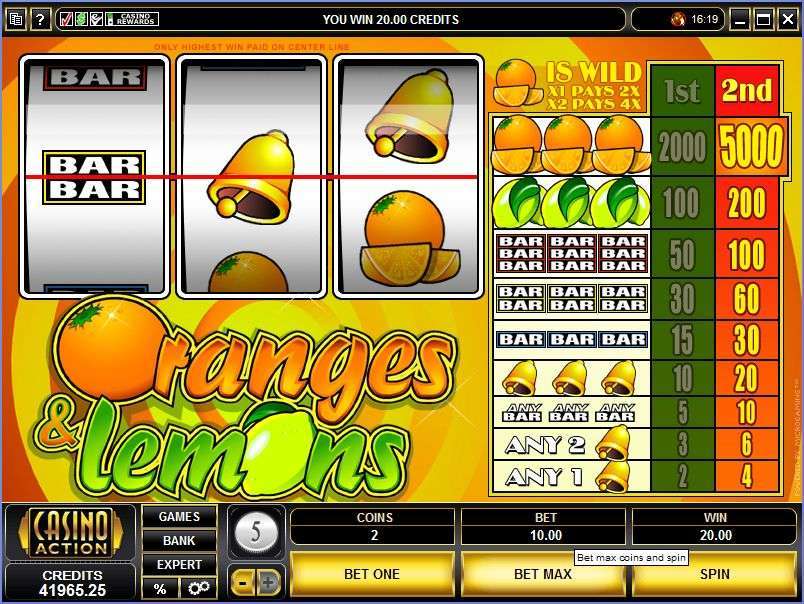
Coin awards, not total-stake multipliers
The first and second columns show the total coin award at a one-coin or two-coin stake. They are not additional prizes to add together. The screen states that only the highest win pays on the centre line. Convert an award into credits by multiplying it by the selected coin denomination.
| Centre-line result | One coin staked | Two coins staked |
|---|---|---|
| Any one bell | 2 coins | 4 coins |
| Any two bells | 3 coins | 6 coins |
| Three mixed bars | 5 coins | 10 coins |
| Three bells | 10 coins | 20 coins |
| Three single bars | 15 coins | 30 coins |
| Three double bars | 30 coins | 60 coins |
| Three triple bars | 50 coins | 100 coins |
| Three lemons | 100 coins | 200 coins |
| Three oranges | 2,000 coins | 5,000 coins |
Payout example: at a hypothetical 1-credit coin denomination, a two-coin spin costs 2 credits. Three lemons award 200 coins, or 200 credits gross; the net gain after the stake is 198 credits. Three oranges instead award 5,000 coins, equal to 2,500 times the two-coin stake. At one coin, their 2,000-coin award equals 2,000 times that stake. The larger award requires a larger coin count; this is a payout comparison, not a guarantee or a recommendation to increase spending.
Orange wild multipliers
The orange is the wild. The visible instructions show one substituting orange doubling a win and two substituting oranges multiplying it by four. Keep these substitutions separate from the listed three-orange award: the table already gives the all-orange prize, so do not apply another wild multiplier to it.
For example, a one-coin three-lemon combination normally pays 100 coins. If one lemon is replaced by an orange wild, the 2x rule gives 200 coins. This is an illustration of the photographed substitution rule, not an additional bonus round.
What the displayed stake tells us
The capture shows denomination 5, two coins, a total bet of 10.00 credits and a win of 20.00 credits. That confirms how its denomination and coin-count controls combine. It does not establish every denomination, a universal minimum or maximum stake, or a current operator’s settings. The earlier review’s complete stake range is therefore not treated as verified here.
This is a fixed paytable game. The 5,000-coin result is not evidence of a growing progressive jackpot. The available capture does not provide an RTP or a full separate help panel, and no numerical return is asserted. Its single screen shows no free-spin or pick-bonus feature; do not transfer features from another similarly named fruit game.
Frequently asked questions
How many paylines does Oranges and Lemons use?
The pictured Microgaming edition has one centre line across three reels.
Do both payout columns apply to a two-coin spin?
No. Read the two-coin column alone. Its values are total awards in coins.
What makes the orange special?
It is wild, with 2x for one substitution and 4x for two. Three oranges have their own listed prize.
Is the top award 5,000 times the stake?
No. It is 5,000 coins on a two-coin stake, equivalent to 2,500 times that stake.
Can the screenshot confirm today’s cash limits or availability?
No. It is historical evidence of this edition’s displayed rules. Check the actual game’s denomination, limits and help if it is offered.
Evidence: the original game capture preserved on Games and Casino’s Oranges and Lemons page. The award table and wild instructions were visually inspected rather than inferred from a generic fruit-slot description.