



Grenada regulates gambling through three separate statutory channels rather than a single code. The state-owned National Lotteries Authority (NLA) runs the national lottery games and, through a private partner, a network of video lottery terminals. The Gaming Act 2016 requires every other provider of gaming, betting or lotteries, from a slot-machine lounge to a church raffle, to hold a licence recommended by a Gaming Commission and granted by the Minister of Finance. The Casino Gaming Act 2014 allows casinos only in hotels of at least 300 rooms or ministerially approved resorts, and bars Grenadian citizens ordinarily resident in Grenada from playing in them. For online play the decisive provision is section 35 of the Gaming Act: the NLA is deemed to hold an “e-gaming” operating licence for twenty years and no one else may be granted one.
Key points
- The Gaming Act 2016 (Act No. 21 of 2016) repealed the colonial-era Gambling, Lotteries and Betting Act (Cap. 120) and created a licensing system for gaming machines, betting and lotteries, overseen by a Gaming Commission. It has been enforced since 2017.
- Only the National Lotteries Authority may hold an e-gaming operating licence. The Act bars the grant of such a licence to anyone else, so no private online casino can be licensed in Grenada.
- Casinos are permitted only in hotels of 300 or more rooms or in approved resorts under the Casino Gaming Act 2014. Resident Grenadian citizens and persons under 18 may not gamble in them. We could not confirm from official sources whether any casino licence has been issued.
- Licensees under the Gaming Act pay 15% to 30% of gross receipts; casinos have a separate sliding-scale tax. Since 1 March 2023, a 15% withholding tax applies to the part of any game-of-chance prize above EC$10,000.
- No national self-exclusion scheme or dedicated gambling helpline could be identified. In January 2026 Prime Minister Dickon Mitchell publicly described the level of gambling in Grenada as a concern.
Last reviewed: 13 October 2026.
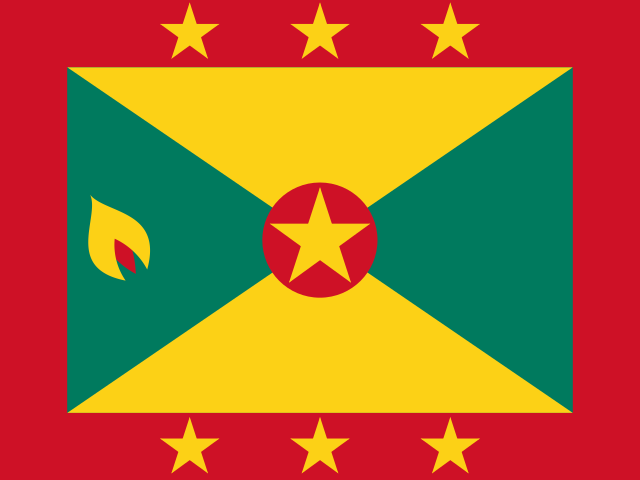
Top Rated Online Casinos for Grenada

Vegas Casino Online
Sign Up400% up to
$500

Liberty Slots Casino
Sign Up100% up to
$259

Sloto'Cash Casino
Sign Up100% up to
$500

Tsars Casino
Sign Up100% up to
€300
+ 100 Spins

Slot Hunter
Sign Up100% up to
$/€1,000
+ 100 Spins

Casoo Casino
Sign Up100% up to
$/€300
+ 100 Spins
Vegas Casino Online
Sign Up400% up to
$500
Liberty Slots Casino
Sign Up100% up to
$259
Sloto'Cash Casino
Sign Up100% up to
$500
Tsars Casino
Sign Up100% up to
€300
+ 100 Spins
Slot Hunter
Sign Up100% up to
$/€1,000
+ 100 Spins
Casoo Casino
Sign Up100% up to
$/€300
+ 100 Spins
Historical development
For most of the period since independence in 1974, gambling in Grenada was governed by the Gambling, Lotteries and Betting Act, Chapter 120, originally Act No. 10 of 1966 (the revised text bears the date 22 April 1970) and amended several times up to 2006. It followed the prohibition model common to former British colonies in the Caribbean. Keeping or using a “common gaming house” (any premises used for gambling) was an offence, and so was gambling in such a house or in a public place. Lotteries were banned except under listed exemptions, and betting offices needed a permit and a licence.
The state lottery developed alongside that prohibition. The National Lotteries Authority Act, Cap. 205A, which established the NLA, commenced on 3 September 1999, according to a NOW Grenada report on the NLA board that reviewed the statute.
In the 2010s the government replaced the old framework in two stages. In August 2014 the House of Representatives passed the Casino Gaming Bill, which the Planning and Economic Affairs Minister, Oliver Joseph, said would mainly serve visitors, while the Tourism Minister linked it to the tourism product (NOW Grenada, First step for legalising casino gambling approved, 15 August 2014). The bill was contested. Tobias Clement, the MP for St George’s North East, questioned whether excluding local people was compatible with citizens’ constitutional rights, and a civil-society group, Citizens in Defence of Grenada’s Lands and Heritage, published a statement opposing casino gaming as a development strategy. The Act received assent on 24 September 2014.
The broader reform followed in 2016. The Gaming Act passed both Houses in May and June 2016 and received assent on 8 July 2016. On 30 January 2017 the Ministry of Finance announced a Gaming Secretariat, located at the Ministry of Legal Affairs, and required existing gaming operators and importers of gaming machines to register by 31 January 2017. In the same month the government appointed the first Gaming Commission, chaired by a senior police officer, Franklyn Redhead. Minister Oliver Joseph said the sector was “right now unregulated”, with slot machines in small shops and children able to play (NOW Grenada, Grenada regulating its gaming sector, 11 January 2017). By December 2017 the licensing requirement for all games of chance was being enforced (CMC report in the Antigua Observer, 26 December 2017).
Legal framework

Four statutes define the present position. Amounts in Grenadian legislation are in Eastern Caribbean dollars (EC$), the currency Grenada shares with the other members of the Eastern Caribbean Currency Union.
The Gaming Act 2016
The Gaming Act 2016 (Act No. 21 of 2016) is described in its long title as an Act “related to the regulation of the use of gaming machines, the conduct of lotteries and betting, and gaming in general”. It defines gaming as playing a game of chance for a prize, including using a gaming machine, betting and taking part in a lottery. A game of chance includes games that combine chance and skill, games in which chance can be overcome by superlative skill, and games presented as involving chance; sport is excluded. The definition of a gaming machine covers any machine, platform, software or device designed or adapted for playing a game of chance for a prize, including e-gaming, which the Act defines as an interactive game of chance run by computer circuitry, including general-purpose computers and other electronic devices with a video display.
Under section 8, a person must register a gaming activity with the Gaming Commission and obtain a licence from the Minister before providing gaming facilities. Section 9 lists eight licence types, covering gaming machines, e-gaming, technical supply and repair of machines, general betting, pool betting, commercial lotteries, lotteries run by non-commercial societies, and gaming in registered members’ clubs.
Providing gaming or betting facilities without a licence is an offence under section 27, punishable on summary conviction by up to 12 months’ imprisonment, a fine of up to EC$100,000, or both. “Providing facilities” is defined broadly and includes inviting people to take part, supplying or repairing machines or software, and possessing a gaming machine. Section 38 repealed Cap. 120 and gave existing providers 90 days from commencement to comply. Appeals go to a Gaming Appeals Tribunal.
The Casino Gaming Act 2014
The Casino Gaming Act 2014 (Act No. 40 of 2014) provides for the licensing of casino premises and for casino taxes. Section 4 states that gaming “is illegal unless conducted in a casino”, while section 3 preserves activities lawful under the lottery and gaming legislation. A licence may be granted only to a company that owns or manages a hotel of at least 300 rooms approved by the Grenada Tourism Authority, or a resort approved or designated by the Minister, and the casino must be in a separate gaming room (section 12). Licences run for up to ten years, and no appeal lies against a decision to grant or refuse one (section 14).
The National Lotteries Authority Act, Cap. 205A
The NLA’s governing statute was amended twice to fit the new framework. The National Lotteries Authority (Amendment) Act 2015 redefined the responsible Minister as the one appointed with responsibility for the NLA. The National Lotteries Authority (Amendment) Act 2016 (Act No. 18 of 2016), passed together with the Gaming Act, allows the NLA, with ministerial approval, to provide gaming facilities under the Gaming Act and to authorise other persons to provide facilities on its behalf under a permit, while remaining liable for their compliance. The Gaming Act binds the NLA (section 2(2)) and requires it to consult the Gaming Commission before introducing new lottery-type games (section 35).
Regulator and licensing model
Grenada combines a state lottery monopoly with a limited licensing system for land-based gaming. Responsibility is divided between several bodies:
- The Minister responsible for Finance grants, varies, suspends and revokes licences under both the Gaming Act and the Casino Gaming Act, and may issue policy directions.
- The Gaming Commission, established under section 5 of the Gaming Act, receives applications, recommends decisions to the Minister, keeps a register of licences, inspects premises and can confiscate equipment.
- The Casino Gaming Commission, established under section 5 of the Casino Gaming Act, reviews casino applications and reports to the Minister. In 2022 the Gaming Commission’s chairman stressed that the two commissions operate under different laws.
- The National Lotteries Authority, a statutory body governed by a board of five to nine members appointed by the Minister. Since 1 November 2024 the board has had seven members, chaired by William Baptiste (NOW Grenada, 4 November 2024).
Fees under the Gaming Act are modest for small promoters. In 2017 the Gaming Commission chairman said an application cost EC$50 and a licence between EC$250 and EC$1,000, with fees waivable at the Minister’s direction for schools, churches and some non-commercial bodies (Antigua Observer, 26 December 2017). Casino licensing is far more expensive: the Casino Gaming Act sets a non-refundable application fee of EC$100,000.
Policy towards slot machines has been restrictive since the Act took effect. In March 2022 the Gaming Commission chairman explained that imports of new slot machines are banned, that technical licences are issued only to import parts for machines already on the island when the law took effect, and that machines may not be sited near schools or churches (NOW Grenada, Senator McQueen concerned about long-term effect of one-armed bandits, 21 March 2022).
The NLA’s own electronic gaming operates under a contract with Canadian Bank Note Company (CBN). In May 2023 the government announced a renegotiated agreement: the profit split on video lottery terminal (VLT) operations moved from 5:95 in CBN’s favour to 50:50, and the contract runs to 2040 (NOW Grenada, NLA and Canadian Bank Note Company renegotiate contract, 31 May 2023). VLTs are marketed under the BLAST Gaming name, which in 2024 had four entertainment centres and numerous agent locations (NOW Grenada, 6 September 2024).
Whether any hotel casino is currently licensed under the Casino Gaming Act could not be verified from the Gazette, the Ministry of Finance or the Casino Gaming Commission, none of which publishes a register online.
Online gambling: what is permitted and how it is enforced

The Gaming Act does not use the words “internet” or “remote”. Online gambling falls under its definition of e-gaming and gaming machines, which expressly includes software and platforms. Section 35(1) deems the NLA to hold an e-gaming operating licence for twenty years and provides that no other person may be granted one. In practice this is a statutory monopoly: a legal reservation of an activity to a single designated operator. A private company cannot obtain a Grenadian licence to offer online casino games, and providing unlicensed gaming facilities in Grenada is an offence under section 27. We could not verify whether the NLA currently sells lottery tickets or other games online.
Grenada previously had a separate offshore regime. Under the International Betting Act, Cap. 151A, the Grenada Authority for the Regulation of Financial Institutions (GARFIN) licensed international betting companies to serve customers abroad. At the end of 2019, 74 companies were registered under the International Companies Act and two held licences under the International Betting Act, and international betting fees brought in EC$96,162 that year (NOW Grenada, 8 March 2021). Four other offshore statutes were repealed with effect from 31 December 2021 after the European Union described them in 2017 as harmful tax practices; the International Betting Act was not on that list. On 13 February 2026 the Government Gazette published GARFIN’s cancellation, “with immediate effect”, of the licence of Bravio Ltd, described as the last international betting company registered with the Authority (NOW Grenada, GARFIN cancels BRAVIO betting company licence, 19 February 2026). The 2026 report says Cap. 151A was repealed in 2021, which conflicts with the 2021 list and with a 2026 cancellation under the Act; its status could not be verified.
The Gaming Act does not expressly address operators based outside Grenada that accept Grenadian residents, and no blocking of websites, internet service provider orders or payment restrictions aimed at offshore gambling could be found.
Position of players
Grenada’s current law focuses its offences on providers rather than players. The Gaming Act punishes providing facilities without a licence, using premises for unlicensed gaming, cheating, and allowing minors to gamble. It does not create a general offence of taking part in unlicensed gaming. The old Cap. 120 offences of gambling in a common gaming house or a public place, with fines of EC$1,500 and up to six months’ imprisonment, were repealed in 2016.
The main exception concerns casinos. Under section 19 of the Casino Gaming Act, a person under 18, and a Grenadian citizen ordinarily resident in Grenada, may not take part in casino gaming, on pain of a fine of EC$10,000. The licensee faces a fine of EC$100,000 if it fails to prevent prohibited gaming. The constitutional question raised in the 2014 debate about excluding citizens has not, so far as we could find, been tested in court.
For online play, no provision was found that makes it an offence for an adult in Grenada to use an overseas website, and no prosecution of a player was identified. That does not make such sites lawful in Grenada: they cannot be licensed locally, and a player using them has no access to a Grenadian regulator if a dispute arises.
Taxation
Operators
Section 25 of the Gaming Act imposes a monthly gaming tax on gross receipts, payable by the tenth day of the following month and administered under the Tax Administration Act 2016. Schedule IV of the Act sets the rates, which the government summarised in January 2017 (NOW Grenada, 11 January 2017):
| Activity | Gaming tax |
|---|---|
| Gaming machines (other than e-gaming) | 30% of gross receipts or EC$250 per machine, whichever is greater |
| Betting (excluding pool betting) | 30% |
| Pool betting | 30% |
| Lottery promoted by a commercial person | 25% |
| Lottery promoted by a non-commercial society or local authority | 15% |
| Gaming in members’ clubs | 15% |
The NLA and its authorised agents are exempt from this tax. Casinos are taxed separately under the Casino Gaming Act. They pay a basic annual tax from EC$50,000 to EC$200,000, depending on floor space, and a tax on gross gaming income on a sliding scale of 15%, 10%, 5% and 2.5% as income rises past EC$250,000, EC$500,000 and EC$3 million.
Players
Since 1 March 2023, a withholding tax of 15% has applied to winnings from lotteries and other games of chance (NOW Grenada, Increased VAT and Excise Tax go into effect, 1 March 2023). The Ministry of Finance explained that the tax applies only to the excess over EC$10,000, not the whole prize, and is deducted by the promoter rather than paid by the winner. The measure was based on a 2014 amendment to the Income Tax Act 2010 that had not previously been enforced (NOW Grenada report by Linda Straker).
Consumer protection and responsible gambling
Protections are mainly structural and age-based:
- Minimum age. Inviting or permitting a person under 18 to gamble, or to enter gaming premises, is an offence under sections 31 and 32 of the Gaming Act, the latter punishable by up to six months’ imprisonment or a EC$50,000 fine; employing a minor carries a fine of up to EC$75,000 (section 33). Premises selling NLA lottery tickets are exempt from the entry ban.
- Machine controls. The ban on importing new slot machines and the siting rules near schools and churches limit the spread of machines outside the NLA network.
- Casino exclusion. Under section 21 of the Casino Gaming Act the Minister may, by Order, declare a person prohibited from casino premises where their presence is undesirable in the public interest. Entering, or knowingly admitting, a prohibited person carries a fine of EC$50,000.
- Licensing tests. The Gaming Commission must consider whether an applicant is a fit and proper person, judged on integrity, competence and financial standing.
We found no national self-exclusion register, no statutory deposit or loss limits, and no dedicated gambling helpline in Grenada. Concern about harm has been raised from both sides of politics. In the Senate in March 2022, Opposition Senator Rolanda McQueen warned of “gambling houses that are popping up in every street corner” and asked what help existed for young men addicted to slot machines (NOW Grenada, 21 March 2022). In January 2026 Prime Minister Dickon Mitchell said gambling addiction “could be highly destructive”, and said some people gamble 12 to 14 hours a day (NOW Grenada, PM Mitchell concerned about domestic gambling, 7 January 2026). General guidance is available in our responsible gambling guide.
Recent and upcoming developments
- Casino Gaming (Amendment) Bill 2022. A bill tabled for debate in the House of Representatives in early 2022 would extend the disqualification of applicants with convictions for fraud, dishonesty or violence to beneficial owners, defined as natural persons holding 10% or more of shares or voting rights or otherwise controlling the business, and would create a summary offence of operating a casino without a licence, with a maximum fine of EC$100,000 (NOW Grenada). We could not confirm the final enactment or commencement of the amendment.
- NLA board (2024). The seven-member board’s two-year term from 1 November 2024 ends in late 2026.
- End of offshore betting licences (2026). GARFIN cancelled Bravio Ltd’s licence on 13 February 2026.
- Policy debate on harm (2026). No bill or consultation had followed the Prime Minister’s January 2026 remarks as of this review.
Casino listings for players in Grenada
The listings below are generated automatically from our casino database and do not show that an operator is licensed in Grenada. Under the Gaming Act 2016, only the National Lotteries Authority may hold an e-gaming licence, so no private online casino can be licensed locally and the listings must not be read as an indication that an operator is authorised in Grenada. No official online register of Gaming Commission or Casino Gaming Commission licensees is published.
Vegas Casino Online
No Deposit Bonus
$ 20
Liberty Slots Casino
No Deposit Bonus
$ 18
Sloto'Cash Casino
100% up to
∞
Tsars Casino
100% up to
€300
+ 100 Spins

Casino Extreme
200 Spins
Slot Hunter
20% up to
∞
Casoo Casino
100 Spins

22Bet Casino
100% up to
$/€300
+ 30 Spins

Lucky Tiger Casino
No Deposit Bonus
$ 55

Shazam Casino
Exclusive No Deposit Bonus
$ 50

Casino Brango
500% up to
$/€100
+ 500 Spins

1Red Casino
20% up to
∞

Lincoln Casino
No Deposit Bonus
$ 18

Rich Palms Casino
250% up to
∞

Miami Club Casino
50 Spins

Red Stag Casino
25% up to
∞

Highway Casino
$ 30

Omni Slots
50% up to
€200
+ 20 Spins

BitStarz Casino
100% up to
₿1
+ 180 Spins

Casino Classic
1 Spins

Yabby Casino
202% up to
∞

LOKI Casino
50% up to
€500
+ 60 Spins

Uptown Aces
250% up to
∞

PlayCroco Casino
300% up to
∞
+ 60 Spins

Betsafe Casino

Fair Go Casino
200% up to
∞

Las Vegas USA Casino
No Deposit Bonus
$ 20

CasinoCasino
100% up to
€100
Drake Casino
300% up to
$2,000

Zodiac Casino

Fruits4Real
125% up to
€125
+ 60 Spins

Omni Casino
75% up to
$/€150
.jpg?x15984)
Everygame Classic Casino
200% up to
∞
+ 50 Spins

Casilando
10 Spins

EnergyCasino
100% up to
$/€200
+ 400 Spins

Sun Palace Casino
No Deposit Bonus
$ 20

Slots Plus
No Deposit Bonus
$ 20

Slots Empire
230% up to
$7,500

Gold Prize Casino
10% up to
$100

Red Dog Casino

EmuCasino
100% up to
∞

Casino Max
400% up to
∞
+ 20 Spins

NetBet Casino

El Royale Casino
230% up to
∞

Slotsroom Casino
400% up to
∞
+ 20 Spins

PokerStars Casino

Luxury Casino
100% up to
$/€150

888 Casino
100% up to
€200

Spinfinity Casino
400% up to
∞
+ 20 Spins

Villento Casino
100% up to
$/€150

Jackpot Capital
25% up to
∞

House of Jack Casino
100% up to
€200

North Casino
100% up to
$/€100
.jpg?x15984)
Eddy Vegas Casino
30% up to
∞

Las Atlantis Casino
$ 2,500

Wicked Plays
45% up to
∞

Scatters Casino
100 Spins

SlotsPalace Casino
50% up to
$/€200
+ 50 Spins

Yeti Casino

BlackJack Ballroom
100% up to
$/€150

Slotastic
250% up to
∞

William Hill Casino

Cherry Jackpot
400% up to
∞
+ 20 Spins

Grande Vegas
150% up to
$300

LadyLuck Casino
100 Spins

Roaring 21 Casino
400% up to
∞
+ 20 Spins

TrueFortune
200% up to
€2,000

Fun Casino

Ozwin Casino
$ 10

21 Casino
21 Spins

Playzee Casino
100% up to
$/€300
+ 100 Spins

Dreamz Casino
10% up to
∞

10bet Casino

PlayOJO Casino
50 Spins

La Riviera Casino
5% up to
∞

Grand Mondial

DBbet Casino
100% up to
€100

Cadoola Casino
120% up to
$/€100
+ 150 Spins

Casino Mate

Dafabet Casino
100% up to
$140

Justspin Casino
100% up to
$/€100

MELBET Casino
100% up to
€350
+ 50 Spins

777 Casino
100% up to
$/€20

Slot Planet
100% up to
€222
+ 22 Spins

Nomini Casino
100% up to
€500
+ 200 Spins

Wazamba
50% up to
∞
+ 200 Spins

Bet365 Casino

Betway Casino
150 Spins

BetOnline Casino
100 Spins

Slottica Casino
200% up to
∞

CasinoClic
200% up to
€100

Jazz Casino
10% up to
$250

Betmaster Casino

Betfair Casino
Related country guides
- Trinidad and Tobago gambling guide
- Saint Lucia gambling guide
- Barbados gambling guide
- Antigua and Barbuda gambling guide
- Venezuela gambling guide
Sources and further reading
- Government of Grenada, Parliament of Grenada, Casino Gaming Act, 2014 (Act No. 40 of 2014) (2014).
- Government of Grenada, Parliament of Grenada, Gaming Act, 2016 (Act No. 21 of 2016) (2016).
- Government of Grenada, Parliament of Grenada, National Lotteries Authority (Amendment) Act, 2016 (Act No. 18 of 2016) (2016).
- Government of Grenada, Parliament of Grenada, National Lotteries Authority (Amendment) Act, 2015 (Act No. 15 of 2015) (2015).
- Government of Grenada, Parliament of Grenada, Gambling, Lotteries and Betting Act, Chapter 120 (accessed 13 October 2026).
- Ministry of Finance, Grenada, Gaming Secretariat Established (2017).
- Straker, L. (NOW Grenada), First Step For Legalising Casino Gambling Approved (2014).
- Citizens in Defence of Grenada’s Lands and Heritage (NOW Grenada), Statement on casino gaming legislation (2014).
- InterGaming, Grenada takes first step (2014).
- Straker, L. (NOW Grenada), Grenada regulating its gaming sector (2017).
- Caribbean Media Corporation (Antigua Observer), Grenada enforces law requiring organisers of all games of chance to have licence (2017).
- Straker, L. (NOW Grenada), GARFIN to experience reduction of thousands in income (2021).
- Straker, L. (NOW Grenada), Senator McQueen concerned about long-term effect of one-armed bandits (2022).
- Straker, L. (NOW Grenada), Report on the Casino Gaming (Amendment) Bill, 2022 (2022).
- Government Information Service (NOW Grenada), NLA and Canadian Bank Note Company renegotiate contract (2023).
- NOW Grenada, Increased VAT and Excise Tax go into effect (2023).
- Straker, L. (NOW Grenada), Report on the 15% withholding tax on winnings from games of chance (2023).
- NOW Grenada, Blast Gaming agents donate school packs in back-to-school initiative (2024).
- Straker, L. (NOW Grenada), Cabinet increases number of people to serve on NLA board (2024).
- Straker, L. (NOW Grenada), PM Mitchell concerned about domestic gambling (2026).
- Straker, L. (NOW Grenada), GARFIN cancels BRAVIO betting company licence (2026).
 Sweden’s Credit Gambling Ban Puts Casino Payment Flows Back in Focus
 GLI Approved to Test New Zealand iGaming Market
 Brazil Sets December Deadline for Former Betting Operators
 Tonybet Adds Poker to Its Irish Platform
 SBC Awards 2026 Winners Announced in Lisbon