


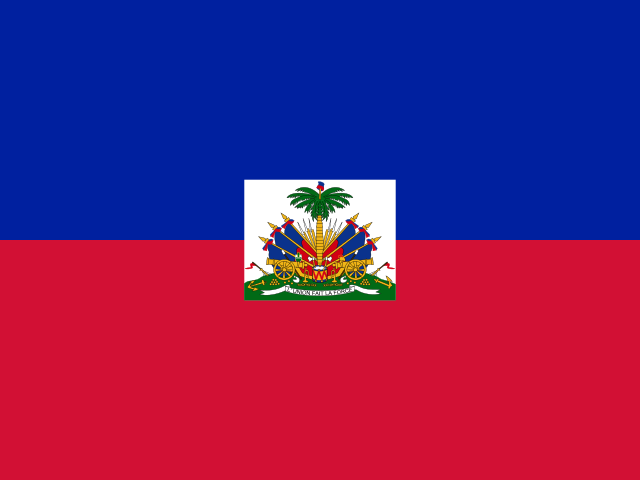
Haiti has a long-established and very large gambling culture but a thin and contested regulatory framework. Legally, games of chance fall under the Loterie de l’État Haïtien (LEH), the state lottery, an autonomous public body attached to the Ministry of Economy and Finance, which claims authority over every form of gambling in the country: the borlette (a private numbers game), casinos, sports betting and, according to its own recent statements, online gaming. In practice, much of the sector operates informally. The LEH was closed for about 14 years before reopening in 2013, its authority has been disputed by a borlette operators’ association, and its own estimates suggest that only a minority of operators declare their activity. There is no published online gambling licensing regime, no blocking of foreign websites and no specific offence for players. This guide sets out what the sources show and where the gaps lie.
Key points
- The LEH bases its claim to regulate all games of chance on a law of 4 September 1958. It was reopened in July 2013 after being closed for about 14 years.
- The borlette, a numbers game usually based on United States lottery draws, is the dominant form of gambling. A 2010 study estimated about 35,000 stalls; a 2025 academic paper notes that a figure of 400,000 borlette banks is often cited but that the number cannot be measured precisely.
- Sports betting, increasingly through mobile platforms, operates under concession contracts with the LEH. No published register of licensed online operators or blocking regime was found.
- No provision making it an offence for an individual to gamble, including online with a foreign site, was found in the sources reviewed.
- Gambling establishments pay a flat annual income tax of 25% of rental value, with a minimum raised to HTG 25,000 in the 2023–2024 budget decree. The LEH also collects authorisation fees.
- In July 2026 the LEH announced a digital registration platform (SYLEH) and a regularisation drive. There is no national self-exclusion scheme or gambling helpline.
Last reviewed: 13 October 2026.
Top Rated Online Casinos for Haiti

Vegas Casino Online
Sign Up400% up to
$500

Liberty Slots Casino
Sign Up100% up to
$259

Sloto'Cash Casino
Sign Up100% up to
$500

Tsars Casino
Sign Up100% up to
€300
+ 100 Spins

Casoo Casino
Sign Up100% up to
$/€300
+ 100 Spins

22Bet Casino
Sign Up100% up to
$/€300
+ 30 Spins
Vegas Casino Online
Sign Up400% up to
$500
Liberty Slots Casino
Sign Up100% up to
$259
Sloto'Cash Casino
Sign Up100% up to
$500
Tsars Casino
Sign Up100% up to
€300
+ 100 Spins
Casoo Casino
Sign Up100% up to
$/€300
+ 100 Spins
22Bet Casino
Sign Up100% up to
$/€300
+ 30 Spins
Historical development
The borlette (bòlèt in Haitian Creole) is the centre of Haitian gambling. Players choose two- to five-digit numbers in small shops or kiosks, often called banks, and winners are determined by external results, mainly those of the New York lottery, with results announced twice a day. A 2010 study by Kim Wilson and Mariah Levin for the Fletcher School at Tufts University, Savings and Chance, estimated that there were over 35,000 borlette stalls “in almost every village”, offering payouts of 10, 20 or 50 times the stake, and cited a 2010 press report putting the stalls’ annual gross receipts at about US$1.5 billion. The study treated the borlette as an informal financial service as much as a pastime: its appeal lies in the hope of a single, transformative lump sum.
The state lottery has had a discontinuous history. Reported founding dates differ between sources: a January 2025 report by Amitié FM dates the LEH to 1949, while the LEH’s own officials have cited a law of 4 September 1958 as its legal basis (see below). The institution was closed for about 14 years, which President Michel Martelly attributed to “socio-political upheaval”. It was formally reopened in July 2013 at its Pacot headquarters in Port-au-Prince, with the stated aims of resuming regulation of the gambling industry, modernising through a computer system and “normalising” games including baccarat, casino games, lotto, borlette and cockfighting (gaguère) (HaitiLibre, 3 July 2013).
During the closure, the Association nationale des tenanciers de borlette (ANTB), a non-profit association of borlette operators, coordinated the sector (HaitiLibre, 2013). Since 2013 the relationship between the two bodies has been the main fault line in Haitian gambling regulation. In 2016 the LEH’s director general complained that standardised borlette slips, printed by the LEH since 2014 under a partnership agreement with the ANTB, had never been sold because of “the unwillingness of ANTB leaders to respect the rules of the game” (HaitiLibre, 27 July 2016). In January 2018 the LEH said it intended to be the only regulator of all games of chance and accused the ANTB of relying on a decree of around 30 years’ standing, which the report did not name, in defiance of the law (HaitiLibre, 15 January 2018).
Sports betting grew alongside the borlette from the 2010s. Geographer Marie Redon, in a 2025 paper titled Vers la cyber-borlette (loterie) : enjeux des jeux d’argent en Haïti, records that several sports-betting companies obtained concession contracts from the LEH over roughly a decade, and cites research identifying six main sports-betting platforms in 2020.
Legal framework

Haiti has no modern, consolidated gambling statute. The framework rests on a small number of older texts, administrative notes issued by the LEH, and tax provisions.
The 1958 law and the LEH’s mandate
According to Redon (2025), a framework law (loi-cadre) of 4 September 1958 governs games of chance and makes the LEH the only body with authority to regulate them. In May 2018 the LEH’s then director general, Marie Margareth Fortuné, cited the same law when she announced that the LEH “seeks to take control of all games of chance in the national territory” and said that all organisers of activities linked to the 2018 FIFA World Cup had to obtain its prior authorisation (the report did not refer specifically to betting) (Radio Nationale d’Haïti, 31 May 2018). The full text of the 1958 law could not be located in an online official source for this guide, so its exact provisions, including any penalties, could not be verified.
A competing legal claim exists. As noted above, the ANTB has relied on an older decree to assert its own authority over borlette operators. Redon (2025) describes two bodies being treated as regulators, with some borlettes holding ANTB authorisations and others LEH authorisations, and concludes that this split leaves much of the sector unregulated. In 2019 the LEH seized what it called false ANTB authorisations during closures of borlette outlets (HaitiLibre, 22 January 2019). In July 2026 the LEH welcomed a decision by “the competent authorities” that, in its account, ended the confusion about the ANTB’s status; the reports seen did not identify that decision or its legal form (see Recent developments).
Operating rules issued by the LEH
Much of the practical regulation takes the form of LEH notes and memoranda rather than legislation:
- Authorisation fees. Under an LEH memorandum dated 16 August 2022, operators pay HTG 10,000 a year per borlette bank or machine, and electronic borlette machines pay HTG 5,000 a month (Redon, 2025).
- Payout protocol. A memorandum dated 3 January 2023 set minimum payouts for borlette games: for each gourde staked on two digits, HTG 50, 20 and 10 for the first, second and third prizes, and higher multiples for three- to five-digit combinations. Operators that deviated were threatened with seizure of equipment and closure of sales points (Haiti Press Network, 9 January 2023).
- Minors. In January 2025 the LEH formally banned minors from gambling establishments, including borlette kiosks, citing the UN Convention on the Rights of the Child. No national statute or specific age threshold was cited in the reports (Vant Bèf Info, 10 January 2025).
Tax and anti-money-laundering law
Two further bodies of law are relevant. The income tax decree of 2005 contains a specific provision on gambling establishments (see Taxation). Haiti’s 2013 anti-money-laundering law, amended in 2016, is the primary statute on money laundering, but the 2019 mutual evaluation by the Caribbean Financial Action Task Force (CFATF) found that there was “no AML/CFT supervision of the DNFBP sector”, the category of designated non-financial businesses and professions that includes casinos. It rated Haiti non-compliant on the relevant recommendations.
Regulator and licensing model
Formally, Haiti operates a state-controlled licensing model: the state does not hold a monopoly over the running of games, but private operators require LEH authorisation, pay fees and, for larger businesses such as sports-betting companies, hold concession contracts. The LEH reopened in 2013 with a mandate covering lottery products, borlette and casino games (HaitiLibre, 2013). In July 2026 its commercial director described its remit as covering the national lottery, borlette, casinos, sports betting, online gaming and digital platforms (SoloAzar, July 2026, reporting iciHaiti).
The model works poorly in practice. Redon (2025) reports an LEH estimate that only about 30% of borlette operators declare their activity, and quotes a former director general, Margareth Fortuné, as saying that the LEH lacks the coercive means to close businesses that refuse to pay. The LEH’s enforcement history illustrates both the intent and its limits:
- In January 2019 it closed four borlette banks and seized machines in the presence of a justice of the peace and police (HaitiLibre, 22 January 2019).
- In November 2021 an LEH team closed borlette banks and sports-betting outlets in the Grand’Anse department that had refused to regularise with the LEH, described as the sector’s “regulatory authority” (Vant Bèf Info, 29 November 2021).
- In January 2022 the LEH suspended its regional coordination offices and all recovery operations “until further notice”, in order to reorganise fee collection (Gazette Haïti, 21 January 2022).
- In January 2024 the LEH, under a new administration led by Luc Ouanche, reported that it had regularised contracts, granted new concession contracts and was developing a technical system to monitor funds entering and leaving the gaming sector in order to prevent money laundering (HaitiLibre, 14 January 2024).
No official register of licensed operators, licence categories or published fee schedule beyond the memoranda described above was found. The LEH’s website (leh.ht) could not be accessed for this review. The number of casinos is also uncertain: the CFATF’s 2019 report cited open sources indicating about 157 licensed casinos in 2017, noted that the authorities’ own figures were “much lower”, and reported “many unlicensed casinos”. The term casino in Haiti commonly includes small slot-machine halls as well as hotel casinos.
Online gambling

Online and mobile betting has grown quickly. Redon (2025) describes a shift towards what she calls the “cyber-borlette”: online borlette-style games based on United States lottery results, a phone-only hybrid game based on New York results with stakes from one gourde, and sports-betting platforms that accept top-ups through mobile money (including Digicel’s MonCash) and international card networks. A 2023 survey cited in the same paper found that about 70% of bettors were aged 15 to 40 and that about 80% of bets were accumulator sports bets. A March 2025 report by Vant Bèf Info based on interviews with young people in Canapé-Vert (Port-au-Prince), described how sports betting, much of it via online platforms, had changed a gaming culture once dominated by the traditional lottery.
The legal position of online gambling can be summarised as follows:
- Domestic operators. Haitian sports-betting companies, including those operating online, work under concession contracts with the LEH. The LEH collects an annual payment from them; an unnamed source cited about HTG 6 million a year, a figure the LEH did not confirm (Vant Bèf Info, March 2025).
- No dedicated online licence. No statute, regulation or LEH instrument creating a specific licence for online casino games was found. The LEH’s July 2026 statements claim online gaming and digital platforms as part of its remit, but no licensing procedure for them has been published.
- Offshore operators. No law expressly addressing foreign online gambling sites was found, and there is no evidence of an official blocklist, internet service provider (ISP) blocking, payment blocking or advertising rules aimed at offshore operators.
Enforcement capacity must also be seen in context. Armed gangs have “overrun large parts of Port-au-Prince”, according to the Security Council Report’s July 2026 forecast, and the UN authorised a Gang Suppression Force in September 2025. Haiti has been on the Financial Action Task Force (FATF) list of jurisdictions under increased monitoring since June 2021, and its June 2026 action plan still includes applying risk-based supervision to higher-risk designated non-financial businesses. Redon (2025) also reports concerns, raised by journalists and denied or treated with caution by some officials, that borlette and betting businesses may be used to launder criminal proceeds.
Position of players
No provision making it an offence for an adult to gamble was identified in the sources reviewed, whether at a borlette, a casino, a sports-betting outlet or a foreign website. Regulatory action reported in the press has been directed at operators: closures, seizures and fee recovery. No prosecution or fine of an individual player was found. Because the 1958 law could not be read in full, it cannot be stated with certainty that it contains no participation offence.
Players should also be aware of practical risks. With most operators undeclared, a player has little recourse if a borlette bank or betting platform refuses to pay. The LEH’s 2023 payout memorandum was issued precisely because operators were paying less than the standard multiples (Haiti Press Network, 2023). Players using foreign online sites have no Haitian body to complain to. Minors are barred from gambling establishments by the LEH’s January 2025 note, which threatened to refer both operators and minors found on the premises to the authorities.
Taxation
Gambling taxation in Haiti combines a general tax on gambling establishments with LEH fees:
- Flat establishment tax. Article 74 a) of the income tax decree of 2005, as published by the Direction Générale des Impôts, provides that operators of games of chance pay, for each establishment, a final flat tax (impôt libératoire) of 25% of the annual rental value, with a minimum originally set at HTG 10,000. The receipt must be displayed in each gambling establishment.
- 2023 increase. Article 37 of the budget decree for the 2023–2024 fiscal year (Le Moniteur, special issue No. 25, 29 September 2023) amended Article 74 so that the tax can never be less than HTG 25,000, payable between 1 and 31 October each year.
- LEH fees. Borlette banks and machines pay the authorisation fees set by the August 2022 memorandum, and sports-betting companies make annual payments under their concession contracts (see above).
No specific tax on players’ gambling winnings was found in the 2005 income tax decree; it contains only a general category for income not otherwise classified. The tax treatment of winnings should therefore be confirmed with the Direction Générale des Impôts. Because most operators do not declare their activity, Redon (2025) concludes that the state loses most of the revenue the sector should generate. No official figure for the LEH’s annual revenue or the sector’s gross gaming revenue (GGR, stakes minus winnings paid) was found.
Consumer protection and responsible gambling
Consumer protection measures are limited:
- Minors. The LEH’s January 2025 ban on minors’ access to gambling establishments is the main protective rule, enforced through inspections (Amitié FM and Vant Bèf Info, January 2025).
- Payout standards. The 2023 payout protocol sets minimum prize multiples for borlette games.
- Self-exclusion. No national self-exclusion register or operator-level exclusion scheme was found.
- Support services. No dedicated gambling helpline or treatment service in Haiti was found.
Concern about harm is growing. Redon (2025) cites reports of young people losing large sums on betting platforms, and Vant Bèf Info’s 2025 report quoted a betting-company manager who said that some young people stake their school fees. No national prevalence study of problem gambling in Haiti was found. Readers looking for general guidance on limiting gambling and recognising warning signs can consult our responsible gambling guide.
Recent and upcoming developments
- LEH regularisation drive (July 2026). At a press conference on 3 July 2026, as reported by SoloAzar citing iciHaiti, LEH commercial director Munson Jean presented the SYLEH digital platform for registering and regularising operators, collecting fees and monitoring activity, and argued that a modern law on games of chance was needed. He said powerful private interests were trying to influence the LEH’s governance (SoloAzar, July 2026). No draft law had been published as of this review.
- ANTB status (2026). The LEH stated that the competent authorities had ended the confusion over the ANTB, which it said had never been a general regulator. The underlying decision was not identified in the reports seen.
- Minors (January 2025). The LEH introduced a formal ban on minors in gambling establishments.
- Tax (2023). The minimum flat tax on gambling establishments rose to HTG 25,000 for fiscal year 2023–2024.
- AML monitoring. Haiti remained under FATF increased monitoring in June 2026, with the FATF noting that “all deadlines have expired and work remains”.
Any reform will take place against an unsettled political background. According to Security Council Report (July 2026), the Transitional Presidential Council was dissolved in February 2026, leaving the prime minister as the sole executive authority, and general elections, the first since 2016, had not yet been scheduled with certainty.
Casino listings for players in Haiti
The listings below are generated automatically from our casino database. They do not show that an operator is authorised in Haiti: the LEH has not published a licensing procedure or register for online casinos, and no online casino licence issued by it was found. Readers should check an operator’s status with the Loterie de l’État Haïtien and consider the limited recourse available to players.
Vegas Casino Online
No Deposit Bonus
$ 20
Liberty Slots Casino
No Deposit Bonus
$ 18
Sloto'Cash Casino
100% up to
∞
Tsars Casino
100% up to
€300
+ 100 Spins

Casino Extreme
200 Spins
Casoo Casino
100 Spins
7Bit Casino
20% up to
∞
22Bet Casino
100% up to
$/€300
+ 30 Spins

Casino Brango
500% up to
$/€100
+ 500 Spins

Lucky Tiger Casino
No Deposit Bonus
$ 55

Shazam Casino
Exclusive No Deposit Bonus
$ 50

Red Stag Casino
25% up to
∞

Lincoln Casino
No Deposit Bonus
$ 18

Omni Slots
50% up to
€200
+ 20 Spins

Rich Palms Casino
250% up to
∞

Miami Club Casino
50 Spins

Highway Casino
$ 30

Yabby Casino
202% up to
∞

LOKI Casino
50% up to
€500
+ 60 Spins

Casino Classic
1 Spins

Uptown Aces
250% up to
∞

Fair Go Casino
200% up to
∞

DuckyLuck Casino
500% up to
$/€2,500
+ 150 Spins

PlayCroco Casino
300% up to
∞
+ 60 Spins

Zodiac Casino

CasinoCasino
100% up to
€100

Fruits4Real
125% up to
€125
+ 60 Spins

Las Vegas USA Casino
No Deposit Bonus
$ 20
GunsBet Casino
60% up to
$/€300
+ 20 Spins

Casilando
10 Spins

Omni Casino
75% up to
$/€150

Slots Plus
No Deposit Bonus
$ 20

Sun Palace Casino
No Deposit Bonus
$ 20

EnergyCasino
100% up to
$/€200
+ 400 Spins

El Royale Casino
230% up to
∞

Gold Prize Casino
10% up to
$100

Red Dog Casino

Slots And Casino
500% up to
∞
+ 150 Spins

Slots Empire
230% up to
$7,500

EmuCasino
100% up to
∞

PokerStars Casino

Luxury Casino
100% up to
$/€150

Villento Casino
100% up to
$/€150

Jackpot Capital
25% up to
∞

House of Jack Casino
100% up to
€200

JacksPay
200% up to
$2,000

888 Casino
100% up to
€200

Las Atlantis Casino
$ 2,500

Ripper Casino
25% up to
∞

SlotsPalace Casino
50% up to
$/€200
+ 50 Spins
.jpg?x15984)
Eddy Vegas Casino
30% up to
∞

Wicked Plays
45% up to
∞

Slotastic
250% up to
∞

BlackJack Ballroom
100% up to
$/€150

Fun Casino

TrueFortune
200% up to
€2,000

Grande Vegas
150% up to
$300

Ozwin Casino
$ 10

21 Casino
21 Spins

LadyLuck Casino
100 Spins

Grand Mondial

La Riviera Casino
5% up to
∞

DBbet Casino
100% up to
€100

Cadoola Casino
120% up to
$/€100
+ 150 Spins

Dafabet Casino
100% up to
$140
Syndicate Casino
100% up to
€225

MELBET Casino
100% up to
€350
+ 50 Spins

Casino Mate

777 Casino
100% up to
$/€20

Nomini Casino
100% up to
€500
+ 200 Spins

iLucki Casino

Slot Planet
100% up to
€222
+ 22 Spins

Wazamba
50% up to
∞
+ 200 Spins

Slottica Casino
200% up to
∞

BetOnline Casino
100 Spins

GetSlots Casino

CasinoClic
200% up to
€100

Jazz Casino
10% up to
$250

Betfair Casino
Related country guides
- Dominican Republic gambling guide
- Jamaica gambling guide
- Puerto Rico gambling guide
- Aruba gambling guide
- Curaçao gambling guide
Sources and further reading
- Marie Redon, Vers la cyber-borlette (loterie) : enjeux des jeux d’argent en Haïti, in Actes des journées d’étude « Failles haïtiennes » (2025).
- Kim Wilson and Mariah Levin, Fletcher School, Tufts University, Savings and Chance: Learning from the Lottery to Improve Financial Services in Haiti (2010).
- Direction Générale des Impôts, Décret sur l’impôt sur le revenu (2005), consolidated version (accessed 13 October 2026).
- Le Moniteur, Journal officiel de la République d’Haïti, Décret établissant le Budget général de la République d’Haïti, exercice 2023–2024, Spécial No. 25 (2023).
- Caribbean Financial Action Task Force, Mutual Evaluation Report: Republic of Haiti (2019).
- Financial Action Task Force, Jurisdictions under Increased Monitoring – June 2026 (2026).
- Security Council Report, July 2026 Monthly Forecast: Haiti (2026).
- HaitiLibre, Official reopening of the State Lottery (3 July 2013).
- HaitiLibre, The Borlettes refuse to respect the rules of the game (27 July 2016).
- HaitiLibre, Lottery of the Haitian State, between pressures and open conflict (15 January 2018).
- Radio Nationale d’Haïti, Tous les jeux de hasard contrôlés par la LEH sur le territoire national (31 May 2018).
- HaitiLibre, The State Lottery goes into action, closure of borlettes and seizures of materials (22 January 2019).
- Vant Bèf Info, Les opérateurs des jeux de hasard sont tenus de respecter la loi, rappelle la Loterie de l’État Haïtien (29 November 2021).
- Gazette Haïti, La Direction générale de la LEH suspend les services des coordinations régionales (21 January 2022).
- Haiti Press Network, Le protocole des lots gagnants doit être respecté, prévient la Loterie de l’État haïtien (9 January 2023).
- HaitiLibre, End of turbulence at the State Lottery since the new administration (14 January 2024).
- Amitié FM, La Loterie de l’État haïtien interdit l’accès des mineurs aux jeux d’argent (11 January 2025).
- Vant Bèf Info, Interdiction stricte des jeux de hasard aux mineurs, la LEH serre la vis (10 January 2025).
- Vant Bèf Info, Les paris sportifs, une addiction chez les jeunes Haïtiens (5 March 2025).
- SoloAzar, New Regulatory Measures for Gambling: Haiti’s Path to Transparency (July 2026).