Legal casino gambling age in Niger
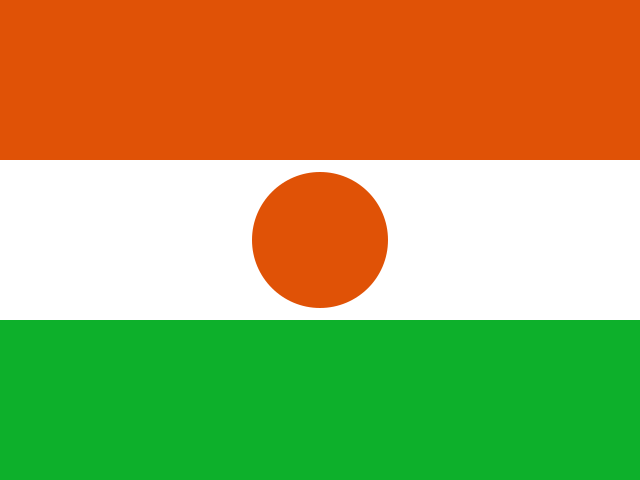
Niger, the landlocked Sahelian republic whose capital is Niamey, operates a state monopoly model of gambling. It should not be confused with its southern neighbour Nigeria, which has a separate, largely state-level licensing system described in our Nigeria guide. In Niger, the Loterie Nationale du Niger (LONANI), a public industrial and commercial establishment re-established by a decree issued under the Ministry of Finance (MF), states that it holds the monopoly over all games involving a money stake throughout the national territory. LONANI runs the lottery, pari mutuel betting on horse racing and fixed-odds football betting, and it also authorises and supervises the few land-based gaming halls and casinos in Niamey. No legal framework for licensing private online casinos has been identified. The only online gambling product offered by the state operator in late 2025 was its football betting game.
Key points
- LONANI traces its origins to Law No. 66-012 of 20 January 1966, was reorganised by Ordinance No. 93-006 of 15 February 1993 and was re-established by Decree No. 2023-409/PRN/MF of 18 May 2023.
- LONANI states that it holds “le monopole de l’activité ludique avec mise d’argent” (the monopoly of gaming activity with a money stake) and describes itself as the authority that controls gaming halls, casinos, online games and promotional games.
- LONANI reported turnover of 73.5 billion CFA francs in 2024, up about 35% on 2023, and forecast 97 billion CFA francs for 2025.
- No licensing regime for private online casinos has been identified, and no published blocklist of unauthorised gambling websites was found.
- No measure by the post-2023 military government specifically banning or restricting gambling could be found in the sources reviewed; a new Penal Code was adopted by Ordinance No. 2026-09 of 16 February 2026.
Last reviewed: 13 October 2026.
Online casinos for Niger
We may earn commission from links. Commission and paid placements do not affect casino ordering. Affiliate disclosure · How these listings work.

Casoo Casino
Sign Up100% up to
$/€300
+ 100 Spins

Lincoln Casino
Sign Up100% up to
$100
+ 25 Spins

Vegas Casino Online
Sign Up400% up to
$500

Liberty Slots Casino
Sign Up100% up to
$259

Sloto'Cash Casino
Sign Up100% up to
$500

Tsars Casino
Sign Up100% up to
€300
+ 100 Spins
Casoo Casino
Sign Up100% up to
$/€300
+ 100 Spins
Lincoln Casino
Sign Up100% up to
$100
+ 25 Spins
Vegas Casino Online
Sign Up400% up to
$500
Liberty Slots Casino
Sign Up100% up to
$259
Sloto'Cash Casino
Sign Up100% up to
$500
Tsars Casino
Sign Up100% up to
€300
+ 100 Spins
Historical development
Organised gambling in Niger has been a state activity since shortly after independence in 1960. According to LONANI’s own account of its history, the institution was created by Law No. 66-012 of 20 January 1966 under the name Tombola Nationale du Niger. A tombola is a raffle-type lottery in which numbered tickets are drawn for prizes.
The institution took its present name under Ordinance No. 93-006 of 15 February 1993, which made it a public industrial and commercial establishment, known by its French initials as an EPIC. The 1993 ordinance is the text most often cited as the source of the gaming monopoly.
Horse-race betting through the PMU, commonly called “Kalé Kalé”, is among the most popular games in Niamey (Le Sahel, 2023). A player interviewed by the national news agency in 2025 dated the introduction of PMU (pari mutuel urbain, a pool-betting system on horse races) in Niger to 1996 (ANP, October 2025). We could not confirm that date from an official source.
Niger also takes part in a regional lottery with other members of the Conseil de l’Entente (Benin, Burkina Faso, Côte d’Ivoire and Togo). This joint draw, the Tranche Commune Entente, was institutionalised in 1994 and rotates between the national lotteries each year (Le Sahel, October 2026).
The most recent institutional change took place in 2023. Decree No. 2023-409/PRN/MF of 18 May 2023 re-established LONANI to bring it into line with Law No. 2020-020 bis of 3 June 2020, which sets the rules for the different categories of public establishment (LONANI). Two months later, on 26 July 2023, the military seized power. The National Council for the Safeguard of the Homeland (Conseil national pour la sauvegarde de la patrie, CNSP), led by General Abdourahamane Tiani, suspended the constitution and state institutions (overview of the 2023 coup). Since then, laws have been made by ordinance rather than by an elected parliament.
Legal framework

Niger’s gambling law is spread across a small number of texts. Most are not available in consolidated form online, and the official gazette (Journal officiel) could not be searched for this review. The texts identified are set out below.
| Text | Subject |
|---|---|
| Law No. 66-012 of 20 January 1966 | Created the Tombola Nationale du Niger |
| Ordinance No. 93-006 of 15 February 1993 | Reorganised the institution as LONANI, an EPIC; cited as the source of the monopoly |
| Law No. 2020-020 bis of 3 June 2020 | General rules on categories of public establishment |
| Decree No. 2023-409/PRN/MF of 18 May 2023 | Re-established LONANI under the 2020 law |
| Penal Code (Law No. 61-27 of 15 July 1961, as amended) | Offences relating to gaming houses, games of chance in public places and lotteries |
| Ordinance No. 2026-09 of 16 February 2026 | Institutes a new Penal Code |
| General Tax Code (Code général des impôts) | Tax on lottery receipts and tax on games of chance |
The LONANI monopoly
A monopoly in this context means that the law reserves an activity to a single body, so that anyone else offering it needs a specific exemption or authorisation. LONANI’s statement of its legal position is direct: it “détient le monopole de l’activité ludique avec mise d’argent et contrepartie en espèces et/ou en nature, sur tout le territoire national”, that is, the monopoly over gaming with a money stake and a reward in cash or in kind throughout the country (LONANI, Présentation). Its stated public-service mission is the “mobilisation de l’épargne nationale”, the mobilisation of national savings, through games of chance. A second mission is the monitoring and oversight of operators that the state authorises to run games.
LONANI therefore has a dual role. It is both an operator, selling its own lottery and betting products, and a supervisory body for the private operators it authorises. In an interview published on 14 November 2025, its Director General described LONANI as the regulatory authority for games of chance in Niger and said that it controls gaming halls, casinos, online games and promotional games (Le Sahel, November 2025). In the same interview he said the legal framework for lotteries and games of chance needed revision. No separate gambling commission was identified. LONANI and its Director General appear on the Ministry of Finance’s website (Ministry of Finance).
The Penal Code
The Penal Code has long contained a chapter on gambling. The 2018 Ministry of Justice edition of the code, published on the UN Office on Drugs and Crime’s legal database, lists Chapter VII, “Maisons de jeux, jeux de hasard, loteries, maisons de prêts sur gages et délit d’usure”, covering articles 356 to 364.5. It includes sections on gaming houses (articles 356 and 357), games of chance on the public highway or in a public place (articles 358 and 359) and lotteries (article 360) (UNODC SHERLOC, Code pénal du Niger 2018). We were unable to obtain the full text of those articles from an accessible copy, so their elements and penalties are not stated here.
In 2026 the government replaced the code. Ordinance No. 2026-09 of 16 February 2026 instituted a new Penal Code (Ordinance No. 2026-09, partial text). Its contents were reported in June 2026, after AFP consulted the official gazette, when the code had already been promulgated for several weeks (RFI/AFP via AllAfrica, June 2026). The partial copy of the new code that we reviewed ends at article 153 and contains no gambling provisions up to that point. Whether the old gambling offences were carried over, changed or dropped could not be verified.
Regulator and licensing model
Niger’s model is a state monopoly with authorised exceptions. LONANI is the only operator of lotteries and betting. Private businesses may operate gaming halls with machines and casinos only under an authorisation from LONANI.
LONANI’s products
LONANI’s products in 2025 were scratch and draw lottery tickets, PMU betting on horse races, the Loto Balsa 5/90 numbers game and the football betting game Parifoot-Niger (ANP, December 2025). They are sold through kiosks found across Niamey on main roads, at roundabouts and in residential districts (Le Sahel).
LONANI’s reported turnover was 54.3 billion CFA francs in 2023 and 73.5 billion CFA francs in 2024, an increase of about 35%. Its Director General forecast 97 billion CFA francs for 2025 and said that more than 5 billion CFA francs were paid to winners each month (Le Sahel, November 2025). Turnover is the total amount staked, not the amount the operator keeps. These are LONANI’s own figures; no independent audited accounts were found.
Gaming halls and casinos
Private gaming halls and casinos are licensed by LONANI. In a January 2023 report, LONANI’s head of sales explained that operators must run from a fixed, identified hall. To obtain an authorisation, they need a sanitation certificate, a morality check on the operator and a fire-safety inspection of the premises by the fire service, and they must pay fees. LONANI inspects licensed halls by checking the authorisation, comparing the number of machines with the number permitted and confirming that the hall is at the licensed address (ANP, January 2023).
A 2019 report counted three casinos in Niamey, offering slot machines, poker, roulette and blackjack (Agenda Niamey, 2019). LONANI does not publish a register of authorised venues, so the current number cannot be confirmed.
Official fee schedules were not found. A 2021 press article reported that a casino authorisation cost 5 million CFA francs for two years and that each slot machine was charged 500,000 CFA francs for two years. The same article alleged that some operators paid for a single casino authorisation while running many machines, and that this reduced the sums paid to the state and to the municipality (Niger Diaspora, 2021). These claims relied on unnamed sources and have not been confirmed officially.
Online gambling and enforcement

The state’s online offer
LONANI’s first significant online product was Parifoot-Niger, a variable-odds football betting game launched on 9 December 2021 with a technology partner. It was sold both at physical points of sale and online on mobile and web, with accounts funded by recharge vouchers bought from vendors. The minimum stake was 300 CFA francs and the maximum 100,000 CFA francs per ticket (Africa-Press, December 2021). In November 2025 the Director General said that “le seul produit commercialisé en ligne est le Parifoot”, meaning that Parifoot was the only product sold online (Le Sahel, November 2025). LONANI’s website also offers a bettor account with registration and login (LONANI website).
LONANI has set the goal of digitising all of its products in 2026 and developing digital games. Its Director General also said it intends to expand partnerships with online gaming operators, particularly in sports betting (Le Sahel, November 2025). Trade press reported the digitisation goal in December 2025 and January 2026 (Focus Gaming News, December 2025; Focus Gaming News, January 2026). The terms of any such partnerships had not been published at the time of this review.
Online casinos and offshore operators
No Nigerien law or LONANI document found for this review provides for licensing private online casinos. Because LONANI claims a monopoly over all games with a money stake, an online casino offering games to residents without LONANI’s authorisation would fall outside the legal framework. LONANI’s leadership describes online gaming offered by others as “la concurrence féroce et déloyale”, fierce and unfair competition, and refers to informal operators and sometimes unauthorised games (Le Sahel, November 2025).
The usual enforcement tools elsewhere are blocking, meaning orders to internet providers to prevent access to websites, and payment blocking, meaning orders to banks and mobile money providers to refuse transactions with unlicensed operators. No published blocklist of gambling websites and no payment-blocking order in Niger were found for this review. Likewise, no specific gambling advertising code was identified.
Enforcement against land-based machines
The documented enforcement activity concerns street gaming machines rather than websites. In January 2023 the national news agency reported a spread of “casinos de trottoir” in Niamey: small slot machines, often of Chinese manufacture, placed in the street in front of hair salons, run by teenagers who had left school and crowded by children under 18, with stakes of 100 CFA francs. LONANI said that “ces machines implantées dans la rue ne sont pas autorisées par la loterie” (these street machines are not authorised by the lottery). It said it had repeatedly asked the morals police to seize them and had set up a committee with stakeholders to keep minors away, but that seized machines were soon replaced (ANP, January 2023).
Position of players
The sources reviewed do not show that playing with an unauthorised online casino is itself a specific offence for players in Niger. The 2018 edition of the Penal Code contains offences on gaming houses, games of chance in public places and lotteries, but the text of those articles could not be checked. Nor could it be checked whether they reach players or only organisers, or whether the 2026 code retains them. No reported prosecution of an individual player for online gambling was found.
The practical position is clearer. Lawful gambling is limited to LONANI’s products and to venues authorised by LONANI. A resident who uses an offshore website has no recourse through a Nigerien authority if the operator refuses to pay, closes the account or misuses personal data. Minors under 18 are not permitted to gamble, according to LONANI’s statements to the national news agency (ANP, January 2023).
Taxation
Gambling taxation in Niger is set out in the General Tax Code. Its table of contents lists a “taxe sur les recettes de loterie” (tax on lottery receipts) and a “taxe sur les jeux de hasard” (tax on games of chance) in Book I. It also lists an exemption from stamp and registration duties for Loterie Nationale du Niger tickets, and a municipal tax on gaming machines installed in public places in Book II (Niger eRegulations, Code général des impôts). The copy available online could not be read as far as those sections, so the rates and the persons liable are not stated here. The edition date of that copy is also unclear, and recent finance laws may have amended the provisions.
No official source was found on whether players’ winnings are taxed. Readers who need certainty should consult the Direction générale des impôts. LONANI also makes contributions outside the tax system. It reported donating 103.9 million CFA francs to the Fonds de Solidarité pour la Sauvegarde de la Patrie on 24 January 2025. It has also funded classrooms, health centres and boreholes (Le Sahel, November 2025).
Consumer protection and responsible gambling
Consumer protection in Niger’s gambling sector is limited and largely depends on LONANI’s own practices. The protections found for this review are:
- Age limit: gambling is prohibited for those under 18, as stated by LONANI (ANP, January 2023).
- Venue authorisation: gaming halls and casinos must hold LONANI authorisation, pass a morality check and a fire-safety inspection, and operate from fixed premises.
- Stake limits: Parifoot-Niger capped stakes at 100,000 CFA francs per ticket at launch.
- Public warnings: at Parifoot’s launch, LONANI’s commercial director warned that games of chance can lead to debt (Africa-Press, December 2021).
No national self-exclusion register, meaning a scheme under which a person can ask to be barred from gambling, was found. Nor was a dedicated gambling helpline or treatment organisation. LONANI’s website contained no responsible gambling page at the time of review. National press reporting describes players ranging from civil servants and students to the unemployed, including an unemployed graduate and a low-paid school guard. Many see gambling as a possible route up the social ladder rather than as recreation, and play despite socio-cultural and religious considerations (Le Sahel, 2023; ANP, October 2025). Anyone concerned about their gambling should seek help from a doctor or health centre. General guidance is available in our responsible gambling guide.
Recent and upcoming developments
- Change of leadership (January 2024). Colonel-Major Soumana Djibo was appointed Director General of LONANI in January 2024 and took office on 31 January 2024 (Ministry of Finance; Le Sahel, November 2025).
- Revenue growth (2024–2025). Turnover rose from 54.3 billion CFA francs in 2023 to 73.5 billion in 2024, with 97 billion forecast for 2025. The 2025 outturn had not been published at the time of review.
- Digitisation plan (2026). LONANI aims to take all of its products online in 2026 and to expand partnerships with online operators, particularly for sports betting. Delivery had not been confirmed by October 2026.
- New Penal Code (2026). Ordinance No. 2026-09 of 16 February 2026 replaced the Penal Code. Its effect on gambling offences could not be verified.
- Regional lottery (November 2026). Niamey will host the 31st Tranche Commune Entente draw on 27 November 2026, after Niger was chosen at a meeting of the Entente lottery directors held in Niamey on 22 to 24 June 2026 (Le Sahel, October 2026).
- Military government measures. No ordinance, decree or official announcement by the CNSP government that bans, suspends or restricts gambling, betting or gaming halls was found in the sources reviewed for the period from July 2023 to October 2026. Any such measure published only in the Journal officiel may not have been captured.
Casino listings for players in Niger
The listings below are generated automatically from our casino database. They do not show that an operator is authorised in Niger. LONANI holds the monopoly on games with a money stake, no private online casino licence is available, and LONANI publishes no register of authorised operators. The listings must not be read as an indication that playing with these operators is lawful. Readers should check LONANI’s official information before relying on any operator’s claims.
Vegas Casino Online
No Deposit Bonus
$ 20
Liberty Slots Casino
No Deposit Bonus
$ 18
Sloto'Cash Casino
100% up to
∞
Tsars Casino
100% up to
€300
+ 100 Spins

Casino Extreme
200 Spins
Casoo Casino
100 Spins

22Bet Casino
100% up to
$/€300
+ 30 Spins

1Red Casino
20% up to
∞

Casino Brango
500% up to
$/€100
+ 500 Spins

Shazam Casino
Exclusive No Deposit Bonus
$ 50

Lucky Tiger Casino
No Deposit Bonus
$ 55

Rich Palms Casino
250% up to
∞
Lincoln Casino
No Deposit Bonus
$ 18

Miami Club Casino
50 Spins

Red Stag Casino
25% up to
∞

Omni Slots
50% up to
€200
+ 20 Spins

BitStarz Casino
100% up to
₿1
+ 180 Spins

Highway Casino
$ 30

Casino Classic
1 Spins

Yabby Casino
202% up to
∞

LOKI Casino
50% up to
€500
+ 60 Spins

Uptown Aces
250% up to
∞

VAVADA Casino
100 Spins

Fair Go Casino
200% up to
∞

Betsafe Casino

DuckyLuck Casino
500% up to
$/€2,500
+ 150 Spins

PlayCroco Casino
300% up to
∞
+ 60 Spins
LeoVegas

Las Vegas USA Casino
No Deposit Bonus
$ 20

CasinoCasino
100% up to
€100

Fruits4Real
125% up to
€125
+ 60 Spins

Zodiac Casino

EnergyCasino
100% up to
$/€200
+ 400 Spins

Sun Palace Casino
No Deposit Bonus
$ 20

Slots Plus
No Deposit Bonus
$ 20

Omni Casino
75% up to
$/€150

Casilando
10 Spins

Gold Prize Casino
10% up to
$100

Slots Empire
230% up to
$7,500

Slotsroom Casino
400% up to
∞
+ 20 Spins

EmuCasino
100% up to
∞

Red Dog Casino

Slots And Casino
500% up to
∞
+ 150 Spins

El Royale Casino
230% up to
∞

NetBet Casino

Casino Max
400% up to
∞
+ 20 Spins

888 Casino
100% up to
€200

Jackpot Capital
25% up to
∞

House of Jack Casino
100% up to
€200

Spinfinity Casino
400% up to
∞
+ 20 Spins

Villento Casino
100% up to
$/€150

JacksPay
200% up to
$2,000

PokerStars Casino

Luxury Casino
100% up to
$/€150
.jpg?x15984)
Eddy Vegas Casino
30% up to
∞

Las Atlantis Casino
$ 2,500

SlotsPalace Casino
50% up to
$/€200
+ 50 Spins

North Casino
100% up to
$/€100

Ripper Casino
25% up to
∞

BlackJack Ballroom
100% up to
$/€150

Wicked Plays
45% up to
∞

Scatters Casino
100 Spins

Slotastic
250% up to
∞

Yeti Casino

21 Casino
21 Spins

Dreamz Casino
10% up to
∞

LadyLuck Casino
100 Spins

Playzee Casino
100% up to
$/€300
+ 100 Spins

Cherry Jackpot
400% up to
∞
+ 20 Spins

Roaring 21 Casino
400% up to
∞
+ 20 Spins

Fun Casino

TrueFortune
200% up to
€2,000

Ozwin Casino
$ 10

Grande Vegas
150% up to
$300

La Riviera Casino
5% up to
∞

PlayOJO Casino
50 Spins

Grand Mondial

DBbet Casino
100% up to
€100

Dafabet Casino
100% up to
$140

777 Casino
100% up to
$/€20

Casino Mate

Cadoola Casino
120% up to
$/€100
+ 150 Spins

Nomini Casino
100% up to
€500
+ 200 Spins

Slot Planet
100% up to
€222
+ 22 Spins

Wazamba
50% up to
∞
+ 200 Spins

BetOnline Casino
100 Spins

Slottica Casino
200% up to
∞

Betway Casino
150 Spins

Bet365 Casino

CasinoClic
200% up to
€100

Betmaster Casino

Betfair Casino
Related country guides
- Burkina Faso gambling guide
- Nigeria gambling guide
- Benin gambling guide
- Togo gambling guide
- Ghana gambling guide
Sources and further reading
- Loterie Nationale du Niger, Présentation (accessed 13 October 2026).
- Loterie Nationale du Niger, Site officiel LONANI (accessed 13 October 2026).
- Ministère des Finances du Niger, Loterie Nationale du Niger (LONANI) (accessed 13 October 2026).
- Le Sahel (ONEP), Colonel Major Soumana Djibo, Directeur Général de la Loterie Nationale du Niger (LONANI) (14 November 2025).
- Agence Nigérienne de Presse, Niger : la loterie nationale a effectué un chiffre d’affaires de plus 73,5 milliards de FCFA en 2024 (19 December 2025).
- Agence Nigérienne de Presse, Niamey : des « casinos de trottoir » dament le pion aux établissements en règle (11 January 2023).
- Agence Nigérienne de Presse, Niamey : des jeux de hasard attirent de plus en plus du monde (29 October 2025).
- Le Sahel (ONEP), Les jeux de hasard à Niamey : quand les rangs des parieurs augmentent ! (November 2023).
- Le Sahel (ONEP), Point de presse à la Loterie Nationale du Niger (LONANI) : des explications sur le grand tirage de la Tranche Commune Entente 2026 (6 October 2026).
- Africa-Press, Lancement officiel du « Parifoot-Niger » à la LONANI (10 December 2021).
- Focus Gaming News, LONANI sets 2026 goal to digitise all lottery products in Niger (5 December 2025).
- Focus Gaming News, Niger’s National Lottery gears up for 2026 digital transformation under Colonel Major Djibo (8 January 2026).
- Agenda Niamey, Trois casinos rivalisent désormais à Niamey pour offrir le meilleur du divertissement et du jeu (23 January 2019).
- Niger Diaspora, Loterie Nationale du Niger : quand le hasard et l’affairisme se côtoient (25 September 2021).
- Ministère de la Justice du Niger (via UNODC SHERLOC), Code pénal du Niger (2018 edition).
- République du Niger (via ILGA World database), Ordonnance n° 2026-09 du 16 février 2026 portant institution du Code pénal (2026).
- RFI/AFP via AllAfrica, Niger : le pays criminalise l’homosexualité dans son nouveau code pénal (11 June 2026).
- Niger eRegulations, Code général des impôts (accessed 13 October 2026).
- Wikipedia, 2023 Nigerien coup d’état (accessed 13 October 2026).