

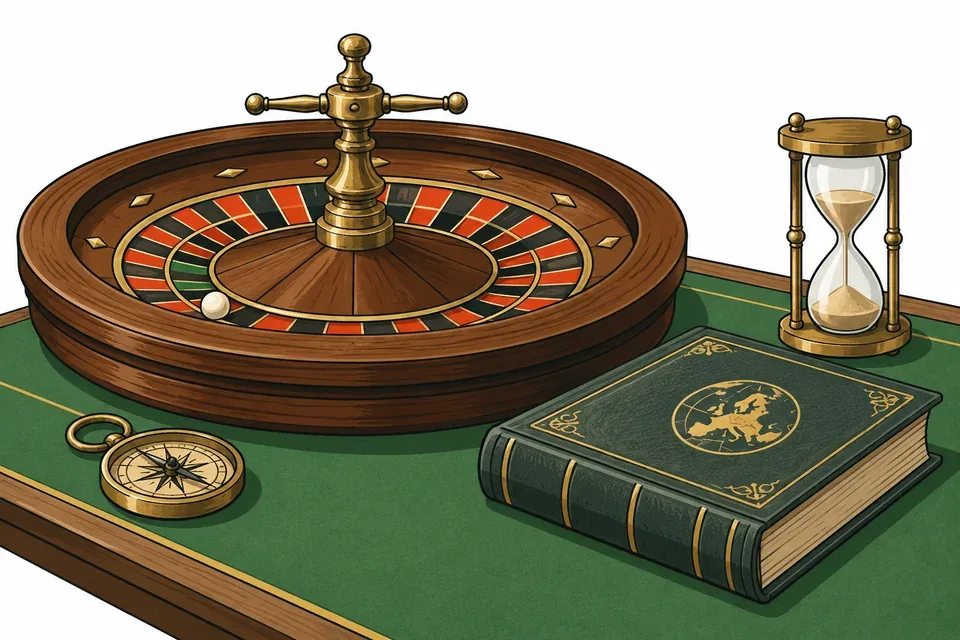
 Roulette developed in Europe before becoming a familiar casino game around the world. Its name is French for “little wheel”. Accounts of its origins often mix documented history with later stories, so precise claims about a single inventor or the first modern table deserve caution.
Early written accounts
Jacques Lablée’s La Roulette, ou Histoire d’un joueur is an early literary reference to the game. The Bibliothèque nationale de France and Hachette publish a facsimile of an 1816 edition. Such publications establish that roulette was already a recognised subject; they do not establish that its rules were identical to every modern version.
European casino history
Roulette became closely associated with European casino resorts. Monte-Carlo’s operator dates François Blanc’s founding role there to 1863. Stories about casinos, famous players and large wins are part of roulette’s cultural history, but individual wins are not evidence of a successful betting system.
Single-zero and double-zero games
Single zero
18 red + 18 black + 1 green
One-number win chance: 1 in 37
Double zero
18 red + 18 black + 2 green
One-number win chance: 1 in 38
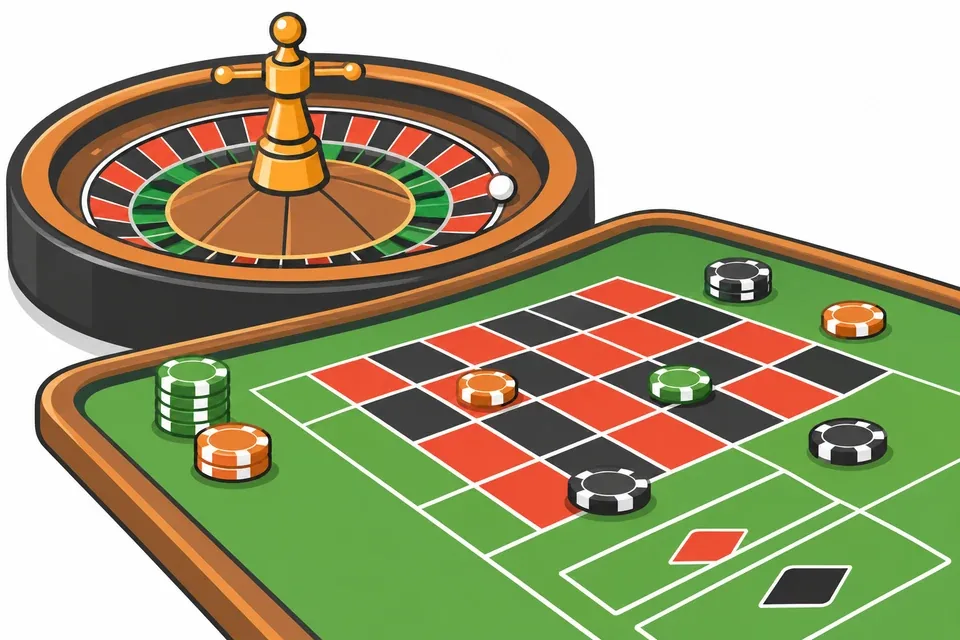
*For a standard one-number bet: 1/37 = 2.70% versus 2/38 = 5.26%. Special rules and bets can differ. Diagrams show pocket counts, not the order around a wheel.
The most important distinction for a player is the actual wheel and paytable. A standard single-zero wheel has 37 pockets: 1–36 and 0. A double-zero wheel adds 00, making 38. With a 35:1 straight-up payout, the house edge is approximately 2.70% and 5.26%, respectively. The double-zero five-number bet has a higher edge of approximately 7.89%.
French-style rules sometimes include la partage or en prison on even-money bets. These are specific table rules, not a guarantee attached to every game with a French name. La partage halves the loss on zero and reduces the single-zero even-money house edge to approximately 1.35%.
From physical tables to online play
Online roulette includes software-generated games and live video games using physical equipment. Graphics, history displays and additional betting controls change the experience, but do not by themselves improve the mathematical return. Novelty games can have different payouts and must be assessed separately.
History and betting claims
Neither a casino’s age nor the size of its betting limits makes roulette profitable for an ordinary player. Progressions cannot remove the house edge of independent spins. Historical accounts of biased equipment or cheating should be distinguished from a reproducible advantage on a present-day game.
Best Online Roulette Bonuses for Australians

Shazam Casino
$ 50

Black Lotus Casino
300% up to
$7,000
+ 45 Spins

Lucky Creek
200% up to
$/€7,500

Grand Eagle
200% up to
$5,500
+ 30 Spins

Treasure Mile
200% up to
$/€4,000
+ 50 Spins

Jazz Casino
200% up to
$2,000
+ 100 Spins

Bovada Casino
100% up to
$1,000

Ignition Casino
200% up to
$100

Slots.lv
100% up to
$2,000
+ 20 Spins

Slots And Casino
500% up to
∞
+ 150 Spins



Further reading: BnF/Hachette facsimile of Lablée’s historical roulette publication.
Historical source: Monte-Carlo Société des Bains de Mer: 150-year history.