
WATCH THE COUNTRY GUIDE · ENGLISH CAPTIONS
Online gambling in Sweden: laws and player risks
Elodie explains online casino rules in Sweden, the evidence on player enforcement, offshore risks and how to assess available options. Checked 8 November 2026.
Video transcript and official sources → · Country video guides →

Sweden regulates gambling through a licensing system created by the Gambling Act (Spellag, SFS 2018:1138), which took effect on 1 January 2019. Before that date most gambling was reserved for state-controlled operators. Under the current model, any company that offers gambling to people in Sweden needs a licence from the national regulator, Spelinspektionen (the Swedish Gambling Authority). Online casino games and betting are open to competing commercial licence holders, while lotteries and certain gaming machines remain reserved for the state, and other lotteries for non-profit associations. This guide summarises the legal framework, the licensing model, the position of players, taxation, consumer protection and the reforms adopted or proposed in 2024–2026.
Key points
- Gambling in Sweden is governed by the Gambling Act (2018:1138) and the Gambling Ordinance (2018:1475); Spelinspektionen issues licences and supervises the market.
- Commercial online casino and betting licences may be granted for up to five years; lotteries and gaming machines in the state segment are licensed to the state-owned Svenska Spel.
- Offering gambling in Sweden without a licence, or promoting participation in such gambling, is a criminal offence for the operator or promoter. Playing is not an offence for the player.
- Licensed operators pay a gambling tax of 22% of gross gaming revenue, raised from 18% on 1 July 2024.
- Spelpaus.se is the national self-exclusion register, and Stödlinjen is the national gambling helpline.
- A wider ban on credit-funded gambling took effect on 1 May 2026. A government memorandum of September 2025 proposes extending the Act to any online gambling that people in Sweden can take part in, but no bill had been presented by October 2026.
Regional overview: Gambling laws in the EU and the rest of Europe puts all 55 countries and territories on one map, grouped by how they regulate gambling.
Read our Swedish-language guide on CasinoNewsDaily.se: Spellagen i Sverige: licenser, skatt och Spelpaus.
Last reviewed: 20 October 2026.
Historical development
For most of the twentieth century, legal gambling in Sweden was organised through a small number of state-sanctioned bodies. Svenska Spel’s own account of its history traces the company back to Penninglotteriet, a money lottery founded in 1897, and Tipstjänst, a football pools operator founded in 1934. The two merged in 1997 to form AB Svenska Spel. In 2001 Svenska Spel opened Casino Cosmopol, the country’s first international-style casino, which later operated venues in Stockholm, Gothenburg, Malmö and Sundsvall.
The growth of internet gambling in the 2000s exposed the limits of this model. Foreign operators offered online casino games and betting to Swedish residents from other jurisdictions, outside the reach of Swedish supervision and taxation. The government’s response was a full re-regulation. Its bill, Prop. 2017/18:220, En omreglerad spelmarknad (April 2018), proposed that everyone active on the Swedish gambling market should hold a Swedish licence. It divided the market into a competitive segment (online gambling and betting), a segment reserved for the state (land-based casinos and gaming machines) and a non-profit segment (lotteries and bingo). The bill also proposed strict consumer protection, a stronger regulator, tougher penalties for illegal operators and an 18% tax on licensed gambling. Applications were accepted from 1 August 2018, and the new system took effect on 1 January 2019.
Legal framework
The principal statute is the Gambling Act (2018:1138), issued on 14 June 2018. Its first chapter states that the Act applies to games for money or prizes of monetary value offered in Sweden. A key qualification in Chapter 1 is that online games which are not directed at the Swedish market are not regarded as offered in Sweden. This “targeting” test decides whether a foreign website falls within Swedish law, and it is now the subject of reform (see below). Chapter 3, section 1 sets the basic rule that a licence is required to offer gambling unless the Act provides otherwise. Chapter 4, section 5 limits a licence to a fixed term of at most five years, unless the Act provides otherwise. The consolidated text is available on lagen.nu as well as from the Swedish Parliament.
Several other instruments complete the framework. Spelinspektionen’s overview of the applicable legislation lists the Gambling Ordinance (2018:1475), which covers fees, applications and technical requirements. It also lists the Marketing Practices Act (2008:486), the Anti-Money Laundering Act (2017:630), Act 2022:1672 on reporting market data to the regulator, and the Swedish GDPR supplementary act (2018:218). As an EU member state, Sweden must keep its gambling rules compatible with EU free-movement law. The EU has not, however, harmonised gambling regulation, so a licence from another member state does not authorise an operator to serve Swedish customers.
Regulator and licensing model
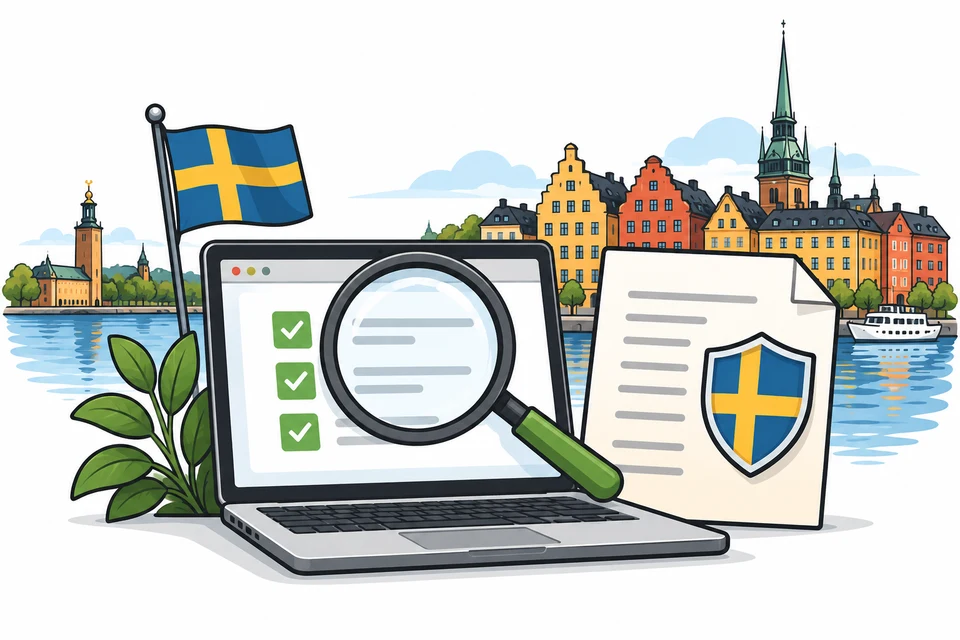
Spelinspektionen grants licences, supervises licence holders and acts against unlicensed gambling. The Act sets out distinct licence categories, each in its own chapter:
- State gambling (Chapter 5): lotteries and gaming on value machines (the “Vegas” machines in restaurants and bars). Only the state may hold this licence, and it is exercised through Svenska Spel.
- Non-profit lotteries (Chapter 6): available to non-profit associations and registered faith communities.
- Commercial online gambling (Chapter 7): covers casino games, online bingo and computer-simulated slot games.
- Betting (Chapter 8): covers wagering on sport, horse racing and other events, online or in retail outlets.
- Land-based commercial gambling (Chapter 9): includes casino games in restaurants, merchandise machines and card-game tournaments.
- Gambling on ships (Chapter 10) in international traffic.
Spelinspektionen’s licence register lists every operator with a valid licence or permit. It also lists the web addresses through which online gambling and betting licence holders may offer games. The register is the authoritative check of whether a specific website is licensed. A licence from Malta, Curaçao or another jurisdiction does not count.
Suppliers are also licensed. Under Chapter 11, section 6 a of the consolidated Act, added by Lag (2022:1674), anyone who manufactures, provides, installs or modifies game software for online casino games or betting must hold a licence. Under Chapter 16, section 1 a, online licence holders may use only software from licensed suppliers. The software-licence provisions took effect on 1 July 2023, and trade press reported that the first supplier licences were granted in March 2023 to apply from that date. According to the Chambers Gaming Law 2025 guide for Sweden, the requirement covers every business that produces, provides, installs or edits gaming software for the Swedish market.
The state’s land-based casinos no longer exist. According to Spelinspektionen’s guidance on casino games, Casino Cosmopol closed permanently on 25 April 2025, and Svenska Spel’s history page links the closure to a government decision to end state-run casinos. Lower-stakes “restaurant casino” games remain legal under licence. The regulator caps their stakes and prizes. For roulette and dice, for example, the stake per winning chance is limited to 1/2,000 of the annual price base amount (prisbasbelopp).
Online gambling and enforcement
Online casino games, online bingo, poker and betting may all be offered lawfully to Swedish residents, but only under a Swedish licence. Spelinspektionen’s guidance for online casino players explains that licensed sites must register and verify each player before play.
The Act gives the regulator several tools against unlicensed websites. Chapter 18, section 28 allows Spelinspektionen to require internet service providers to show a warning message to users who try to reach a site offering unlicensed gambling. Chapter 21, section 17 allows the government to require payment service providers to refuse transactions linked to unlicensed gambling. Under Chapter 19, operators who intentionally or through gross negligence provide unlawful gambling face fines or imprisonment of up to two years. Anyone who promotes participation in such gambling faces the same penalties.
The regulator’s March 2025 situation report, Spelinspektionens lägesbild: onlinespel utanför den licensierade marknaden, describes the scale of the problem. It estimated that in 2023 about 86% of competitive online gambling took place within the licensed market, while noting that the measure is disputed and varies by type of game. Spelinspektionen’s annual report for 2025 put this “channelisation” rate at 85% for 2024 and described the 2025 level as slightly lower, while noting that the method is still being developed. The report described monitoring of around 1,100 unlicensed sites with traffic from Sweden and prohibition orders against more than 60 gambling companies. It recorded a fall of roughly 40% in traffic to sites covered by such orders. It also identified obstacles to payment blocking, including manipulated merchant codes, e-wallets, crypto-assets and instant-banking services, and noted a 2023 court ruling that overturned one payment-blocking decision. The report distinguishes “unlicensed” gambling from “illegal” gambling. A site is illegal under Swedish law only if it offers gambling in Sweden in the legal sense, which currently means targeting the Swedish market.
Position of players
The Gambling Act’s criminal provisions are aimed at those who provide or promote unlicensed gambling, not at people who play. We found no provision that makes it an offence for an individual to gamble on an unlicensed website, and the regulator’s situation report addresses enforcement against operators rather than players. Playing outside the licensed market still has practical consequences. Players lose the Act’s protections, including deposit limits, Spelpaus and supervision of how winnings are paid out. They may also owe tax on their winnings.
The Swedish Tax Agency’s guidance on winnings from games and competitions sets out the rules. Winnings are tax-free if they are worth 100 kronor or less, or if they come from a game that requires a Swedish licence and the operator holds one. Winnings from games directed at the Swedish market that need no licence are also tax-free, as are winnings from games directed at a market within the European Economic Area (EEA). Winnings over 100 kronor are taxable in some cases. These include games that require a Swedish licence but are offered by an unlicensed provider, online games outside the EEA that are not directed at an EEA market, and physical casinos outside the EEA. Such winnings are taxed at 30% of the net amount, meaning total winnings less stakes paid to the same operator in the calendar year.
Taxation of operators
Licensed operators pay gambling tax under the Gambling Tax Act (Lag 2018:1139 om skatt på spel). The tax is charged on gross gaming revenue, defined as total stakes received less winnings paid out in each tax period (one calendar month). The rate was set at 18% in 2019. The government’s bill Prop. 2023/24:74, Höjd spelskatt raised it to 22% from 1 July 2024. Lotteries run for public-benefit purposes remain outside the tax. Trade press reporting on the change, such as Intergame, cited government estimates of SEK 270 million in extra revenue in 2024 and SEK 540 million a year after that.
According to Spelinspektionen’s preliminary figures, published on 24 February 2026, licensed operators’ net turnover reached SEK 28.2 billion in 2025, up 1.3% on 2024. Commercial online gambling and betting accounted for about SEK 18 billion (up 3.3%). The state segment of lotteries and value machines declined by 3.4%, while land-based commercial gambling, mainly restaurant casinos, generated SEK 263 million.
Consumer protection and responsible gambling
 Chapter 14 of the Act sets out the main consumer-protection duties. Licence holders must ensure that social and health considerations are observed to protect players from excessive gambling (section 1). Licensable games may not be offered to anyone under 18. For online play, the player must set an upper limit on deposits (section 7). A licence holder may offer or give a bonus only on the first occasion a player gambles with it (section 9). Marketing must be moderate and may not be specifically directed at people under 18 (Chapter 15, section 1).
Spelpaus.se, run by Spelinspektionen, is the national self-exclusion register. Using BankID or another approved electronic identification, a person can exclude themselves from all licensed gambling that requires registration, both online and in shops, for 10 days, one month, three months, six months or until further notice. An exclusion cannot be reversed early, and an exclusion “until further notice” lasts at least 12 months. The 10-day option was added in mid-2026. According to Spelinspektionen’s annual report for 2025, 134,484 people were excluded through Spelpaus at the end of 2025. The Spelpaus website showed 143,436 active exclusions on 14 October 2026.
Stödlinjen is the national helpline for people worried about their own or someone else’s gambling. It is run by the Stockholm region’s health services with support from the Public Health Agency of Sweden (Folkhälsomyndigheten). It offers free, confidential advice by telephone (020-81 91 00) and chat, with interpretation available in more than 100 languages. General guidance is available in our responsible gambling guide.
Recent and upcoming developments
Credit ban (2026). Swedish law already restricted gambling on credit. The government’s bill Prop. 2025/26:11, Ett nytt förbud mot spel på kredit (25 September 2025) proposed a wider ban. It was presented in advance in a Spelinspektionen news item of June 2025, with a proposed start date of 1 April 2026. Parliament’s Committee on Cultural Affairs, in its report of 27 January 2026, recommended adoption with a start date of 1 May 2026, and the amending Lag (2026:90) entered into force on that date. The consolidated Act now contains the ban in Chapter 14, sections 8 and 8 a. Licence holders and gambling agents may not allow or take part in the financing of gambling with credit, and they must take appropriate measures to prevent it. A narrow exception may be granted for certain non-political lotteries.
From a “targeting” test to a “participant” test. A Ministry of Finance memorandum, Ds 2025:23, Spellagens tillämpningsområde, proposes to replace the rule that only gambling directed at Sweden is covered. Under the proposal, online gambling would be regarded as offered in Sweden whenever people located in Sweden can take part. Operators wishing to stay outside Swedish law would have to take appropriate and effective steps to keep Swedish participants out. The memorandum also proposes extending the ban on promotion to payment and financial services. It suggests 1 January 2027 as the start date. As of October 2026 the government’s gambling policy page listed no bill or Council on Legislation referral based on the memorandum, and the scope provision in Chapter 1 of the Act had not been amended. The change therefore remains a proposal, and the 2027 start date is uncertain.
End of state casinos (2025). The closure of Casino Cosmopol on 25 April 2025 removed the last land-based casinos from the state segment. Land-based casino gaming in Sweden is now limited to licensed restaurant casinos.
New head of the regulator (2026). On 26 March 2026 the government appointed a new Director-General of Spelinspektionen for a six-year term starting on 17 August 2026, replacing an acting head.
Deposits and withdrawals
The Swedish credit restrictions described above apply to payment funding as well as direct credit-card use. Check the regulator’s credit guidance and the licensed operator’s cashier before selecting a method.
Comparing Payment Methods
Debit Cards
For a Visa card or another debit product, check whether the casino and issuing bank support the transaction. Deposit acceptance does not automatically mean that withdrawals can return to the same card. Confirm the permitted withdrawal route before depositing.
Older references to Visa Electron and Maestro should not be treated as proof of current availability. Check the exact card product with its issuer instead of following a generic set of instructions for an old brand.
Bank Payments and Trustly
A bank transfer can have different processing times from an instant bank-payment service. Confirm fees, the intended recipient and the stated processing time with the provider. A universal three-to-five-day estimate is not reliable for every transfer.
Trustly supports deposits and withdrawals at participating merchants. Its own help page explains that the merchant decides which services are available and when a withdrawal request is sent.
If you bank with Nordea, check the options supported by your bank and the licensed operator. Do not assume a payment is anonymous, fee-free or instant simply because a familiar bank appears in the cashier.
Wallets and Prepaid Methods
Our guides cover EcoCard/ecoPayz, Neteller, Paysafecard, Skrill and WebMoney. These are general references, not a verified list of currently accepted methods at Swedish casinos.
Check the provider’s Swedish terms and the operator’s cashier for eligibility, funding restrictions, identification checks, fees and withdrawals. A wallet must not be treated as a way to use prohibited credit funding. Prepaid payment does not mean that identity checks never apply.
Before Using a Casino Cashier
Check the licence for the exact website, then confirm the payment method, limits, fees and withdrawal route. Read any bonus conditions separately: a payment method can be accepted for deposits without qualifying for an offer.
No payment service guarantees absolute safety or complete anonymity. Use the provider’s official authentication process and never disclose your banking password or one-time code to a support agent. Contact the operator and payment provider if a payment is missing.
Our casino reviews and game guides are background reading. Check current licence and cashier information before relying on an operator listing.
SEK accounts, conversion fees and withdrawals
Check the operator and its website against the Swedish licence directory before assessing its SEK cashier. A Swedish-language site or krona balance alone does not establish a Swedish licence.
Check the account currency, the currency charged by the payment service and the currency of the receiving bank account separately. Keeping all three in SEK can avoid a currency conversion, but does not guarantee a fee-free transaction. Review the operator’s cashier charges and your bank, card or wallet provider’s current fees and exchange-rate terms before paying.
Before opening an account, confirm whether its base currency can be changed. Check deposit and withdrawal limits, identity requirements and the available payout route; an accepted deposit method may not support withdrawals. If a payout is converted, check which provider sets the rate and whether a further conversion occurs when the money reaches your bank or wallet. Keep the transaction confirmation so you can compare the amount requested with the amount received.
Sources and further reading
- Sveriges riksdag, Spellag (2018:1138) (consolidated text, accessed 5 October 2026).
- lagen.nu, SFS 2018:1138 Spellag (accessed 5 October 2026).
- Regeringen, En omreglerad spelmarknad, Prop. 2017/18:220 (2018).
- Sveriges riksdag, Höjd spelskatt, Prop. 2023/24:74 (2024).
- Sveriges riksdag, Ett nytt förbud mot spel på kredit, Prop. 2025/26:11 (2025).
- Sveriges riksdag, Spellagens tillämpningsområde, Ds 2025:23 (2025).
- Spelinspektionen, Lagar och förordningar (accessed 5 October 2026).
- Spelinspektionen, Licensregister (accessed 5 October 2026).
- Spelinspektionen, Kasinospel (accessed 5 October 2026).
- Spelinspektionen, Onlinekasino (accessed 5 October 2026).
- Spelinspektionen, Spelinspektionens lägesbild: onlinespel utanför den licensierade marknaden (2025).
- Spelinspektionen, Spelbolag med svensk licens omsatte 28,2 miljarder kronor under 2025 (2026).
- Spelinspektionen, Regeringen föreslår ett nytt förbud mot spel på kredit (2025).
- Skatteverket, Vinster i spel och tävlingar (accessed 5 October 2026).
- Spelinspektionen, Spelpaus.se (accessed 5 October 2026).
- Stödlinjen, Stödlinjen – för dig som har frågor om spel om pengar (accessed 5 October 2026).
- Svenska Spel, Vår historia (accessed 5 October 2026).
- Intergame, Increased gambling tax in Sweden comes into effect (2024).
- Spelinspektionen, Spelinspektionens årsredovisning 2025 (2026).
- Sveriges riksdag, Kulturutskottet, Ett nytt förbud mot spel på kredit, betänkande 2025/26:KrU3 (2026).
- Regeringen, Spelpolitik (accessed 14 October 2026).
- Regeringen, Ny generaldirektör för Spelinspektionen (2026).
- Chambers and Partners (Westerberg & Partners), Gaming Law 2025: Sweden (2025).
- SBC News, Sweden issues market’s first three gaming supplier licences (2023).
- Gambling Insider, Spelpaus inför ny avstängning på 10 dagar (2026).
Casino listings for players in Sweden
The listings below are generated from our casino database. They do not by themselves show that an operator holds a Swedish licence. Before registering, check the exact website against Spelinspektionen’s licence register. If an operator is not listed there, Swedish consumer protections such as Spelpaus and mandatory deposit limits do not apply.

Liberty Slots Casino
No Deposit Bonus
$ 18
Tsars Casino
100% up to
€300
+ 100 Spins

Casino Extreme
200 Spins

Casoo Casino
100% up to
$/€300
+ 100 Spins

22Bet Casino
100% up to
$/€300
+ 30 Spins

1Red Casino
20% up to
∞

Casino Brango
500% up to
$/€100
+ 500 Spins

Miami Club Casino
40 Spins

Lincoln Casino
25 Spins

Red Stag Casino
25% up to
∞

Lucky Tiger Casino
No Deposit Bonus
$ 55

Highway Casino
$ 30
Omni Slots
100% up to
€300
+ 50 Spins

Shazam Casino
Exclusive No Deposit Bonus
$ 50

Guts Casino
LOKI Casino
150% up to
€6,000
+ 150 Spins

Mr Green Casino
200% up to
$/€100
+ 50 Spins

Rich Palms Casino
250% up to
∞

Yabby Casino
202% up to
∞

Sloto'Cash Casino
35% up to
∞

LeoVegas
50 Spins
Casumo
100% up to
$/€300
+ 50 Spins

Betsafe Casino
100% up to
€100
+ 150 Spins

Uptown Aces
150% up to
$1,000

Videoslots.com
100% up to
$/€200

Fair Go Casino
200% up to
∞

PlayCroco Casino
300% up to
∞
+ 60 Spins

Vegas Casino Online
$ 20

Las Vegas USA Casino
No Deposit Bonus
$ 20

CasinoCasino
100% up to
€25

Slotsroom Casino
400% up to
∞
+ 20 Spins

Slots Plus
No Deposit Bonus
$ 20

Sun Palace Casino
No Deposit Bonus
$ 20

Gold Prize Casino
10% up to
$100

Everygame Classic Casino
200% up to
∞
+ 50 Spins

El Royale Casino
230% up to
∞

EnergyCasino
100% up to
$/€200
+ 400 Spins

Spinfinity Casino
400% up to
∞
+ 20 Spins

Slots Empire
230% up to
$7,500

Everygame Casino
125% up to
$1,000

CasinoExtra
100% up to
$/€50
+ 100 Spins

Red Dog Casino

Casino Max
400% up to
∞
+ 20 Spins
Paf Casino
99 Spins

Yeti Casino
10% up to
∞

Scatters Casino
100 Spins

Lucky31
100% up to
$/€100

Jackpot Capital
25% up to
∞

Ripper Casino
25% up to
∞

LadyLuck Casino
100 Spins

North Casino
100% up to
$/€100

Fun Casino
100 Spins

Las Atlantis Casino
$ 2,500

Ozwin Casino
$ 10

TurboVegas
500 Spins

PlayOJO Casino
50 Spins

10bet Casino
100% up to
£25
Charmius
10% up to
∞

Dreamz Casino
10% up to
∞
JuJu Vegas
150% up to
∞

Cherry Jackpot
400% up to
∞
+ 20 Spins

Grande Vegas
$ 25

Roaring 21 Casino
400% up to
∞
+ 20 Spins
La Riviera Casino
5% up to
∞

Wicked Plays
45% up to
∞
Dafabet Casino
100% up to
$140
Betway Casino
30% up to
∞

BetOnline Casino
100 Spins

Bet365 Casino

RedCherry Casino
20% up to
∞
CasinoClic
100% up to
€200
+ 30 Spins
 UK Gambling Review Puts Racing Funding in Focus
 Gambling Regulation Roundup: Brazil’s Top Court Freezes Betting Cases, CFTC Targets Geoblocks and More
 Malta Examines AI Risks in Gaming
 Gambling Regulation Roundup: Nebraska Rejects Online Betting, Haiti Creates a Regulator and More
 Pragmatic Play Rolls Out Smart Studio Tables for Rank Group