
WATCH THE COUNTRY GUIDE · ENGLISH CAPTIONS
Online gambling in Great Britain: laws and player risks
Elodie explains online casino rules in Great Britain, player enforcement evidence, offshore risks and available options. Reviewed 13 November 2026. AI presenter. Covers England, Scotland and Wales; Northern Ireland is excluded.
Video transcript and official sources → · Country video guides →

Great Britain has one of the most developed licensing systems for online gambling in the world. The Gambling Act 2005 applies to England, Wales and Scotland. It allows commercial operators, including online casinos, to offer gambling under a licence from the Gambling Commission. Since 2014 any operator serving consumers in Great Britain has needed that licence, wherever the operator is based. Northern Ireland has a separate legal framework. Since the Government’s 2023 white paper, regulation has tightened considerably. Measures include stake limits on online slots, a statutory levy to fund research, prevention and treatment, financial risk assessments for high-spending customers, and a sharp increase in Remote Gaming Duty.
Key points
- Online casino gambling is lawful in Great Britain when offered under a remote casino operating licence from the Gambling Commission. Overseas licences, such as those issued in Malta or Gibraltar, do not replace it.
- Since 9 April 2025, online slots stakes have been capped at £5 per game cycle. Since 21 May 2025, the cap for 18 to 24-year-olds has been £2.
- A statutory levy on licensed operators began in April 2025. Online operators pay 1.1% of gross gambling yield, and the proceeds are ring-fenced for research, prevention and treatment.
- Remote Gaming Duty, paid by operators, rose to 40% of profits from 1 April 2026.
- Credit cards have been banned for gambling since 14 April 2020. GAMSTOP provides self-exclusion from all licensed online operators in one request.
- The Act’s offences are aimed at those who provide gambling facilities, not at adults who gamble.
Regional overview: Gambling laws in the EU and the rest of Europe puts all 55 countries and territories on one map, grouped by how they regulate gambling.
Last reviewed: 20 October 2026.
This guide summarises the law as described by official sources at the date of review. It is not legal advice.
Historical development
Modern British gambling law was shaped by a liberalising statute, the Gambling Act 2005, which replaced earlier legislation. The 2005 Act created the Gambling Commission as a unified regulator and introduced licensing for remote (online and telephone) gambling.
The Gambling (Licensing and Advertising) Act 2014 changed this. It moved remote gambling regulation to a “point of consumption” basis: the location of the customer, not of the operator, now decides which law applies. Operators offering gambling facilities to people in Great Britain must hold the appropriate Commission licence, and the 2014 Act also created offences for advertising unlicensed remote gambling. The Commission’s remote sector guidance explains the licensing requirements that follow.
A government review of the 2005 Act concluded with the white paper High stakes: gambling reform for the digital age, published by the Department for Culture, Media and Sport on 27 April 2023. The white paper proposed stake limits for online slots in a range of £2 to £15, financial risk checks, a statutory levy, an ombudsman, controls on bonuses and changes for land-based venues. Most of the measures described below come from that document.
Legal framework
 Section 1 of the Gambling Act 2005 sets three “licensing objectives” that guide every regulatory decision:
- “preventing gambling from being a source of crime or disorder, being associated with crime or disorder or being used to support crime”;
- “ensuring that gambling is conducted in a fair and open way”; and
- “protecting children and other vulnerable persons from being harmed or exploited by gambling”.
Part 3 of the Act contains the general offences. The central offence, in section 33, is providing facilities for gambling without the necessary authorisation. Section 36 sets out how this applies to remote gambling across borders. Part 4 protects children and young persons and creates offences relating to gambling by children. The Act does not contain a general offence of taking part in gambling as an adult.
The legislation leaves a great deal to the regulator. The Commission attaches conditions to operating licences and issues codes of practice, together known as the Licence Conditions and Codes of Practice (LCCP). Many of the post-2023 reforms, including the online slots stake limits, were implemented as licence conditions rather than as amendments to the Act.
Northern Ireland
The Gambling Act 2005 extends to England, Wales and Scotland (see section 362). Gambling in Northern Ireland is governed by the Betting, Gaming, Lotteries and Amusements (Northern Ireland) Order 1985. It was amended by the Betting, Gaming, Lotteries and Amusements (Amendment) Act (Northern Ireland) 2022. The 2022 Act allowed betting offices to open on Sundays and Good Friday, created an offence of inviting children to play gaming machines, and introduced powers relating to an industry levy and a code of practice. The Gambling Commission’s remote licensing regime described in this guide applies to Great Britain.
The Gambling Commission and the licensing model
Great Britain uses an open licensing model, not a state monopoly: any operator that meets the Commission’s requirements may apply for a licence. The Commission issues operating licences for each type of activity, such as remote casino, remote betting, remote bingo and gambling software. Licensed businesses, together with their trading names and website domains, appear on the public register. The Commission advises consumers to check that “the details of the licence (including activities and website domain names) match the public register” (Gambling Commission, What to look at before you gamble). A betting licence alone does not authorise casino games.
The Commission also regulates the National Lottery. It has extensive enforcement powers, including licence suspension and revocation, regulatory settlements and financial penalties. Its news page records a steady flow of enforcement cases. Recent examples include a £5 million settlement in October 2026 by a group of land-based casino operators for anti-money laundering and safer gambling failures (Gambling Commission, 7 October 2026), and settlements of £4.75 million in July 2026 and £900,000 in June 2026. In 2026 the Commission decided that regulatory settlement money should be paid to the Consolidated Fund, given the new levy funding structures.
The market is large. According to the Commission’s statistics hub, the British gambling market was worth £17.5 billion between April 2025 and March 2026, and 47% of adults had gambled in the previous four weeks (January 2025 to January 2026).
Online gambling and the white paper reforms
 Online casino games, slots, poker, bingo, betting and lotteries may all be offered online under the appropriate licence. The white paper measures have reshaped the online casino sector in particular.
Stake limits for online slots
Following the white paper, the Government implemented stake limits through the Gambling Act 2005 (Operating Licence Conditions) (Amendment) Regulations 2025 (SI 2025/215). The Commission’s guidance sets out the licence condition: the total stake on an online slots game cycle “may not exceed— (a) £2, where the individual is less than 25 years old” or “(b) £5, where the individual is 25 years old or over”. The £5 limit took effect on 9 April 2025 and the £2 limit for 18 to 24-year-olds on 21 May 2025. The limits apply to online slots only, not to other casino games such as roulette or blackjack. The Government justified the lower limit by pointing to evidence of higher problem gambling scores among under-25s (DCMS, November 2024).
The statutory levy
The statutory gambling levy “commenced in April 2025”. It is charged as a percentage of gross gambling yield (GGY, stakes minus winnings paid). The rate is 1.1% for online operators and software licences, 0.5% for land-based casinos and betting, and lower rates for other sectors. Proceeds are split 20% to research (through UK Research and Innovation), 30% to prevention (through the Office for Health Improvement and Disparities) and 50% to treatment (through NHS England). DCMS reports that the levy raised “just under £120 million” in its first year.
Financial risk assessments
The white paper’s “affordability” proposals have become Financial Risk Assessments (FRAs). These are document-free checks that use credit reference agency data to identify customers in financial difficulty. In July 2026 the Commission announced a staged introduction. The first stage will apply at net deposits of £5,000 in a rolling 24 hours for customers aged 25 and over, and £2,500 for under-25s. The final thresholds will be £1,000 in 24 hours or £3,000 in 90 days for those aged 25 and over, and £750 or £2,000 for under-25s. The Commission reports that in its pilot “97 percent of those spending above the threshold levels could be easily and frictionlessly assessed”. The timetable for stage one was still to be confirmed at the date of review.
Unlicensed operators
An operator that offers gambling to people in Great Britain without a licence commits an offence under the 2005 Act. Advertising unlicensed remote gambling is an offence under the 2014 Act. The Commission’s public register allows unlicensed operators to be reported confidentially. Consumers who use unlicensed sites fall outside the Commission’s protections, including GAMSTOP, the stake limits and the complaints and dispute resolution requirements.
Position of players
The Gambling Act 2005 regulates the supply of gambling. It does not make it an offence for an adult to gamble, including with an operator that lacks a British licence, and its offences concern providing facilities, advertising and gambling by children. Licensed operators must carry out age and identity verification before customers can gamble. The Commission’s verification guidance explains these checks. Players in dispute with a licensed operator can use its complaints procedure and the routes described in the Commission’s consumer guidance. Customers of unlicensed operators have no equivalent route in Great Britain.
Taxation
Gambling taxes in the United Kingdom are paid by operators. HM Revenue and Customs’ guidance on gambling duties sets out the current rates:
- Remote Gaming Duty (online casino, slots, bingo and other remote gaming): 40% of profits “on or after 1 April 2026”, up from 21%, which had applied since 1 April 2019.
- General Betting Duty: 15% for fixed-odds and totalisator bets, 3% for financial spread bets and 10% for other spread bets. Betting exchanges pay 15% of the commission charged to UK customers. From 1 April 2027 a new 25% rate applies to remote betting. Remote bets on UK horseracing stay at 15%, and pool betting, spread betting and self-service betting terminals are excluded (HMRC, Changes to gambling duties).
- Pool Betting Duty: 15%.
- Bingo Duty: abolished from 1 April 2026 (HMRC).
The duties apply to operators serving UK customers “no matter where” the operator is based. Profits are generally calculated as stakes received less winnings paid out. The duties are levied on operators’ profits; the guidance does not impose any duty on players’ winnings.
Payments, consumer protection and responsible gambling
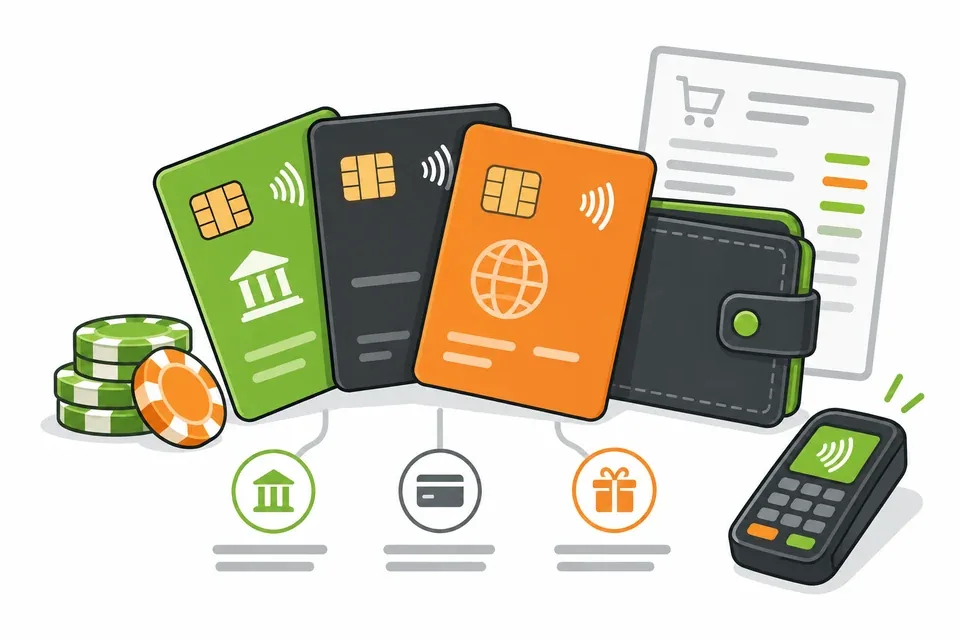 Credit card ban. Since 14 April 2020 “gambling businesses must not accept credit card payments for gambling”, according to the Commission’s credit card guidance. The ban covers online casinos, betting, bingo and lotteries paid for online. Credit cards may still be used to buy lottery tickets and scratchcards in shops. Debit cards, bank transfers and many e-wallets remain available. Our deposit methods guide explains how they differ.
Self-exclusion. Every licensed operator must offer its own self-exclusion. For online gambling, the Commission explains that GAMSTOP “allows you to self-exclude from online operators with one request” (Gambling Commission, Self-exclusion). GAMSTOP is run by the National Online Self-Exclusion Scheme Limited and is free to use. For land-based gambling, multi-operator schemes let a person make “a single request to self-exclude from the same type of land-based gambling” in their area.
Support. A free helpline is available 24 hours a day. The National Gambling Helpline, run by GamCare, is on 0808 8020 133 across Great Britain (GamCare). In Wales, the NHS All Wales Gambling Treatment Service also has a 24-hour line on 0808 2819 265. Many banks also allow customers to block gambling transactions. Our responsible gambling guide covers further tools.
Deposits and withdrawals
The credit-card restriction described above also covers credit-card funds routed through electronic wallets. The Gambling Commission explains the wallet requirements. The following checks concern licensed services in Great Britain; Northern Ireland has a different regulatory position.
Debit cards and bank transfers
A debit card uses money from your bank account and is different from a credit card. A VISA logo alone does not identify which type you hold or establish whether a gambling transaction will be accepted. Check the card issuer’s controls and the casino’s cashier before paying.
Direct bank transfers may provide a separate deposit or withdrawal route where offered. Confirm the recipient, payment reference, currency and any charges. Payment authorisation, receipt by the operator and crediting your casino balance are separate stages; an instant notification is not a promise that every payment or payout will be immediate.
Electronic wallets and prepaid products
Our Neteller and Skrill guides explain these wallet products. Availability depends on the operator, account and funding source. Check deposit fees, withdrawal charges, currency conversion and any restrictions on bonus eligibility. A wallet is not an anonymous account, and identity checks may apply.
PaySafeCard products also need to be checked individually. A prepaid voucher and an account-based payment service are not interchangeable. Before buying a voucher, establish whether the casino accepts that product and how any remaining balance or winnings can be withdrawn. Prepaid funding does not remove the casino’s verification requirements.
For background on other products, see EcoCard, EcoPayZ and WebMoney. These guides are not confirmation that a named service is currently available for your British gambling account. Use the provider’s current country terms and the operator’s cashier rather than an old list of accepted methods.
Check withdrawals before making a deposit
Ask which payout methods your account can use, whether the payment account must be in your name, and what verification documents are required. Review minimum and maximum amounts, the operator’s processing period and the payment provider’s settlement time. Keep these stages separate when comparing advertised withdrawal speeds.
Since 19 January 2026, wagering requirements on bonuses are capped at 10 times, and promotions that require play on two or more product types, such as betting and slots, are banned (Gambling Commission). Read bonus conditions before opting in, including wagering requirements and payment exclusions. Do not borrow to gamble or increase a payment limit to recover losses. Set a spending limit you can afford to lose, keep transaction records and contact the operator if a payment is delayed. Our casino deposit and withdrawal methods overview explains the main payment categories.
Recent and upcoming developments
- Land-based casinos. Since 22 July 2025, small 2005 Act casinos may have five gaming machines per table, up from two. Converted 1968 Act casinos with enough floor space may offer up to 80 machines and betting (Gambling Commission).
- 27 April 2023: the white paper High stakes is published.
- April 2025: the statutory levy begins.
- 9 April and 21 May 2025: online slots stake limits of £5 and £2 (for under-25s) take effect.
- 1 April 2026: Remote Gaming Duty rises to 40%.
- July 2026: the Commission confirms a staged introduction of financial risk assessments.
Several white paper measures, including the later stages of financial risk assessments, were still being implemented at the date of review. Readers should check the Commission’s announcements and the Department for Culture, Media and Sport for implementation dates.
Playtech games at licensed British casinos
Playtech supplies games and gambling technology; the casino operator serving the player is a separate business. A Playtech logo or game in the lobby does not establish that the website holds the required remote casino licence. Check the operator, exact domain, current licence status and permitted activities in the Gambling Commission’s business register. The licensing rules discussed here concern Great Britain; Northern Ireland has the separate framework described above.
As an example checked on 16 October 2026, the Commission’s Betfair register results list Betfair Casino Limited under account 39435 and the betfair.com domain. Betfair’s Playtech game directory separately shows its Playtech selection, including Age of the Gods titles. These are two different checks: the regulator identifies the business and its permissions, while the operator’s lobby shows the games offered. Recheck both for your location and account; this example is not a guarantee of availability or a recommendation based on licensing alone.
Review the actual game’s rules and paytable, the operator’s withdrawal process, complaint route and any bonus restrictions before playing. A casino can carry games from several studios, and a provider’s international catalogue does not mean every title is available on every regional site. A familiar supplier, a large promotion or a licence cannot guarantee a trouble-free experience or protect against gambling losses.
Sources and further reading
- UK Parliament, Gambling Act 2005 (accessed 5 October 2026).
- UK Parliament, Gambling (Licensing and Advertising) Act 2014 (accessed 5 October 2026).
- Department for Culture, Media and Sport, High stakes: gambling reform for the digital age (2023).
- UK Government, Explanatory Memorandum to the Gambling Act 2005 (Operating Licence Conditions) (Amendment) Regulations 2025 (2025).
- Gambling Commission, Online slots stake limit guidance (accessed 5 October 2026).
- Department for Culture, Media and Sport, Statutory levy and online slot stake limits to be introduced to tackle gambling harm (27 November 2024).
- Department for Culture, Media and Sport, Statutory gambling levy (updated 26 March 2026).
- Gambling Commission, Commission to introduce Financial Risk Assessments in staged approach (7 July 2026).
- HM Revenue and Customs, General Betting Duty, Pool Betting Duty and Remote Gaming Duty (accessed 5 October 2026).
- Gambling Commission, Gambling using a credit card (accessed 5 October 2026).
- Gambling Commission, Self-exclusion (accessed 5 October 2026).
- Gambling Commission, What to look at before you gamble (accessed 5 October 2026).
- Gambling Commission, Public register: businesses (accessed 5 October 2026).
- Gambling Commission, Statistics and research (accessed 5 October 2026).
- Gambling Commission, Latest news (accessed 5 October 2026).
- Northern Ireland, Betting, Gaming, Lotteries and Amusements (Northern Ireland) Order 1985 (accessed 5 October 2026).
- Northern Ireland Assembly, Betting, Gaming, Lotteries and Amusements (Amendment) Act (Northern Ireland) 2022 (2022).
- GAMSTOP (National Online Self-Exclusion Scheme Limited), GAMSTOP (accessed 5 October 2026).
Casino listings for players in Great Britain
The listings below are generated from our casino database. They do not by themselves show that an operator holds a Gambling Commission licence. Only operators with a current remote casino licence may offer casino games to people in Great Britain. Check the exact website on the Commission’s public register.

Shazam Casino
Exclusive No Deposit Bonus
$ 50

1Red Casino
20% up to
∞

Highway Casino
$ 30

Rich Palms Casino
250% up to
∞

Casumo
100% up to
$/€300
+ 50 Spins

DuckyLuck Casino
500% up to
$/€2,500
+ 150 Spins

Videoslots.com
100% up to
$/€200

Drake Casino

CasinoCasino
100% up to
€25

Casilando
10 Spins

Las Vegas USA Casino
No Deposit Bonus
$ 20

Vegas Casino Online
$ 20

Zodiac Casino
$ 80

Slots Plus
No Deposit Bonus
$ 20

Sun Palace Casino
No Deposit Bonus
$ 20

Slots And Casino
500% up to
∞
+ 150 Spins

Red Dog Casino

NetBet Casino
100 Spins

Luxury Casino
100% up to
$/€150
All British Casino
100 Spins

BoyleSports
400% up to
£40

NewVegas Casino
400% up to
$3,000

PokerStars Casino

Yeti Casino
10% up to
∞

William Hill Casino
200 Spins

21 Casino
21 Spins

Playzee Casino
100% up to
$/€300
+ 100 Spins

BetFred Casino
200 Spins
G'Day Casino
100% up to
€100
+ 25 Spins

Fun Casino
100 Spins

UK Casino Club

10bet Casino
100% up to
£25
JuJu Vegas
150% up to
∞

Wicked Plays
45% up to
∞

PlayOJO Casino
50 Spins

Slot Planet
100% up to
€222
+ 22 Spins

Bet365 Casino

Jazz Casino
10% up to
$250

Hippodrome Casino
100% up to
£100
+ 100 Spins

Amber Spins Casino
Betfair Casino



 GambleAware Survey Shows Strong Support for Stricter Gambling Ad Regulations