

 In short: Roulette probability is ways to win divided by all outcomes: a single number on a 37-pocket wheel is 1/37, or 2.70%. The odds against it are 36:1, but the bet pays only 35:1, and that gap gives the casino its 2.70% edge on single-zero wheels (5.26% on double-zero).
Having explained the basic terms and variations of the game, we move forward to discuss the mathematical aspect of roulette. Although some of you may ignore this topic, we should underscore that knowledge of such concepts as probability and odds is crucial before one digs deeper into the various strategic approaches to the game.
What do we mean by the term ”probability”?
If we are to offer a formal definition of the term ”probability”, it would be the following: ”The probability of the occurrence of an event is defined as the number of cases favorable to the event, divided by the number of equally-likely possible cases.”
If we presume that all possible outcomes have an equal chance to occur, as they are a result of a random device (the roulette wheel), and for every single outcome there are only two possible scenarios (a success or a loss), the definition above may be transformed into the following: ”The probability of winning equals the number of ways to win, divided by the number of possible outcomes.”
The number of possible outcomes includes the possible ways to win and the possible ways to lose. Having said this, the probability of success may be presented with a simple formula:
PROBABILITY OF SUCCESS = Ways to Win / (Ways to Win + Ways to Lose)
Probability always belongs within the range between 0 and 1 and can be expressed as a fraction or a decimal. If one is to present probability as a percentage, then the decimal needs to be multiplied by 100.
Let us use a simple example of tossing a coin. As the coin is two-sided, it has one way to win and one way to lose. Therefore, in this case, the probability of success will be as follows:
Best Online Roulette Bonuses for Australians

Shazam Casino
$ 50

Black Lotus Casino
300% up to
$7,000
+ 45 Spins

Lucky Creek
200% up to
$/€7,500

Grand Eagle
200% up to
$5,500
+ 30 Spins

Treasure Mile
200% up to
$/€4,000
+ 50 Spins

Jazz Casino
200% up to
$2,000
+ 100 Spins

Bovada Casino
100% up to
$1,000

Ignition Casino
200% up to
$100

Slots.lv
100% up to
$2,000
+ 20 Spins

Slots And Casino
500% up to
∞
+ 150 Spins
PROBABILITY OF SUCCESS = 1 / (1 + 1) = 1 / 2 = 0.5, or 50%
An expert in statistics would interpret the probability of success when tossing a well-balanced coin as one half. An expert in gambling, however, would interpret it as 1 chance out of 2. We would interpret it as 50 percent.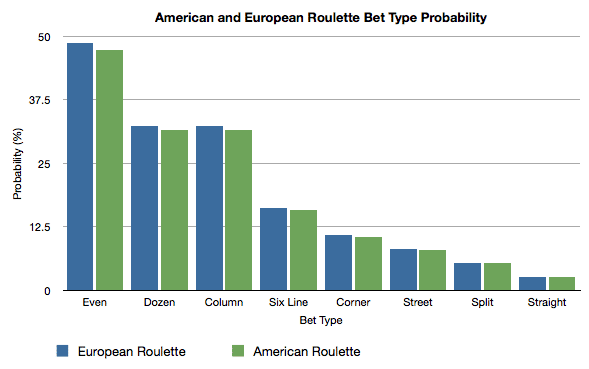
Another example we will use is the tossing of an ordinary six-sided die. As there is one way to win and five ways to lose, the probability of success (rolling a specific number) will be as follows:
PROBABILITY OF SUCCESS = 1 / (1 + 5) = 1 / 6 = 0.1667, or 16.67%
A statistics expert would now interpret the probability of rolling the particular number as one-sixth, while the expert in gambling would say it is 1 chance out of 6. We would interpret it as 16.67 percent.
If we take the French roulette wheel, having 37 numbers, and we place a straight-up bet, then we have 1 way to win and 36 ways to lose. Therefore, the probability of success (the number we selected to win) will be as follows:
Classic Roulette Bets

French Roulette

Double Ball Roulette

Double Action Roulette
Probability and Odds in Roulette
PROBABILITY OF SUCCESS = 1 / (1 + 36) = 1 / 37 = 0.0270, or 2.70%
If we take the French wheel again and place a street bet on a row of three numbers, then we have 3 ways to win and 34 ways to lose. Thus, the probability of success (one of the three numbers to win) will be as follows:
PROBABILITY OF SUCCESS = 3 / (3 + 34) = 3 / 37 = 0.0811, or 8.11%
And lastly, if we place a dozens bet on the French wheel, then we have 12 ways to win and 25 ways to lose.
PROBABILITY OF SUCCESS = 12 / (12 + 25) = 12 / 37 = 0.3243, or 32.43%
| Bet | Payout | Probability(American) | Probability(European) |
|---|---|---|---|
| Straight Up | 35 to 1 | 2.63% | 2.7% |
| Split | 17 to 1 | 5.26% | 5.41% |
| Street | 11 to 1 | 7.89% | 8.1% |
| Corner | 8 to 1 | 10.53% | 10.81% |
| Line | 5 to 1 | 15.79% | 16.22% |
| Dozens | 2 to 1 | 31.58% | 32.43% |
| Columns | 2 to 1 | 31.58% | 32.43% |
| Red/Black | 1 to 1 | 47.37% | 48.65% |
| Even/Odd | 1 to 1 | 47.37% | 48.65% |
| Low/High | 1 to 1 | 47.37% | 48.65% |
What do we mean by the term ”odds”?
The majority of players at a casino will use the term ”odds” instead of ”probability”. There is a certain difference between odds and probability and it lies in the way the two terms are mathematically expressed. Once we have calculated the probability of success, we can easily estimate the odds for success by using the following formula:
ODDS FOR SUCCESS = Ps / (1 – Ps), where
Ps equals the probability of success.
If we go back to the coin-tossing example, then we will get the following result:
ODDS FOR SUCCESS = 0.5 / (1 – 0.5) = 0.5 / 0.5 = 1 / 1
Odds are usually not transformed into a decimal but rather presented as a ratio of whole numbers. In the case above we simply multiplied the numerator and denominator by 2, so that we come up with the result we wanted. Odds are presented as 1:1 and pronounced as ”one-to-one”, or ”even odds”.
We should note that there is another way to calculate the odds for success. There is no need to estimate the probability first and then the odds. We can get straight to the desired result by using the following simple formula:
ODDS FOR SUCCESS = Ways to Win / Ways to Lose
If we go back to the die tossing example and use the above-mentioned formula, we will get:
ODDS FOR SUCCESS = 1 / 5, or…
…the odds are 1:5 (one chance to be successful and five chances to lose). This is different from the probability of success, which, as we estimated, is 1 chance out of 6. And it is what causes confusion.
| Bets | Payout | Probability |
|---|---|---|
| Even | 1:1 | 48.6% |
| Odd | 1:1 | 48.6% |
| Black | 1:1 | 48.6% |
| Red | 1:1 | 48.6% |
| 1-18 | 1:1 | 48.6% |
| 19-36 | 1:1 | 48.6% |
| 1-12 | 2:1 | 32.4% |
| 13-24 | 2:1 | 32.4% |
| 25-36 | 2:1 | 32.4% |
| Single Number | 35:1 | 2.7% |
| Combination of two numbers | 17:1 | 5.4% |
| Combo of three numbers | 11:1 | 8.1% |
| Combo of four numbers | 8:1 | 10.8% |
| Combo of six numbers | 5:1 | 16.2% |
People may be confused, also when the odds are presented in reverse. If the odds for success are 1:5, then the odds against success are 5:1. What makes it so is the following formula:
ODDS AGAINST SUCCESS = Ways to Lose / Ways to Win
If the two above mentioned odds are closer to even, it becomes a more delicate situation. If we have odds for success of 5:6, then the odds against success will be 6:5. An experienced player will surely see the difference, while the beginner may easily be misled.
House odds (odds paid) represent the opposite of odds for success. This explains why the lower the chance of success is, the higher the payout is. As the house is playing against the player, the odds paid equal the odds against success, if, of course, we presume that the casino does not take a share. The reality is that house odds are always set a bit lower than the odds against success, which provides casinos with a profit margin.
Let us get back to the examples concerning the French roulette wheel. If we place a straight-up bet, we have one way to win and 36 ways to lose.
ODDS FOR SUCCESS = Ways to Win / Ways to Lose = 1 / 36
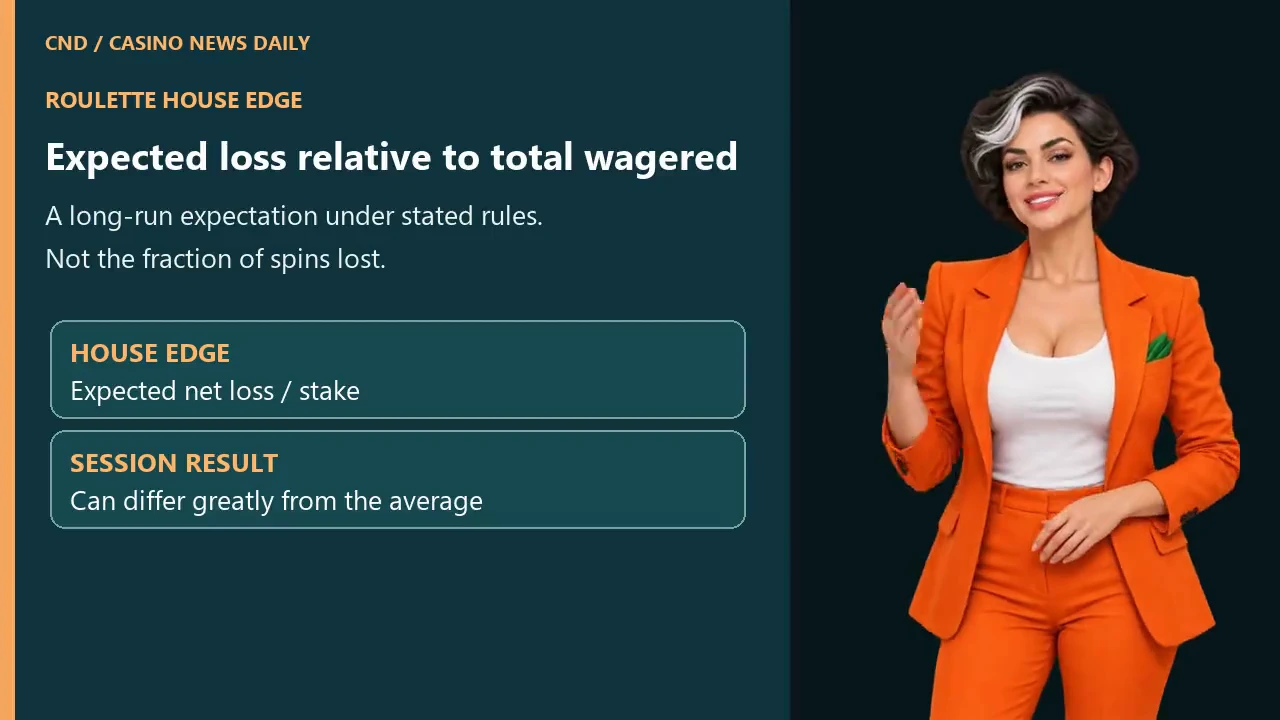
A single-zero straight-up bet has odds against winning of 36:1, but pays 35:1 profit. The difference gives an expected loss of 1/37 of the amount wagered, about 2.70%; it is not a guaranteed casino profit on an individual spin.
If we are to place an even-money outside bet (black), we have 18 ways to win and 19 ways to lose (18 red numbers and one green single zero).
ODDS FOR SUCCESS = Ways to Win / Ways to Lose = 18 / 19
The odds in favour are 18:19 and the odds against are 19:18. A fair profit payout would be 19:18, but ordinary roulette pays only 1:1 (18:18). The expected loss is again 1/37 of the stake. These calculations assume zero loses the entire bet.
Further reading: Gambling Commission explanation of house edge.