

 In short: With basic strategy, blackjack’s house edge is typically about 0.2% to 0.7%, depending on rules such as the number of decks and whether the dealer hits soft 17. Paying 6:5 for blackjack instead of 3:2 adds about 1.4% to the house edge. Only advantage play such as card counting can give a player an edge, and only under favourable conditions.
 We begin this Blackjack guide with a very important assertion – casino games, hence the name, are designed with a built-in house advantage – a casino’s edge in odds over a player at any given bet.
A house edge means the game has a negative expected return for the player under the stated rules and strategy. It does not mean every player loses every session, or that a particular finite session must end in a loss.
Casinos believe that as soon as you enter their premises, it is just a matter of time before all your money becomes theirs. And since they want to keep you around for as long as possible, they will attract you with the so-called comps – complimentary items and services given out by the house to encourage players to gamble.
Casinos will do everything they can to make you feel cozy, valued and inclined to prolong your stay at the tables. These “freebies” they give out depend on the game a person plays, for how long, and of course on the size of his bets. Casinos have staff whose job is to manage the comps and contact players to persuade them to visit and play.
As a casino game, Blackjack also falls under this principle and is designed to transfer the money from your pocket into the house’s vault, unless some method of advantage play is used. This is where this guide comes in.
We will present ideas which will can help you shift odds to near-even, and in some cases even slightly in your favor. This will be done in the first section of the guide where we will discuss strategies relating to the basic strategy player.
Best Online Blackjack Bonuses for Australians

Shazam Casino
$ 50

Lucky Tiger Casino
$ 55

Rich Palms Casino
250% up to
∞

Lincoln Casino
100% up to
$100
+ 25 Spins

Liberty Slots Casino
$ 18

Miami Club Casino
100% up to
$100

Bovada Casino
100% up to
$1,000

Ignition Casino
200% up to
$100

Red Stag Casino
275% up to
$550
+ 100 Spins

Slots.lv
100% up to
$2,000
+ 20 Spins

Slots And Casino
500% up to
∞
+ 150 Spins

Jazz Casino
200% up to
$2,000
+ 100 Spins

Black Lotus Casino
300% up to
$7,000
+ 45 Spins

Lucky Creek
200% up to
$/€7,500

Grand Eagle
200% up to
$5,500
+ 30 Spins

Treasure Mile
200% up to
$/€4,000
+ 50 Spins

Drake Casino
300% up to
$2,000
Basic strategy chooses the best available decision without tracking the shoe’s changing composition. It usually reduces the house edge but does not by itself make an ordinary blackjack game profitable.
Blackjack is one of the most widely played casino games for several reasons – it has simple rules, it is offered by almost every casino and most importantly – offers some of the best odds for the player, even for the non-advtantage one. It is simply a game that falls under the principles of odds and probabilities and can be beaten only through advantage play such as card counting, and only under favourable conditions.

Odds and probabilities
Now, one would wonder how come if the stacks are always stacked against the non-advantage players, who make up most of the player mass, there are still many people going to the casinos. After all, if all these people were constantly losing, they would ultimately become discouraged and the majority will stop playing.
A fair coin has a 50% chance of heads on each toss, even if only one toss is made. A sequence of 20 tosses could still contain 14 heads and six tails. The observed proportion and the underlying probability are different concepts.
And because many people get lucky at any given moment, they will earn money, fueling their excitement and luring them back in the casino the next night. And although this causes the house to lose money, the casino relies on the fact that players place millions of bets, which irons out the outcome in the long-term and makes the house profitable. In mathematics, this is known as the law of large numbers.
Over many comparable trials, the average return tends towards its expectation. That does not mean the next hand becomes harder to win simply because earlier hands were played, or that losses must arrive to cancel a winning streak.
Basic-strategy play ordinarily retains a house edge. A genuine advantage-play model may have a positive expectation, but its results still vary and losses remain possible. Confusing a recent streak with an advantage is one of the common mistakes in blackjack.


Calculating the house’s advantage in blackjack is difficult due to the huge amount of card combinations and also because not all winning bets have the same payout (for example, a blackjack which is a 21-hand with an ace and a 10-valued card, pays 3:2 at standard tables, although some casinos pay only 6:5, which adds about 1.4% to the house edge).
The extent and source of the house’s advantage varies in different casinos. In blackjack, for example, it is derived from the fact that when the player busts himself by exceeding the count of 21, the house wins the bet, regardless of whether the dealer would also bust when drawing more cards to complete the hand for other players on the table.

Improving or reducing the house’s advantage
The house edge depends on the rules the casino has established for the blackjack table and they are posted and easily visible either on, or near the table.
For example, a casino where dealers stand on a soft 17 (S17), instead of hitting it (H17), favors the players’ odds, reducing the house’s edge by around 0.2%. Increasing the number of decks also increases the house’s edge, and vice versa.
The implementation of other rules such as the allowance or disallowance of resplitting, doubling down after split, double on 9/10/11 or only on 10/11 and so on. Casinos typically aim to boost their advantage but also not to discourage players from joining the game and, thus, seek some form of balance. For example, if they offer one-deck blackjack, they typically forbid doubling on soft hands or after splitting, restrict resplitting and so on.
| Number of Decks | House Advantage |
|---|---|
| Single deck | 0.17% |
| Double deck | 0.46% |
| Four decks | 0.60% |
| Six decks | 0.64% |
| Eight decks | 0.65% |
The table above illustrates the house’s edge relative to the different number of decks, considering the following set of rules:
– dealer hits soft 17
– double split is allowed
– resplit to four hands is allowed
– no surrender
– no hitting split aces
– double on any two cards
– original bets only lost on dealer blackjack
– cut-card used
As evident, the house’s edge experiences the most dramatic jump when raising the number of decks from one to two and grows progressively slowerr as more decks are added.
Hand-held and shoe games, house edge
Single-deck games belong to the so-called hand-held games. Double-deck games could also be hand-held. Although they are still being offered by some casinos, their peak of popularity has passed. Nowadays, casinos more often host shoe games.
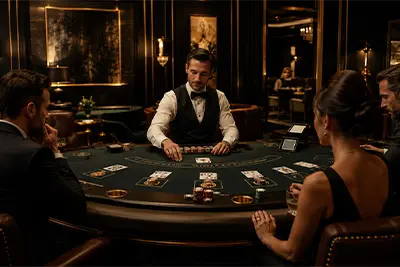
In a shoe game, a card shoe (rectangular box) holds multiple decks of cards. The dealer pulls cards out of the shoe and slides them to the appropriate areas in front of the players. Cards are most often dealt face up, which prohibits the player from touching them. Even if the gambler splits their hand, they don’t touch the cards and instead just place their additional bet and the dealer does the splitting.
Only in games where cards are dealt facing down can the player hold his cards, but only in one hand.
Almost always you will see shoe games consist of multiple decks, four and more, and on rare occurrences two. Thus, shoe games will logically favor the house’s odds.
You may also encounter tables using the so-called Continuous-Shuffling Machines. These devices hold three or more decks and after a couple of rounds the dealer returns the used cards to the machine and shuffles them with the unused cards. Thus, each shuffle refreshes the shoe, making it impossible to count cards, which is why card counters avoid these games.
As for basic strategy players, CSMs don’t have such an impact, but they increase the number of hands played per hour, meaning the player will incur larger money losses (why we will explain later).